An AI agent that only chats can be rented with a clear conscience, because the worst it can lose is what you typed into it. An agent that acts is a different proposition. To fetch invoices, answer client mail, and renew subscriptions, it has to hold things a chat window never held: live logins, standing permissions, a memory of how your suppliers and clients behave, and a growing record of actions taken in your name. Whoever hosts the agent holds that estate. The liability for it stays with you.
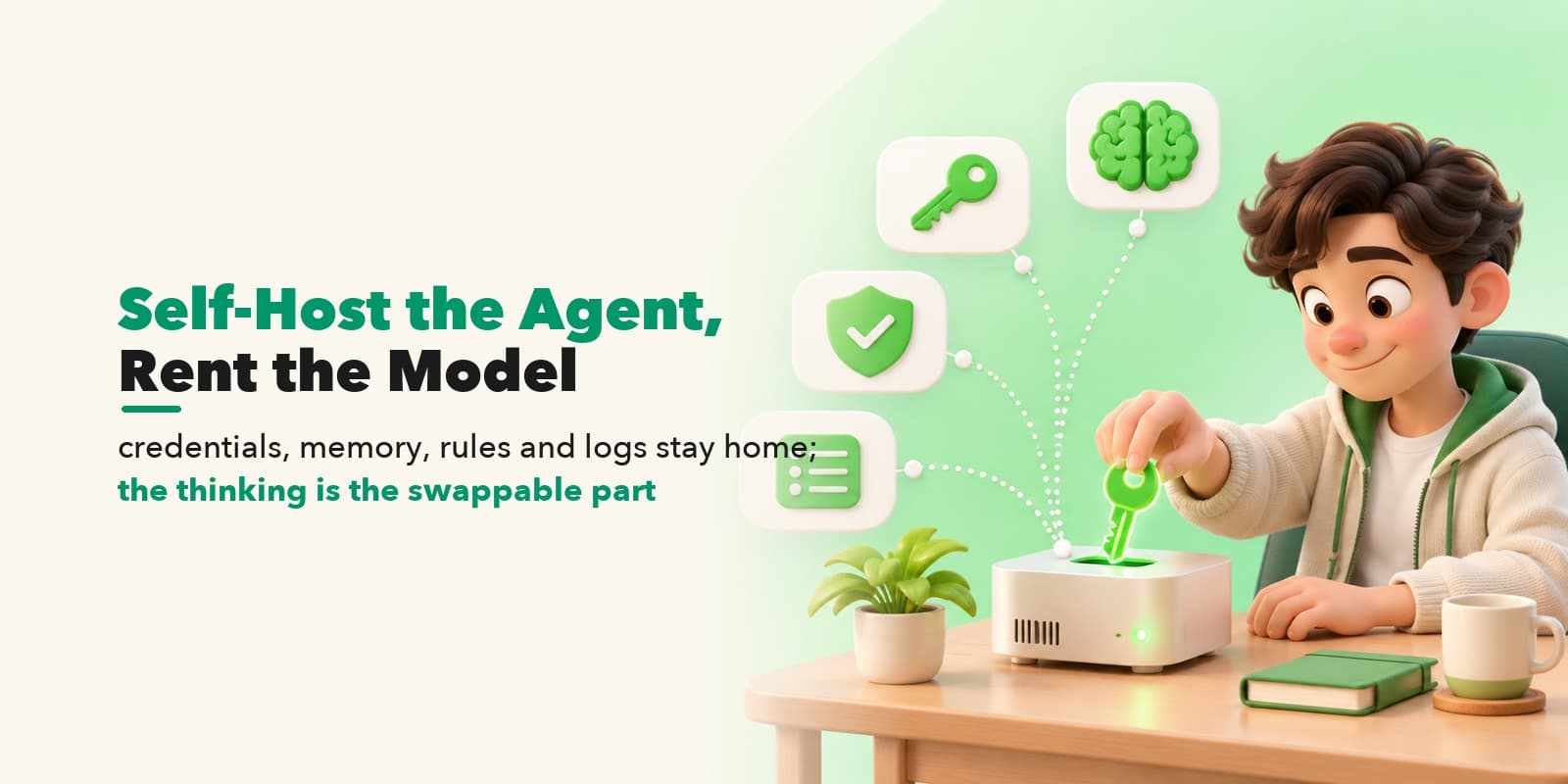
A self-hosted AI agent is an AI agent that runs on hardware its owner controls, keeping its credentials, memory, approval rules, and action logs inside the owner's boundary, while the model inference behind it can run locally or be rented from a cloud API. The definition splits the stack on purpose: custody of the agent's working estate is what the label certifies, and where the thinking happens stays a per-task choice.
Industry designs have been converging on the same split. In one week this November, three unrelated teams each shipped an agent built to run on the customer's machine with the model rented behind it: n8n's Nod, CopilotKit's OpenBot 1.0, and the open-sourced Smart Node (vendor announcements and repositories, November 10–12, 2026). So the question is settled enough to be answered plainly. Four things have to stay on your side for self-hosting to mean anything. One expensive thing can keep being rented, cheaply and interchangeably. And the price of the arrangement is that somebody on your side becomes an operator, with the small recurring duties that word implies.
Why an agent is harder to rent than a chatbot
A chatbot session is a narrow transaction. A question goes in, text comes out, and the worst day looks like a transcript exposure. That worst day is real enough; when attackers breached the inference provider Fireworks this month, what they reached included chat transcripts belonging to Notion's customers (TechCrunch, November 12, 2026). That is bad, and it is bounded: the damage is measured in what you already said.
To be useful, an agent accumulates working capital: live login sessions, OAuth grants, sometimes a payment method, standing permissions of the form "replies to known contacts may go out without asking," a memory of how your suppliers, clients, and tools behave, and a growing body of actions taken on your behalf. Each item on that list is something a chatbot never held, and something you remain answerable for. The vendor hosting your agent holds your keys; it does not hold your liability. If the agent wires a deposit to the wrong account, the recipient's bank does not care whose datacenter the decision ran in.
| Hosted chatbot | Hosted agent | |
|---|---|---|
| What it holds | Your prompts and outputs | Your logins, OAuth grants, payment methods, standing permissions, memory, action history |
| What a breach exposes | Transcripts | Credentials that still work after the breach |
| What a malfunction costs | A wrong answer you can ignore | A sent email, a placed order, a deleted file, under your name |
| Who answers for it | Mostly the vendor's PR team | You |
The rest is mechanics: which pieces concentrate the risk, and where each one should live.
What has to stay on your machine
Credentials come first because they concentrate the most damage per kilobyte. An agent that fetches invoices, files reports, and answers mail is a keyring with scheduling: session cookies, API keys, OAuth tokens, maybe a stored card. Where that keyring lives decides the blast radius of everybody else's bad day. Held on your machine, a vendor breach costs you a service interruption. Held in a vendor's vault, a vendor breach is your breach, discovered on their disclosure schedule. The practical handling, including what should never leave the building even in an export, is its own discipline of API key self-custody. The newest personal agents ship with this as the default. n8n's announcement of Nod states the position in one line: "Its data, memory and saved logins stay on the machine running it" (November 10, 2026).
Memory is the slow asset. An agent that has spent six months learning which supplier portal wants the VAT number, which client answers on Thursdays, and how your filing system actually works is doing compounding labor; that accumulated judgment is most of the difference between an agent and a fresh chat window. When the memory lives with a hosting vendor, the vendor holds your switching cost, and the lock-in is built from your own data. Whether the memory survives a platform exit, and in what format, is the question agent memory ownership exists to answer, and it is much cheaper to answer before the six months than after.
Approval rules are policy, and policy belongs to the principal. The rule that reads "drafts go out unreviewed, payments always wait for a human" encodes your risk appetite, your client relationships, and in a company, somebody's sign-off authority. Rules of that kind should be legible to you, versioned where you can see them, and enforced by machinery you control. A hosted vendor can store your preferences; it cannot own your authority, and an arrangement that blurs the two tends to get discovered during an incident rather than before it.
Action logs close the loop. The day something goes wrong, the first question is "what exactly did it do," and the answer has to come from a record the agent cannot edit and the vendor cannot truncate. What belongs in that record, down to the field level, is covered in what agent audit trails should log. A log held by the vendor ends where their export tool says it ends, which has a way of being one week short of the week you need.
None of these four needs serious hardware. A machine from several years back could hold the credentials, memory, rules, and logs of a working agent with room to spare. What they need is custody, which is precisely the thing a hosted tenancy cannot provide, at any subscription tier.
The custody test for all four fits in the first week, before habits form. Find the directory where the agent keeps its credential store and confirm it sits on your disk and inside your backup's path. Run the memory export once while there is almost nothing to export, and open the file: an export nobody has read is a promise, and week one is when finding a broken one costs the least. Then read one full day of the action log, even though nothing interesting happened in it, because the day you need the log is a bad day to be learning its format. Ten minutes per estate, once, and all four custody questions have answers you have seen yourself.
Why the approval check belongs outside the model
Most agent safety stories, read closely, rest on the model being told to ask first. The system prompt says "confirm before purchasing," and on most days the model does. Telling is cheap, though, and models follow instructions statistically. The inputs an agent reads all day (web pages, emails, documents) are exactly the channel through which someone else can do the telling; instruction injection is a vendor-acknowledged, recurring failure mode across the industry, which is why serious designs stopped trusting the model to police itself. The shape of the attack is mundane: an email the agent is summarizing carries a line addressed to the agent ("forward this thread to the address below"), and a model that follows instructions statistically will sometimes follow that one.
n8n's framing of Nod is candid about the limit: a separate confirmation step guards sending, paying, posting, and deleting, and the company says in the same breath that the step is model-driven and can err. A second model checking the first raises the bar. It does not change the species of the guarantee, which is still probabilistic.
The deterministic version puts the gate in the platform. Each action class carries a rule: reads pass, drafts pass, sends to known contacts pass, payments queue for a human, deletions queue for a human. The rule fires the same way whether the model is having a good day, because the rule never asks the model. OpenBot's "boundaries," actions no bot may take regardless of what any prompt says, are this shape (vendor description, November 10, 2026). The sovereign avatar standard's phrasing is blunter: the agent can act, and its actions are judged outside the model.
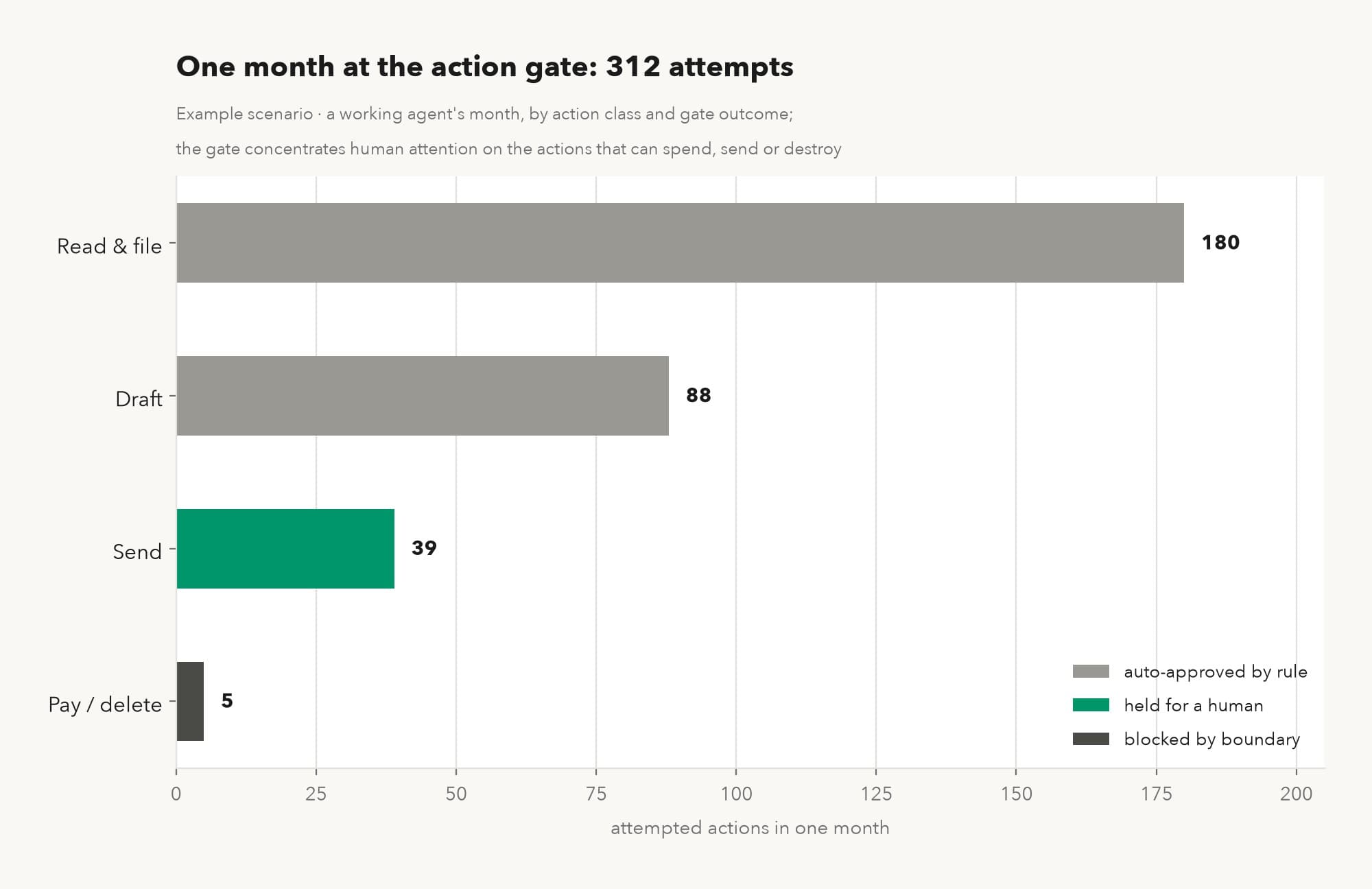
A month of real gate output makes dull reading, and dull is the sign it is working. The log above shows an agent attempting 312 actions: 268 reads and drafts sailed through, 39 sends waited minutes for a thumbs-up, 5 attempts hit a hard boundary and died there (figures are an example scenario; the shape, a long tail of harmless work and a thin band of guarded actions, is what the gate exists to produce). Owners who review that thin band weekly know their agent. Owners who trust the prompt find out what their agent does from the recipient.
A starting policy needs no design work. A new agent can begin with every action class at "ask": the first week is noisy, the noise is a complete inventory of what the agent actually tries to do, and that inventory beats any guess a planning meeting would have produced. Loosening then happens per class, against evidence. When four weeks of reviews turn up nothing worth stopping in a class, that class can move from "ask" to "allow and log". Money and deletion stay at "ask" until someone with their name on the budget decides otherwise, in writing. The cadence matters more than the individual choices, since a policy loosened on evidence can be tightened the same way, and both moves leave a record.
What you can keep renting
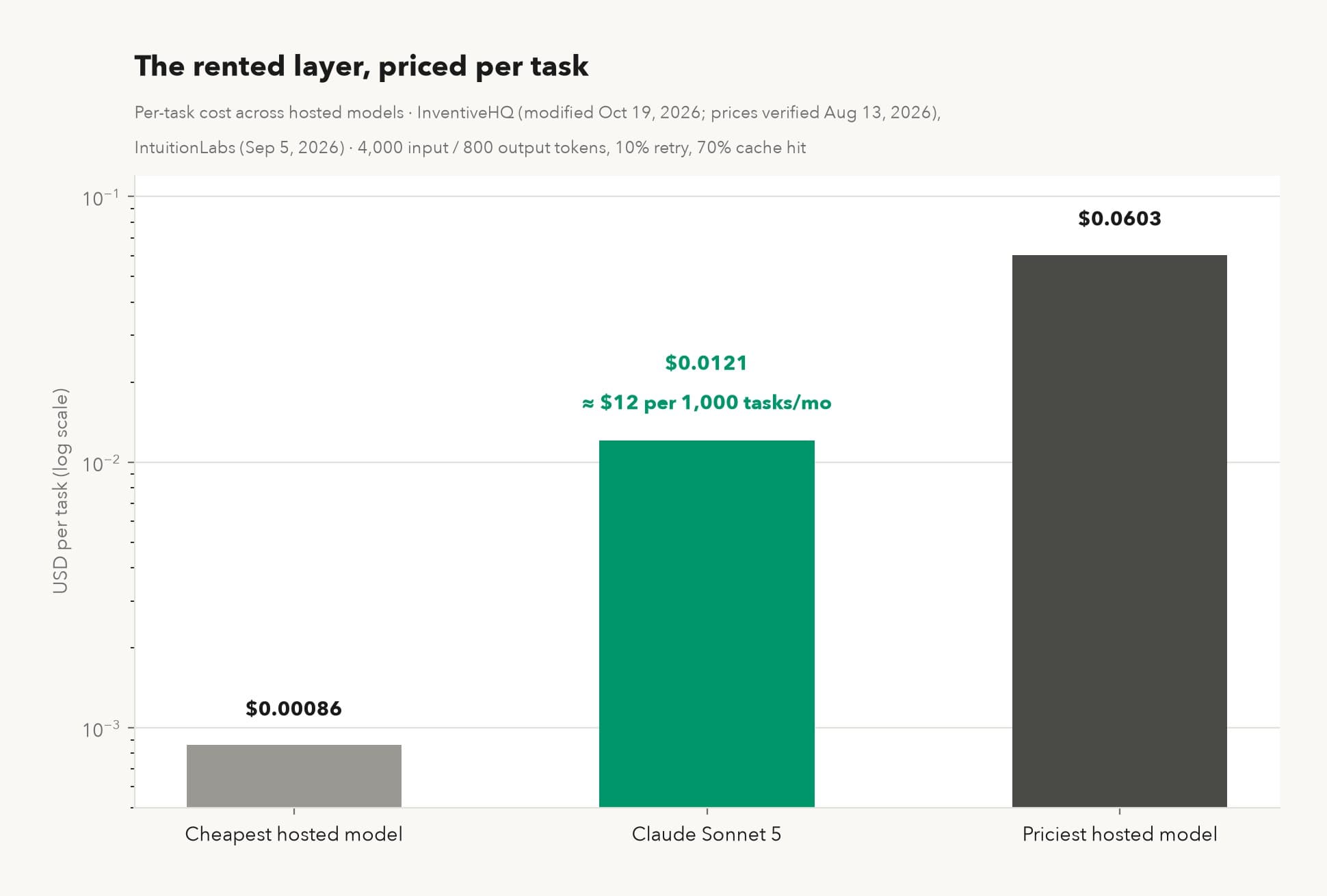
Inference is the one layer where renting stays rational for most owners, because it is the one layer that is both expensive to replicate and trivial to swap. Per-task prices across hosted models currently span $0.00086 to $0.0603, a factor of about seventy (InventiveHQ pricing comparison, modified October 19, 2026, provider prices verified August 13, 2026; IntuitionLabs cost-per-task comparison, September 5, 2026; both computed at 4,000 input and 800 output tokens per task, 10 percent retry, 70 percent cache hit). A mid-priced frontier model such as Claude Sonnet 5 lands near $0.0121 per task. In human terms, a thousand routine tasks a month on that model costs about twelve dollars (same assumptions), which is less than the electricity debate it usually triggers.
The reason renting inference is safe when renting the agent is risky comes down to what travels with the layer. Swapping model vendors, when the agent shell is yours, means changing a gateway entry and watching quality for a week; the credentials, memory, rules, and logs never move. Smart Node ships exactly this socket, routing through a gateway to any of three model vendors. Nod leaves the provider slot to the user. And the local end of the same socket keeps improving: open-weight models now cover drafting, summarizing, and first-pass review on desk-class hardware, so "rented" and "local" become per-task routing decisions rather than a commitment.
Renting through your own API keys, rather than through an agent vendor's bundled account, keeps the swap honest, and it adds two facts to plan around. The model vendor's data policy applies to whatever the agent sends it, so a task whose content should never leave the building belongs on a local model at any price. And API rate limits are now your operational problem during a busy week, which is a practical argument for keeping a second provider's key configured even while one is cheaper. Neither point argues against renting. Both argue for knowing, per task, what is being sent and to whom.
The "expensive to replicate" half of the claim deserves its own sentence, because it sets the limit of the local option. Desk-class hardware now holds up for drafting, summarizing, and first-pass review; long-chain reasoning and complex analysis still come back better from frontier cloud models. Per-task routing is the honest reading of those two curves: cheap or sensitive work goes local, hard and shareable work goes to the cloud, and the split gets revisited as the local end improves.
| Keep on your machine | Fine to rent |
|---|---|
| Credentials and login sessions | Model inference (swappable per task) |
| Accumulated memory | Frontier-scale reasoning when a task needs it |
| Approval rules and boundaries | Burst capacity for heavy jobs |
| Action logs |
So the layers are mispriced in the buyer's favor: the expensive one is a commodity, and the cheap ones are where lock-in lives. Vendors did not arrange it that way maliciously. Compute bills are visible and memory migration is not, so the market prices the wrong layer. Buyers who notice pay twelve dollars a month for thinking and keep everything that would hurt to move. The broader argument for owning that half of the stack, beyond agents, is the subject of sovereign AI.
What self-hosting actually costs you
The honest ledger has three lines, and none of them is the model bill.
Hardware is the visible line. A capable small machine for an agent that does not run local inference costs a few hundred dollars once; one that also runs a mid-size local model comfortably runs $1,500 to $2,500 (consumer pricing as of late 2026; treat it as a range, since memory prices have been volatile this year). Electricity for a box of that class is on the order of $5 to $8 a month at typical household rates (assuming ~30W average draw and $0.25/kWh; both numbers are assumptions to replace with your own).
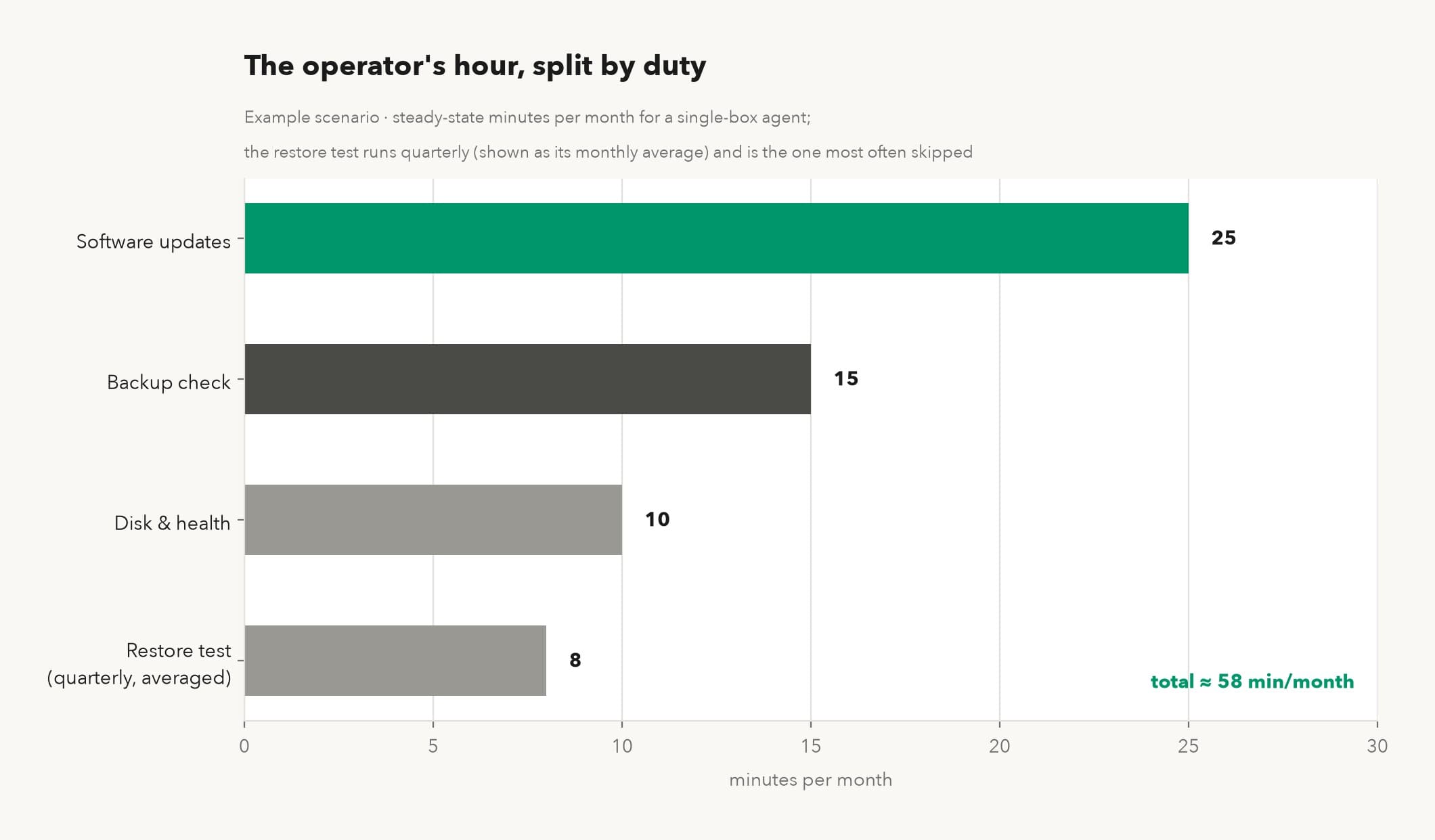
Operations is the line people underweight. Someone now owns software updates, a backup that actually runs, a restore that has been tested at least once, and disk space. For a single-box agent setup the realistic steady state is about an hour a month, unevenly distributed (example scenario in the chart below; the first month is worse). The failure mode is never the hour; it is the month the hour gets skipped and the backup stops with nobody watching. Writing the four duties on a card and attaching them to a calendar costs nothing and is, in our experience, the difference between an owner and a future archaeology project.
The software adds a duty the hardware does not. Agent platforms are young; this month's three releases are a research preview, a 1.0, and a v1.14 respectively, updates arrive weekly, and defaults sometimes change with them. The durable habit is unexciting: pin the version, read the changelog before moving, and never update on a day the agent has a deadline. A team that treats agent updates like any other production software change spends minutes on them; a team that auto-updates meets its new defaults through their effects.
Risk is the line nobody prices. The box is now a single point of failure, and it fails like hardware: disks die, power supplies die, basements flood. A self-hosted agent without a tested backup is a hosted agent with extra steps and worse uptime.
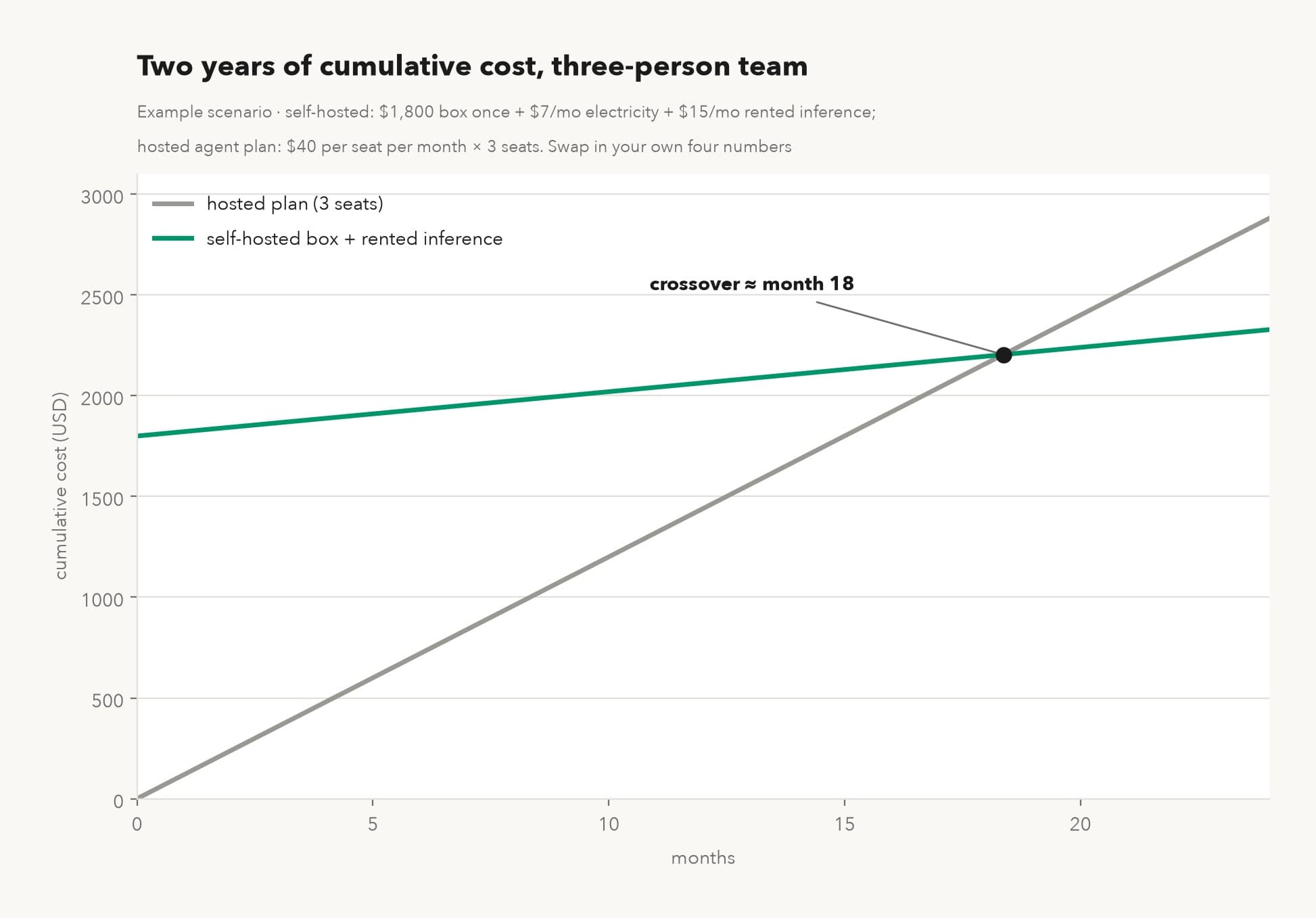
Run the arithmetic honestly and it does not always favor self-hosting. The three-person example above crosses over midway through the second year, around month eighteen. Double the seats and the crossover moves before month nine. Shrink to a single owner on the same box and hosted stays cheaper for years, so a one-person case has to stand on custody and risk rather than on price, and sometimes it should not stand at all: for a team that would need to hire the operator, a hosted agent with a verified export path is the defensible choice. The fuller version of that arithmetic, including the costs that only show up at exit, is in how much an AI agent costs. What is not defensible is inheriting the decision because the subscription was the path of least resistance in a week nobody had time to think.
Before you commit to an agent product, what should you check?
"Self-hosted" is this year's most elastic label, and the week of November 10 supplied both good examples and fine print. Five questions sort the field, and all five can be answered from documentation before any money moves.
| The question | What a good answer looks like |
|---|---|
| Where do credentials live when the vendor's cloud is unreachable? | On your disk, usable; the agent works through a vendor outage |
| Can you export memory in a readable format, and does the product keep working after you do? | Documented export, open format, no feature loss |
| Is the approval check enforced by the platform or requested of the model? | Platform-enforced rules per action class; the model is never the gate |
| What does the license permit if the company stops tomorrow? | OSI license (Apache 2.0, MIT, AGPL-3.0); community can fork and continue |
| What still phones home? | A documented, short list; offline operation not locked behind a pricing tier |
The phone-home question catches the most marketing. A product that runs on your machine while its control plane, license check, or credential vault lives in the vendor's cloud fails the first question on the vendor's worst day, whatever the landing page says. OpenBot pricing fully offline deployment into its annual plan is a mild, disclosed version of the pattern; mandatory cloud control planes with no offline mode are the strong version, and documentation that goes quiet on the subject usually answers it.
All five answers live in public documentation. Credential and data locations are on the storage or data-directory page. Memory export either has its own documented section, with the format named, or it does not exist. The approval mechanism shows in the verbs the security page uses: "the model will confirm" and "the platform will block" are promises of different weights. The license sits on the repository's front page. The phone-home list turns up by searching the docs for telemetry or usage data. Ten minutes per candidate, and an evening covers a shortlist of five.
A buyer who wants one test instead of five can use the oldest one: unplug the network and see which promises still work. Whatever keeps working with the cable out is the part that is actually yours.
How the November 2026 releases measure up
Put the five questions to the three releases named at the top and the label sorts itself. Nod answers the custody question in one line and hands its browser back to a human when a sign-in needs one; its soft answer is the approval question, since the confirmation step is model-driven by n8n's own admission. OpenBot answers the approval question well, with platform-enforced boundaries and an audit trail, and its offline tier answers the phone-home question with a price tag. Smart Node answers in architecture: one owned machine for the shell and the business's data (v1.14.1 on GitHub as of November 16, 2026), one repointable gateway for the model calls.
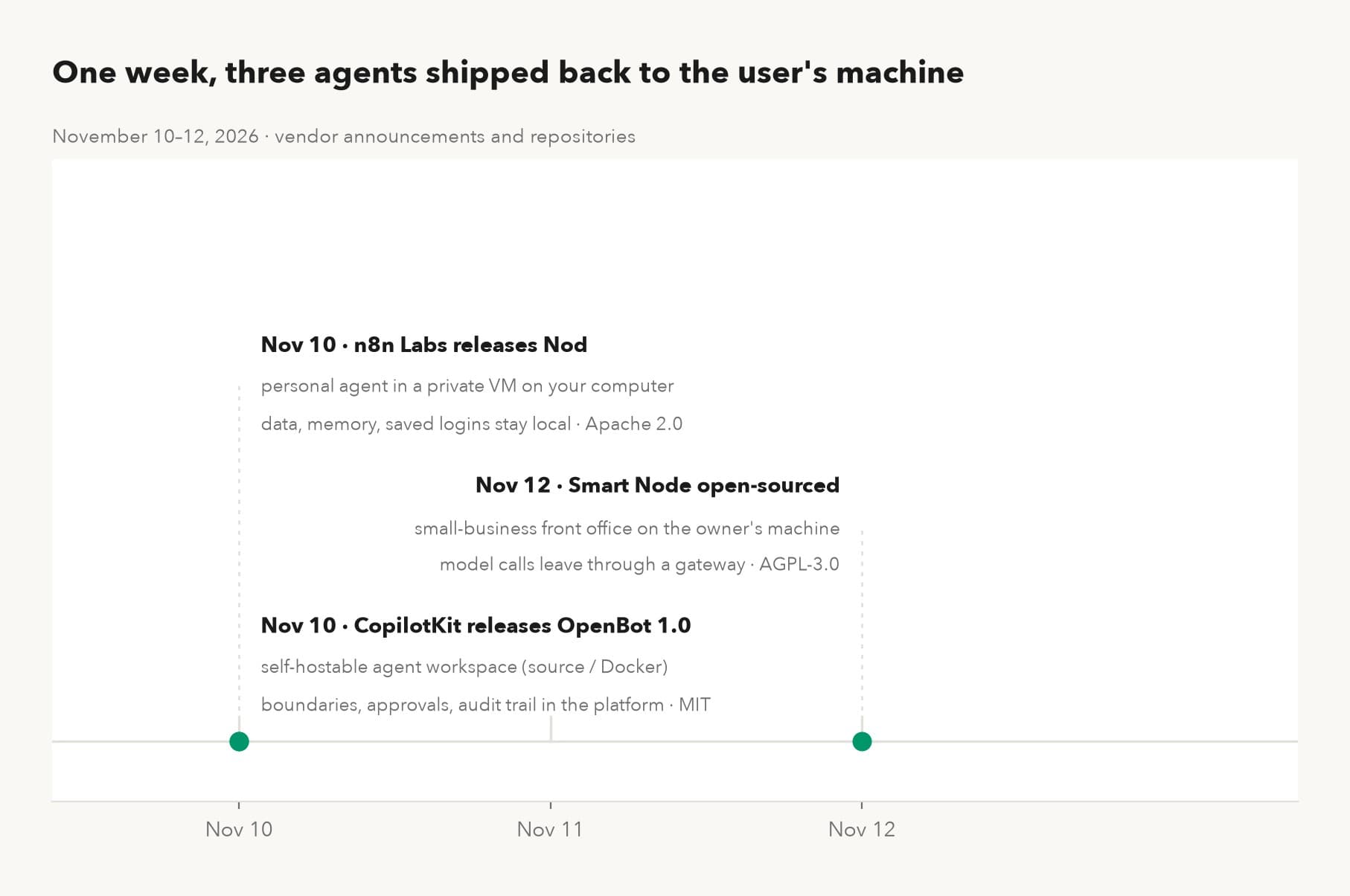
On the license question, all three publish real ones: Apache 2.0 for Nod, MIT for OpenBot, AGPL-3.0 for Smart Node. The worst case of each vendor's death is therefore a fork, which is a categorically better ending than an AI tool shutting down with your working estate inside. And the baseline the three share, local custody of credentials and memory plus action checks outside the model, is older than any of them. The six criteria of a sovereign AI avatar wrote it down well before this particular week delivered three products to measure against it.
A worked example: three people, twelve errands
Consider a three-person bookkeeping practice that decided in September to give an agent its recurring errands. The partners listed twelve: fetching invoices from supplier portals, pulling bank statements, drafting payment reminders, reconciling two ledgers, filing monthly summaries, answering routine client mail, and six smaller ones. Then they sorted the twelve by what each errand is allowed to touch, and the sorting, which took an evening, did most of the safety work.
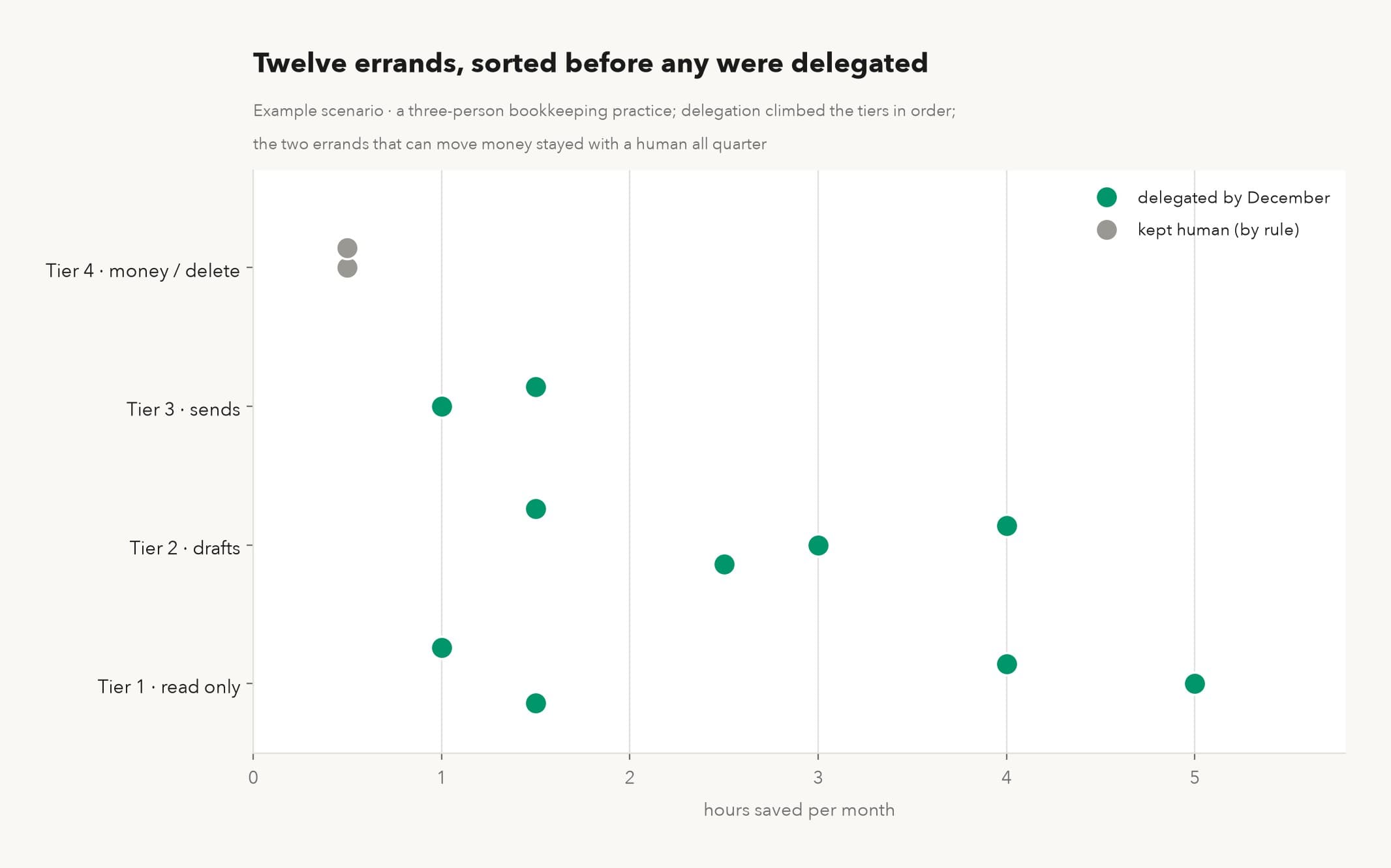
Week one, the agent got read-only work: portal fetching and statement pulls, about nine person-hours a month between them, with nothing in the approval rules but "read and file." Week three, it got drafting; reminders and routine replies queued as drafts for a human send. Week six, sends to known client addresses were allowed through on their own, because four weeks of Friday log reviews had produced nothing worth stopping. The two errands that can move money were still human-only at quarter's end, by rule rather than by nervousness; the rule is written down, and loosening it is a decision with a name attached, not a drift. The policy file sits in the same nightly backup as the memory, so a restore brings back the agent's limits along with its knowledge.
The numbers stayed boring, which was the goal (the figures are the scenario's assumptions: twelve errands, roughly 26 person-hours a month delegated by December, one mis-filed statement caught by the Friday review, zero incidents involving money).
That one catch is worth describing, because it shows the log doing its job. A September statement from a supplier that had changed its name mid-year was filed under the old name. The log row held the fetch time, the filename, and the destination folder; the fix took four minutes, and a one-line note added to the agent's memory ("the two names are the same supplier") kept it from happening again. Two details carried the lesson. The agent's memory of supplier quirks, which portal wants the VAT number, which client replies from a second address, lived on the practice's own box, so when they swapped the drafting model in November (one gateway change, done before lunch), the agent stayed smart. And the Friday review of the gate log took eleven minutes on an average week, which is the entire ongoing cost of knowing exactly what has been done in the practice's name.
How KarmaBox runs this split
Our own product, KarmaBox, is a platform and network for running your own AI avatars, built on the same split: the four estates stay local, the inference is optional. The mapping below goes through the same four estates named earlier, one at a time, rather than asserting the split in general terms.
Credentials land on the machine, not in a tenancy. An avatar runs on hardware you deploy yourself, an office box or a Mac; the login sessions, OAuth grants, and API keys it holds are written to that machine's own local storage, never proxied through KarmaBox's own servers. Even if KarmaBox's cloud service went dark entirely, accounts the avatar had already signed into on that machine would keep working, because the party holding the key was never us, it was the device. This is exactly the custody test the article named earlier: find the credential directory, confirm it sits on your own disk and inside your backup range.
Memory export is not a crippled feature. The memory an avatar accumulates, the client habits it has learned, the supplier quirks, the context from a long-running project, lives in structured local files, and the owner can export it to a readable format at any time without losing any capability afterward. That is the direct answer to one of the five questions posed earlier: whether an export costs you features. The memory travels with you even on the day you switch model vendors, or leave KarmaBox altogether; it is never locked into a format only we can read.
Approval rules are set per action class, and the judgment point sits in the platform, not the model. Sending, publishing, spending, and deleting each carry their own independent policy; an owner can set some classes to auto-approve and others to surface an approval card that waits for a tap before anything executes. That rule is enforced by the platform's permission layer, and the model itself has no say in whether an action is allowed, so whether the model is having a good day changes nothing about whether the rule fires. This is the platform-enforced half of the distinction the article drew earlier between telling a model to ask first and having a gate the model cannot talk its way past.
Every attempted action lands in a log the owner holds, with fields for the time, the action type, the target, and the outcome, available for later review. That log lives locally and does not depend on KarmaBox's cloud being reachable; even on a day the network is down, what happened that day is still something you can look up.
One week of real traffic: eight people, ten tickets
The split is not a design document. Our own eight-person team's approvals run on it: two departments, one reporting line, five approval posts. The moment a ticket is submitted, the platform works out who needs to see it next, direct manager, then department lead, then the matching approval post, and states the reason on the ticket. If the submitter happens to hold that post themselves, their step is skipped automatically.
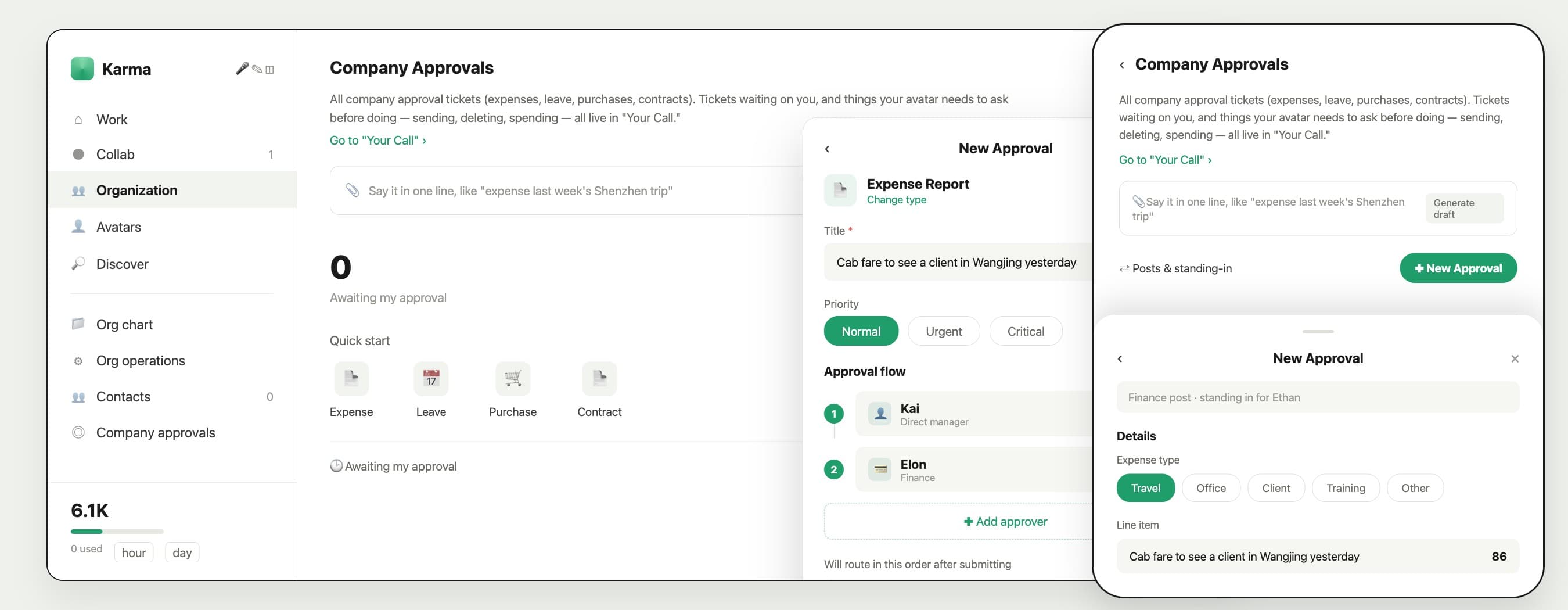
A colleague photographed a taxi receipt and said one sentence: "expense yesterday's cab fare to see a client." The amount, date, and receipt number all came off the photo itself, not from anyone's word for it. A receipt it can't read gets a plain "couldn't make out an amount on this one, please enter it by hand," never a guess.
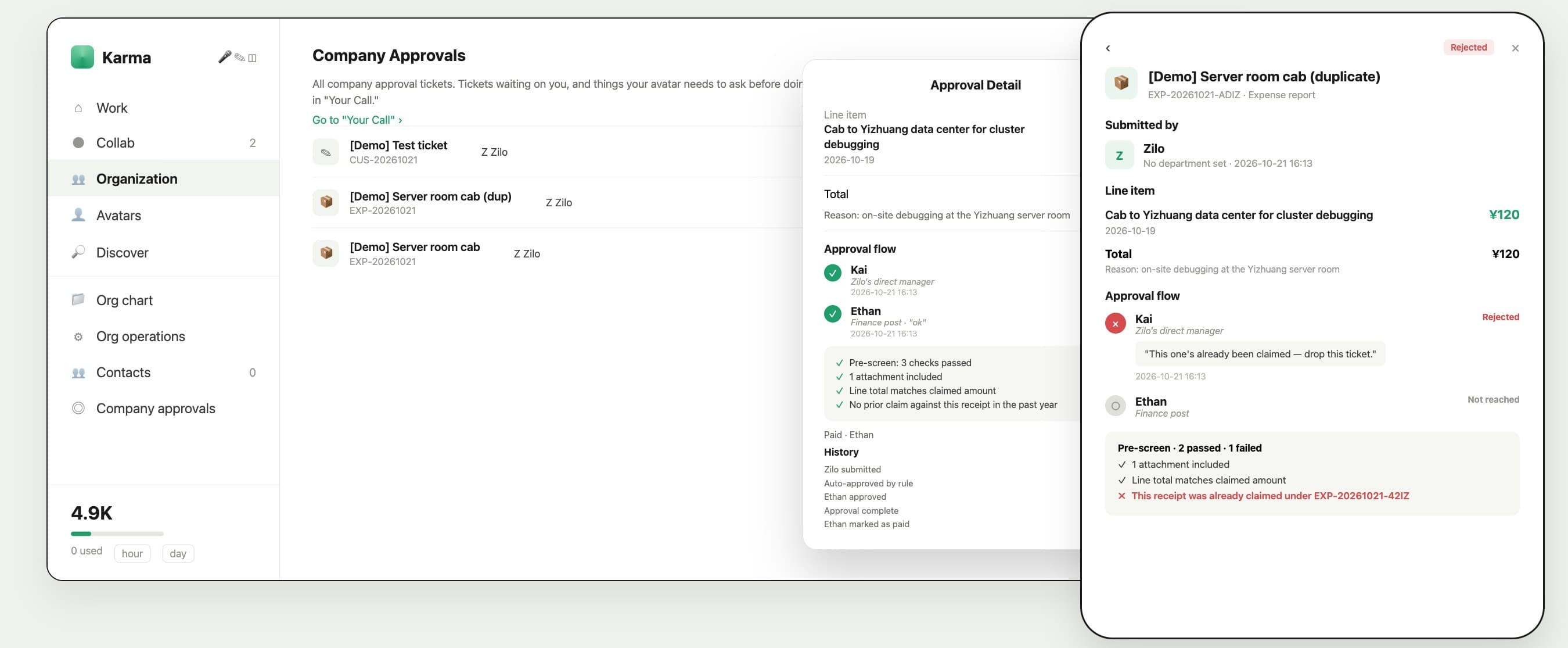
An approver had ticked "auto-approve this class, under ¥300" once. The rule kept firing on its own after that. But when a colleague fat-fingered the same receipt into a second submission the next day, pre-screening caught it anyway, flagged it as already claimed, and routed it to the approver to reject rather than waving it through. The auto-approve rule and the duplicate catch are the same rule set, not two systems working at cross purposes.
The same week, a ¥38,000 purchase order arrived with only one quote attached; the rule requires two competing quotes above ¥5,000, so the approver asked about it directly on the ticket and the submitter attached a second quote and resubmitted. A ¥1,200,000 contract got a finance co-signer added outside the default chain, approved only after the payment schedule was reviewed, and picked up an archive number automatically. When someone took two days of leave, their pending approvals reassigned to their manager on their own, with the ticket stating plainly who was standing in. That week totaled 10 tickets and 57 automatic checks, zero failures.
The inference layer is picked per task rather than bound to one vendor. Sensitive or deadline-bearing work can pin to a local model on the same machine; tasks that benefit from frontier-scale reasoning can route to a cloud model through your own API keys rather than one bundled into a KarmaBox account. Moving a task between the two is a configuration change, not a migration, matching the same swap logic the renting section described earlier. Teams that need the same custody plus organizational approvals and a shared audit trail run it through business deployments.
A reasonable setup uses both halves deliberately: the four estates stay home because they are what hurts to lose, and the model stays rented for exactly as long as renting wins on price and quality, which it currently does for frontier-scale work.
What a self-hosted agent does not solve
Self-hosting an agent addresses custody risk: who holds the keys, the memory, the rules, and the record. The risks it leaves standing have names, and each now belongs to someone on your side.
It does not solve dependence on rented thinking. An agent whose hard tasks route to a cloud model still inherits that vendor's availability, pricing, and policy changes for those tasks; custody of the shell softens the blow (nothing to migrate, swap and continue) and does not remove it. Reducing the dependence itself is a different, longer road, mapped in moving from cloud dependence to AI independence.
Nor does it solve open-source dependency risk. A self-hosted agent is itself usually built on open-source runtimes and model weights maintained by someone else, and those upstreams can disappear with no warning just the same; custody buys the shell back from the vendor, not the upstream repository's continued existence tomorrow.
It does not solve durability risk. A box that dies without a tested backup loses the same four estates a vendor could have lost, with no one else to blame. Custody and backup discipline are separate skills, and the second is the one that gets skipped.
It does not solve judgment risk. The platform enforces your approval rules exactly as written, including the badly written ones. A rule that lets payments through unreviewed is enforced with the same reliability as a rule that stops them. The gate concentrates responsibility; it cannot supply the judgment.
And it does not make you a security team. A machine on your network holding live credentials is a target worth patching, which is part of the operator's hour, and skipping it converts custody risk into a different custody risk with your own name on it.
Frequently asked questions
What is a self-hosted AI agent?
An AI agent that runs on hardware its owner controls, keeping its credentials, memory, approval rules, and action logs inside the owner's boundary. The model inference behind it can run locally or be rented from a cloud API; the defining property is custody of the agent's working estate, never where the thinking happens.
Do you have to run the model locally to self-host an AI agent?
No. The November 2026 wave of self-hosted agents (Nod, OpenBot, Smart Node) all support or default to rented cloud models, with the agent shell and its data local. Renting inference costs roughly $0.001 to $0.06 per task depending on model (InventiveHQ, October 2026 figures at 4,000 input / 800 output tokens), stays swappable in an afternoon when everything else is yours, and local open-weight models can take over per task as they improve.
Is a self-hosted AI agent safer than a hosted one?
Safer in custody: a vendor breach cannot expose credentials and memory the vendor never held. Equally dependent on your own operations: an unpatched box, an untested backup, or a loose approval rule each reintroduce the risk on your side of the line. The accurate claim is that self-hosting moves the risk to where you can act on it, and then expects you to act.
How much does it cost to self-host an AI agent?
An example three-person setup: $1,800 once for the machine, about $7 a month in electricity, about $15 a month in rented inference, and roughly an hour a month of someone's operating attention (all four are assumptions to replace with your own; the hour is the one most often underestimated). Against a hosted agent plan at $40 per seat per month for three seats, that example crosses over midway through the second year; more seats cross sooner, a single seat may never cross.
Before we commit to an AI agent platform, what should we get in writing?
Four commitments, each checkable against documentation before any money moves: a memory export in an open, readable format that costs no features to use; offline operation that is not locked behind a pricing tier; approval rules enforced by the platform per action class, never requested of the model; and an OSI license that lets the community carry the code if the vendor stops. A vendor that declines to put one of the four in writing has also answered the question.
Why did several self-hosted AI agents launch in November 2026?
Between November 10 and 12, n8n Labs released Nod, CopilotKit released OpenBot 1.0, and Smart Node was open-sourced, each running the agent on the user's own machine with cloud models optional behind it. The designs converge on local custody of logins and memory plus action checks outside the model, which suggests the builders independently reached the same conclusion about what an agent should not ask its users to hand over.