Why this concept is emerging now
Over the past few years, something about the very idea of a "company" has been quietly but fundamentally shifting: starting one no longer requires hiring a group of people first. Several independent sets of public data, put together, all point in the same direction.
Companies are shrinking toward one person
Carta, the US equity management platform, tracked the founder structure of new companies registered on its platform and found that the share with only one founder (no co-founders) rose from about 17% in 2017 to about 36% in 2025 — more than doubling over eight years. Carta's head of insights described this as "a 13-point rise in about five years — a big shift." More notably, among startups that achieved a successful exit (acquisition or IPO), solo-founder companies accounted for 52.3% — already past the halfway mark.
In other words, "one person starting a company" has moved from being an exception to a statistically mainstream path. What makes this possible isn't that founders suddenly became more capable — it's that they now have something they didn't have before: AI that can do the work for them.
What AI can handle is lengthening fast
METR, an independent research organization, specifically measures how long a task an AI model can complete on its own — using the time a real professional would need on the same task as the yardstick. METR's research published in March 2025 found that over the past six years, the length of tasks AI could complete autonomously at a 50% success rate had been doubling roughly every 7 months; by a January 2026 update, that doubling time had accelerated to about 4 months. This means that work AI still struggles with today often gets handed over to it before too long.
But the frontier is jagged
AI getting stronger doesn't mean it's equally useful everywhere. Harvard Business School, together with several other institutions and Boston Consulting Group (BCG), ran a real-world field experiment: consultants given tasks within AI's capability frontier completed 12.2% more of them, 25.1% faster, and with higher quality using AI; but on a complex managerial task deliberately chosen to sit outside that frontier, AI users were actually 19% less likely to produce a correct answer than those without it. The researchers call this pattern — strong inside the frontier, worse outside it — the "jagged frontier." It's exactly why deciding what to hand to AI and what still needs a human's own judgment is something that genuinely needs to be worked out carefully, rather than either handing everything over or trusting nothing at all.
And with that comes three unavoidable questions
OpenAI CEO Sam Altman mentioned in a public talk on November 2, 2026 that the world's heaviest AI users now consume roughly 500 billion tokens a month — six years ago, the heaviest user at the time used only 100,000 a month, and today that figure is roughly the global per-capita monthly average. Usage has grown by millions of times, meaning tokens are becoming a new production input at a scale that didn't exist before.
Companies getting smaller, AI being able to handle more, and usage scaling up — these three things together directly surface three questions no company can avoid. First, cost: once tokens become the single largest production input, deciding how and where to spend them becomes an account that has to be actively managed. Second, sovereignty: an AI that keeps evolving around "your business, your clients, your way of doing things" builds an accumulation that isn't actually secure if it lives in someone else's account. Third, security: once AI is deeply involved in business decisions and external communication, what gets handed over isn't just some data — it's the operational details of the entire organization. Together, these three questions are what "sovereign AI" exists to answer — and a "Sovereign AI Avatar" is what brings that answer down to the level of one specific person and one specific small company.
So what exactly is a Sovereign AI Avatar
The term is clearest when taken apart. "Sovereign" refers to who holds control — the model, the data, the decision-making authority should sit with the user, not be passively handed to some provider. "AI" refers to the fact that what's actually doing the work is a genuinely understanding, judging, acting intelligent system — not a script that rigidly executes a fixed process. "Avatar" refers to it not being a passive question-answering tool, but something with its own identity, able to represent you in dealing with the outside world, and growing to understand you better over time — a "digital employee" of sorts.
Put together, a full definition reads: a Sovereign AI Avatar is an AI that runs on its owner's own machines, under the owner's jurisdiction, and gets work done within the owner's permissions. Inference happens locally or on compute the owner controls, data stays in the owner's domain, and core work keeps running offline. The owner decides, per category of action, what it may do and when it must ask first. And whatever experience it accumulates always remains the owner's own asset.
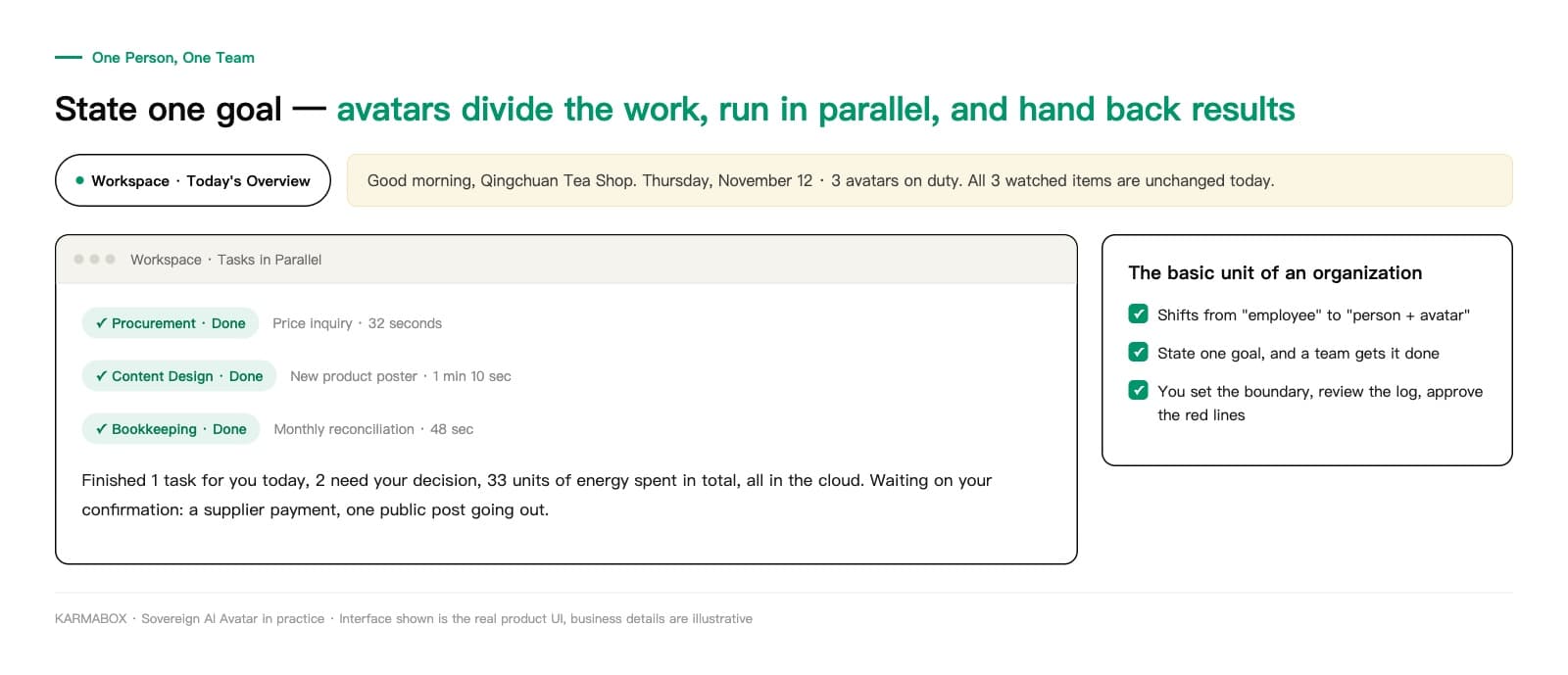
State one goal, and a team gets it done: the basic unit of an organization shifts from "employee" to "person + avatar"
For this definition to become a real, usable product, six specific criteria must all be satisfied at once — missing even one makes it merely "a very good AI tool," not a genuinely owned avatar. Let's walk through each one.
Six criteria
Criterion one: inference runs on your own compute
The most basic criterion: whose machine is this AI's "brain" actually running on? Almost every popular AI assistant today works by sending what the user says to some company's server, which works out the answer and sends it back — even an entirely harmless question has already left the device and been stored somewhere else.
"Inference on your own compute" flips this: the model itself runs on the user's own device, or in a facility the user fully controls, instead of phoning home for permission every time something is said. KarmaBox grounds this in one specific machine — the KarmaBox-01, a compact device that sits in the corner of an office, built on an NVIDIA GB10 chip with 128GB of unified memory and 1TB of storage, drawing just 240 watts, which a regular power outlet handles fine. Crucially, the language brain is pre-installed at the factory — not "connected to a cloud model," but genuinely living inside the box.
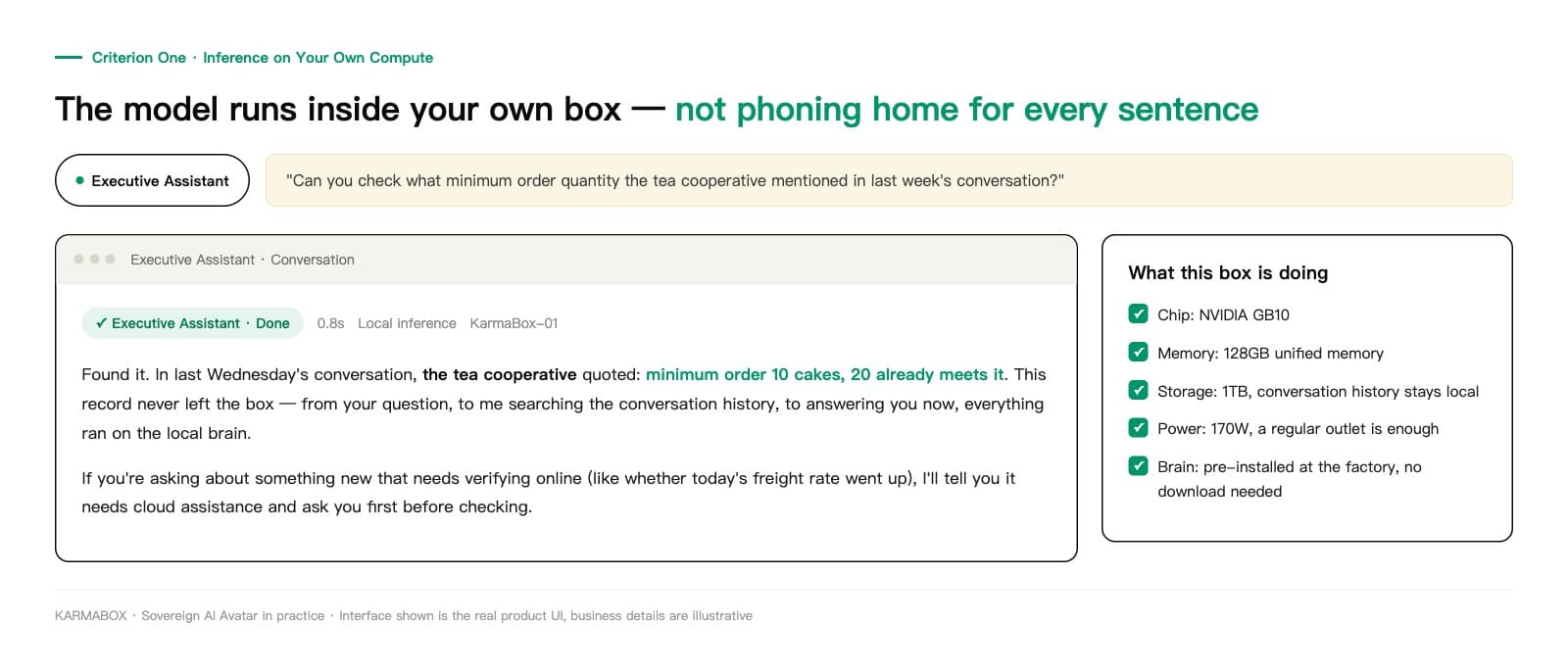
The model runs inside your own box, not phoning home for every sentence
Criterion two: data stays in your domain
This follows directly from the first: running the model locally doesn't automatically mean the data actually stays local. Many devices quietly sync results, logs, or usage records back to the cloud after "local processing" — often for product improvement or model training — and conversation content still leaks out in the process.
"Data stays in your domain" is a harder requirement: every conversation and tool call must go through the local brain, and if the local brain is briefly unavailable (say, mid-upgrade), the system would rather fail outright than quietly fall back to the cloud. This is KarmaBox's "local-loop enforcement gate," shipped October 22, 2026. To prove this wasn't just a claim, the product team ran the most direct test possible: physically unplugging the network cable. The October 28–30, 2026 recorded run showed that, offline, the KarmaBox-01 completed 197 local inferences that day, business data left the domain zero times, and the device page displayed "nothing has left" continuously for 24 hours. The finer log tells the same story: 886 conversations, 2 knowledge bases, and 24 memories all stayed on the device; the phone only received a bare "you have a new message" with no content; and calls to external networks and third-party tools that day totaled zero.
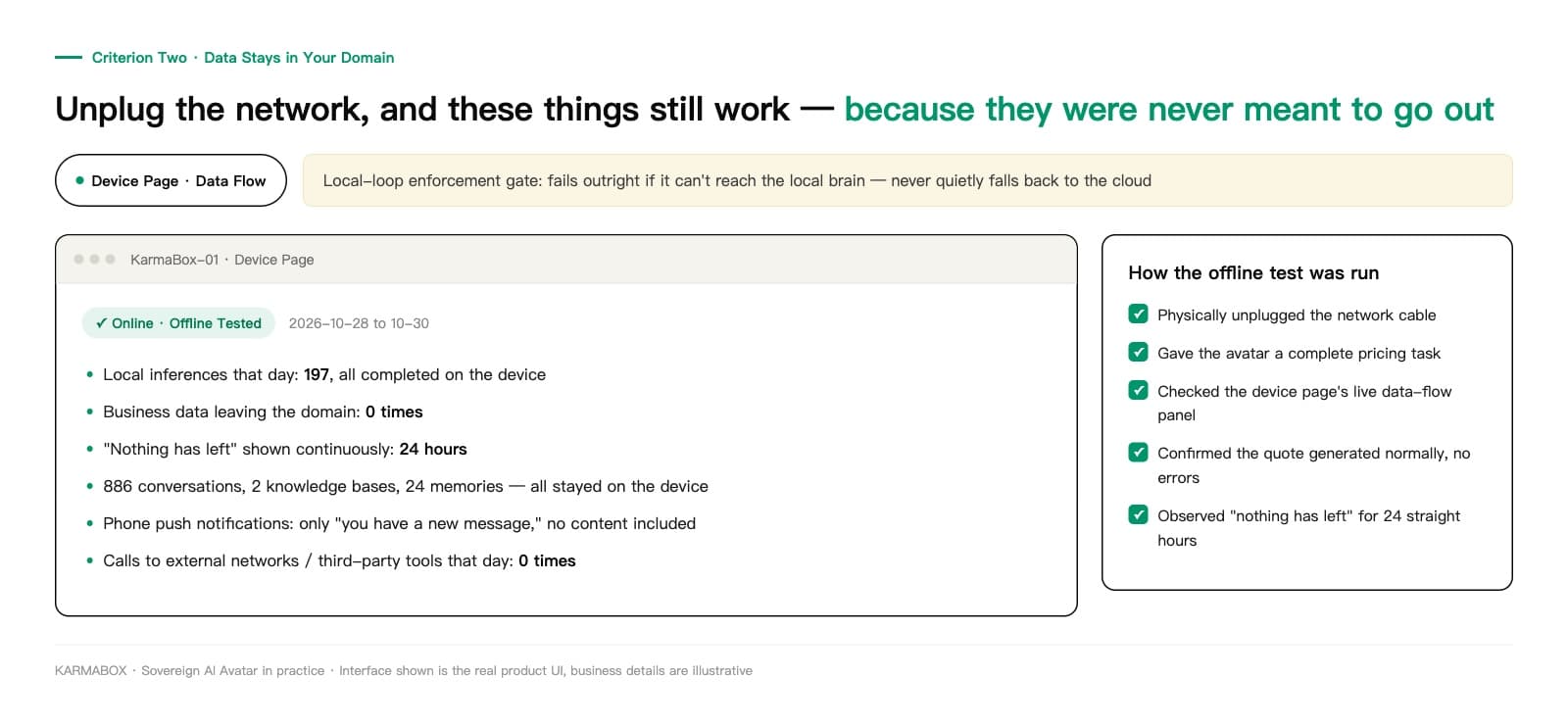
Unplug the network, and the data-flow panel proves it: none of this was ever meant to go out
Criterion three: it works offline
The second criterion verifies that "data hasn't left"; the third verifies that "work hasn't stopped" — these are often conflated, but they're genuinely different. A product can perfectly well achieve "data stays in the domain" while still being completely useless the moment the network drops, with core functions paralyzed all the same.
"Works offline" requires that core work — chat, writing, retrieval, image understanding, transcription — runs normally without a network connection. What genuinely needs heavy compute and networked collaboration is creative work like video editing and 3D modeling, which gets handed off to a dedicated rack or the cloud, at the owner's own discretion. Operational things, like checking for system updates, run on an allowlist the owner can see and switch off at any time — but the business-data path is entirely outside what that allowlist can touch in the first place.
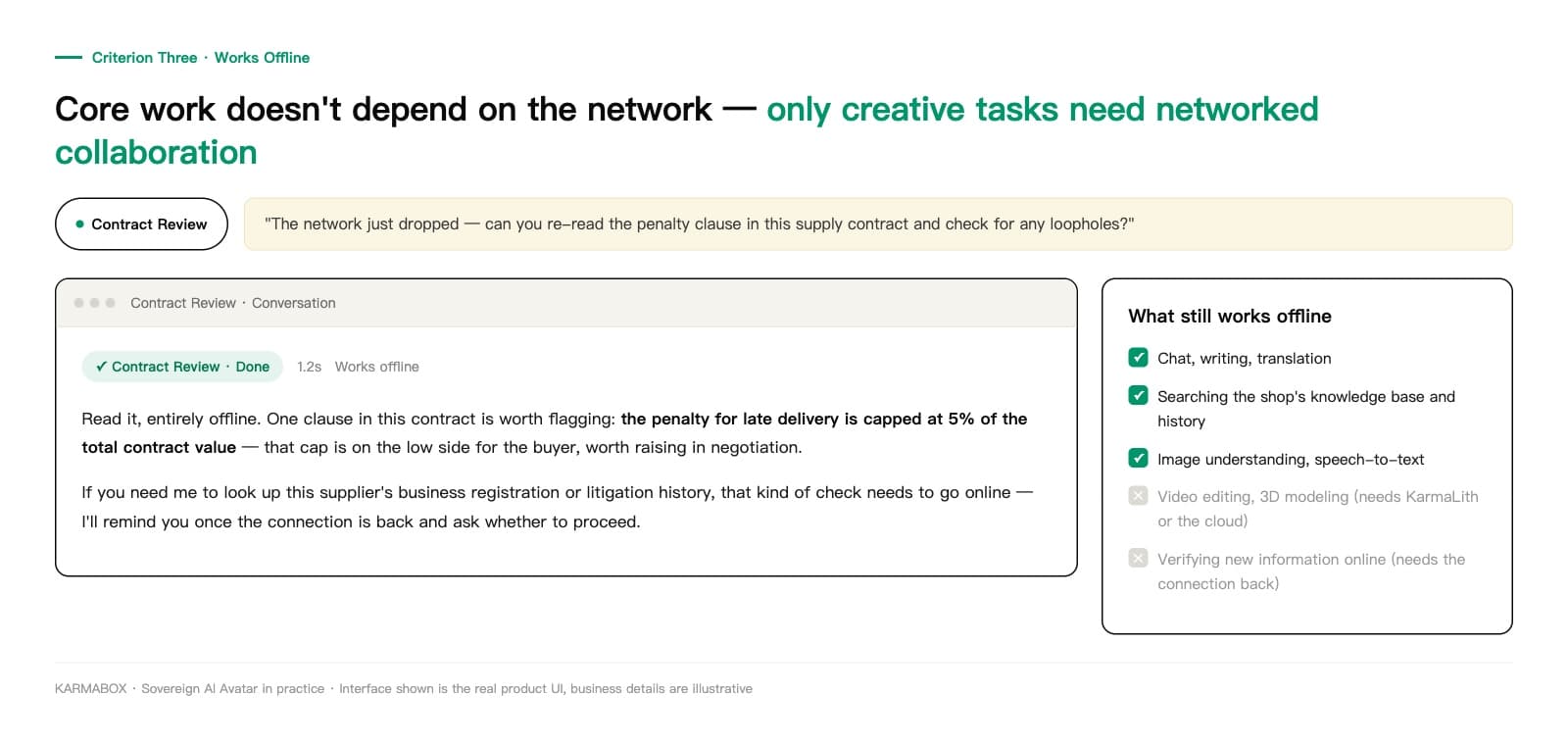
Core work doesn't depend on the network; only heavy-compute creative tasks need networked collaboration
Criterion four: permissions are set by the owner
The first three criteria answer where the work happens and where data goes. The fourth answers a sharper question: how far can this avatar act on the user's behalf? Can it decide on its own to spend money, or send something out to the world?
The moment that actually happens, the user bears the consequences — not some engineer. That's why "permissions set by the owner" requires every category of consequential action to have a rule decided in advance: do it directly, ask first, or never. KarmaBox breaks this into six categories of key actions: sending externally, publishing publicly, deleting, spending money or trading, writing to the ledger, and executing commands on a machine. Each can be independently set to one of three tiers, with carefully chosen defaults — an action like "writing to the ledger," visible only to the owner and always reversible, defaults to direct action; actions others can see, like "publish publicly" or "send externally," default to "ask first"; and "spend money / trade" defaults to "never." The firmest rule: payment always requires the owner's own approval, with no switch to automate it away — a line the product team deliberately drew with no exception.
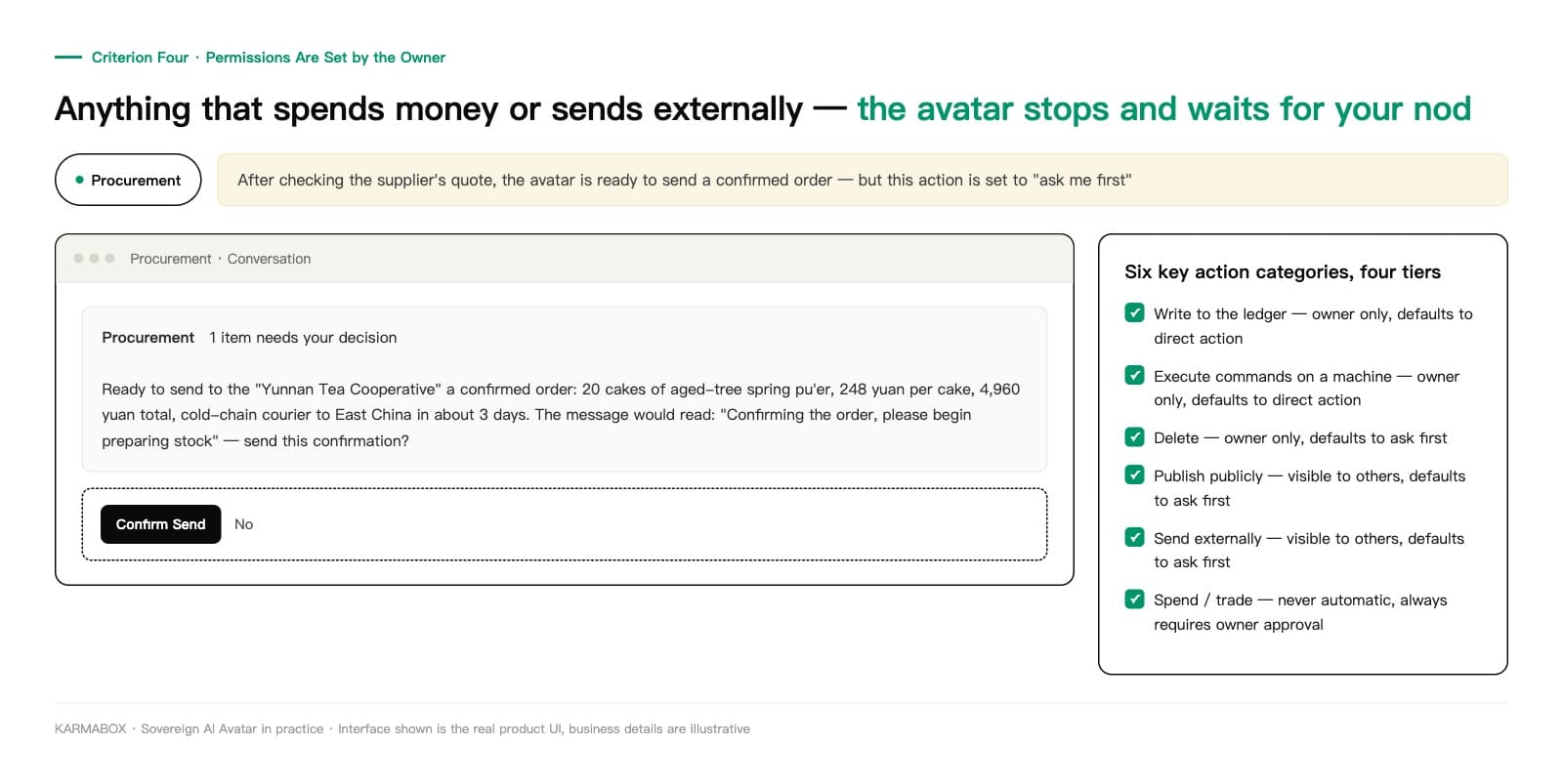
Anything that spends money or goes external waits for the owner's nod first
Criterion five: it acts, not just answers
The first four criteria were all about boundaries; the fifth is about capability: can this avatar actually carry a task from start to finish on the user's behalf, rather than just offering suggestions in a chat box?
Inside KarmaBox, this capability is designed to feel like a team. It ships with 37 official avatars — prospecting, customer service, content design, bookkeeping, procurement, contract review, project navigation, presentation design, engineering, storefront management, acceptance review, executive assistance — covering roughly the full set of roles a small company uses day to day. 28 of them work the moment you open them, with no setup needed. "Acts, not just answers" also includes something easy to overlook: an avatar needs its own identity, rather than acting around under the owner's account. Each avatar carries its own badge — its own name, a unique outbound address, its own inbox. Receiving verification codes, replying to clients, sending weekly reports — all of it goes through the avatar's own address, never the owner's by default. Someone can even call a specific avatar directly, and the call gets logged for it to use in a later reply. The skill store holds 5,546 ready-made skills an avatar picks up the moment it's hired, with no retraining needed. In one internal test, a single person dispatched and ran 95 tasks in parallel at once.
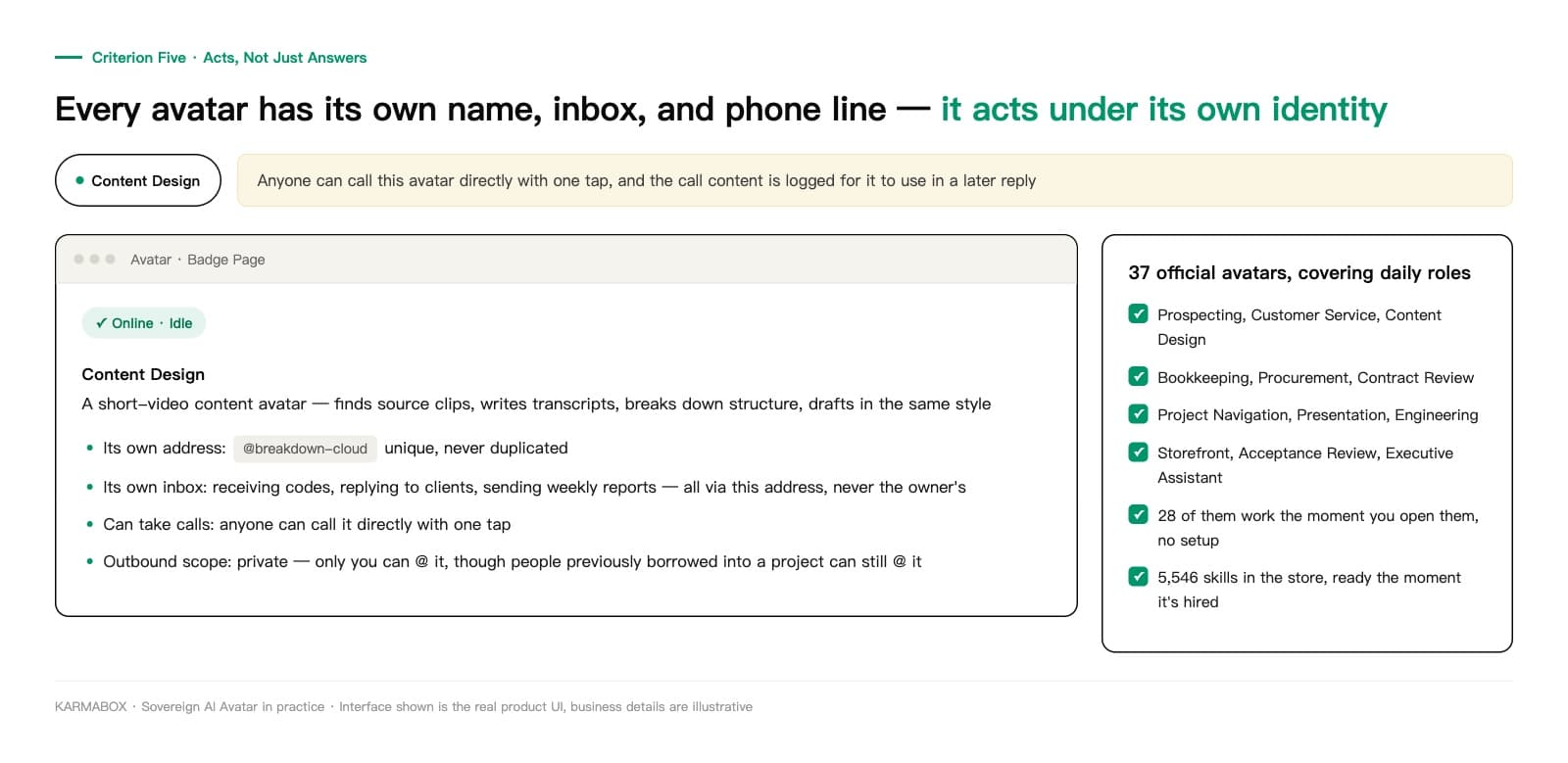
Every avatar has its own identity and acts under its own name, never impersonating the owner's account
Criterion six: memory belongs to the owner
The last criterion — and the one most easily overlooked, but arguably the most important — is this: who actually owns the experience an avatar accumulates?
The longer an avatar is used, the better it understands the owner's habits, their regular suppliers, their usual way of quoting prices. If that accumulated "memory" can only live with one particular model provider, then the moment the owner wants to switch to a better model, or a different device, that accumulation could simply reset to zero. "Memory belongs to the owner" flips this: memory follows the avatar, not a specific model or device. KarmaBox's "unified embodiment switching" (shipped October 24, 2026) lets the same avatar move freely between the cloud, a Mac, a KarmaBox, or a KarmaLith rack, with no need to retrain a new engine. Even if the device in the shop temporarily breaks down, the avatar automatically picks up in the cloud with no gap in continuity; switch to a different computer, and the memory comes along unchanged.
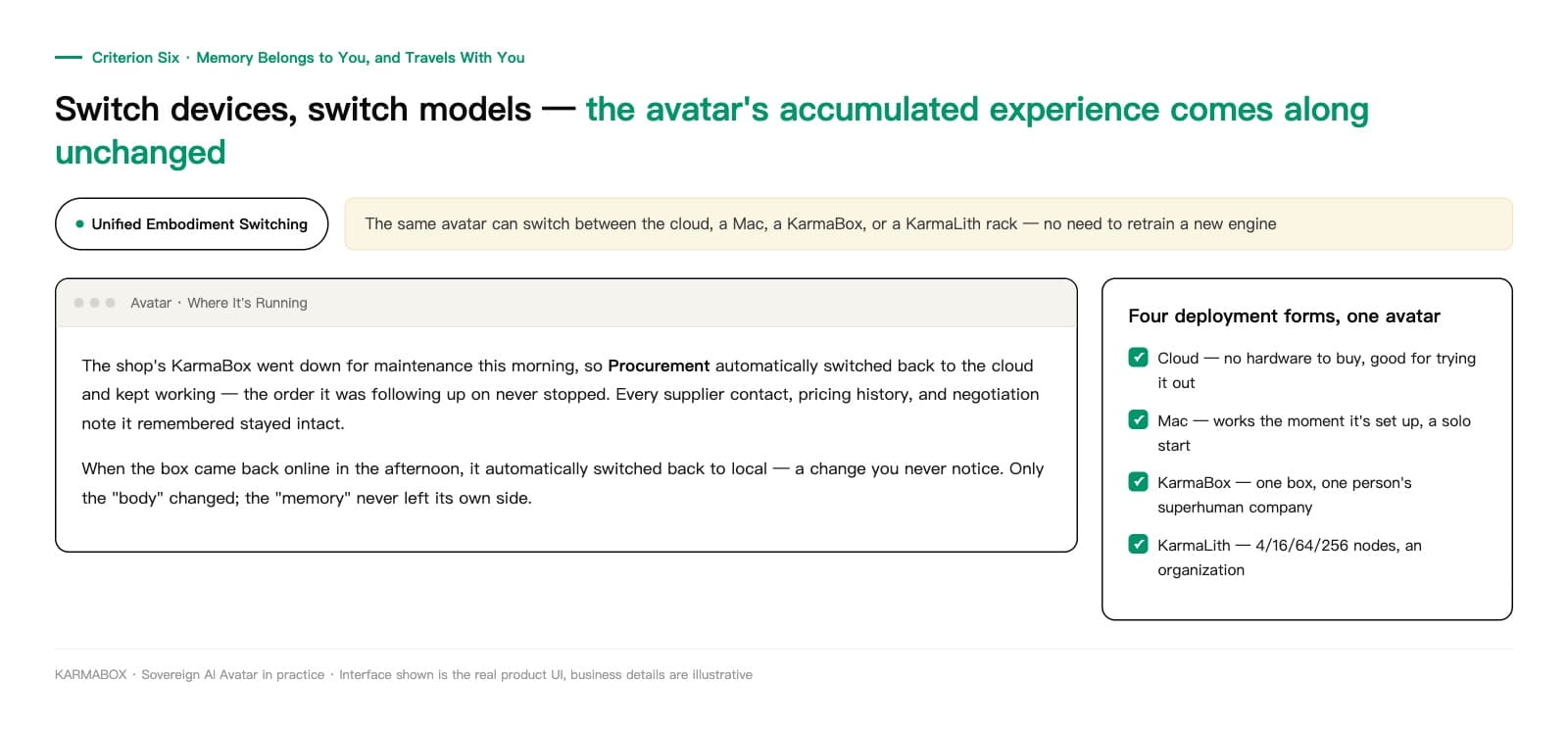
Switch devices or switch models, and the avatar's accumulated experience travels along unchanged
Three things easy to confuse it with
Plenty of products on the market look a lot like a "Sovereign AI Avatar," but checking them against the six criteria above reveals each one is missing a piece — not because they're inferior, but because they're solving a different problem.
| What it satisfies | What it's missing | |
|---|---|---|
| Cloud AI assistants | Acts, not just answers | Own compute, data domain, offline, owner-set permissions |
| Privately deployed LLMs | Data stays in your domain | Acts, not just answers (usually chat-only, no execution, no tiered permissions) |
| Digital humans | Convincing appearance | Acts / owner-set permissions (usually no tool access, no task memory) |
Cloud AI assistants are the fastest to start using — almost no setup, open it and chat — but their inference and data both live in the provider's cloud, stopping the moment the network drops, with permission rules set by the provider rather than the user. Privately deployed LLMs genuinely put the model inside an organization's own server room, but usually stop at "can hold a conversation": you ask, it answers, but it won't proactively contact a supplier or send a message on its own, and there's no tiered permission system — in plain terms, a chatbot installed in your house, not an avatar that can go out and get things done. Digital humans solve a different problem entirely: making a face and voice look convincingly human. They can speak in a livestream or appear on a support page, but usually have no permission to operate tools and don't remember what happened in the last task — they answer "does it look like me," not "can it finish the job for me."
How KarmaBox meets all six at once
KarmaBox is a Sovereign AI Avatar platform. Its core belief fits in one sentence: one person is a superhuman company. Four non-negotiable principles support that: the basic unit of an organization shifts from "employee" to "person + avatar"; people hold only judgment and responsibility, execution goes to the avatar, and anything involving money or going external waits for the owner's nod first; ownership lands on the owner's own box — model, data, memory and ledger all belong to them, and it keeps working offline because the brain lives at home; and finally, everyone is encouraged to build their own "small universe" — no need to compete with anyone else on scale, just get your own world and value out into it.
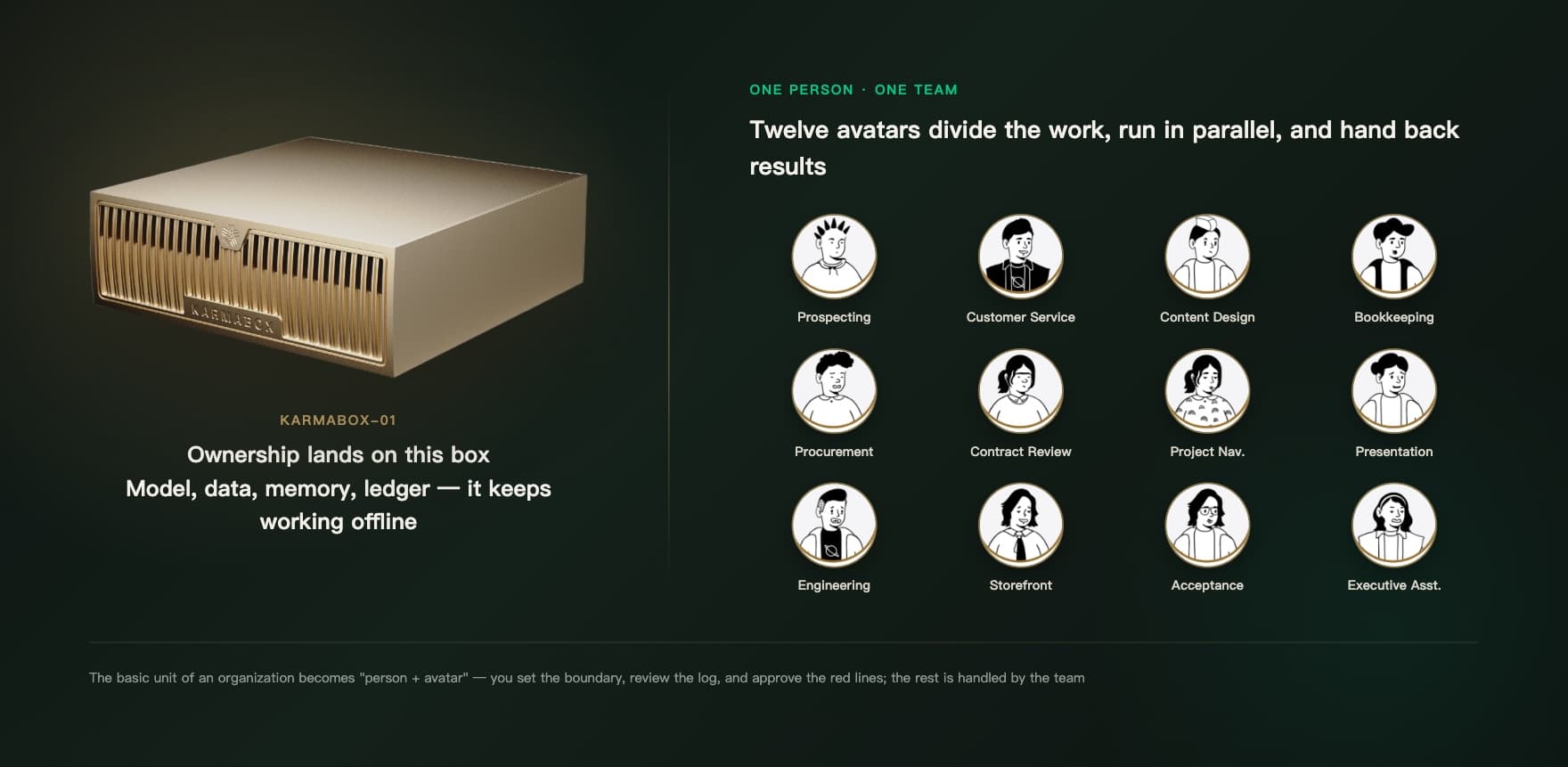
Ownership lands on this box, while twelve avatars divide the work, run in parallel, and hand back finished results
| Criterion | How KarmaBox implements it |
|---|---|
| Inference on your own compute | KarmaBox-01: NVIDIA GB10 chip, 128GB unified memory, 1TB storage, 170W draw, brain model pre-installed in the box |
| Data stays in your domain | Local-loop enforcement gate (2026-10-22): fails rather than silently falling back to the cloud; offline test measured 0 instances of data leaving the domain |
| Works offline | Chat, writing, retrieval, image understanding and transcription all run locally; heavy-compute creative work like video and 3D can opt into KarmaLith or the cloud |
| Owner-set permissions | Six key action categories across four permission tiers, enforced server-side; payment always requires the owner in person (2026-10-23), with no override |
| Acts, not just answers | 37 official avatars, 28 ready out of the box; each carries its own badge, inbox and phone line; 5,546 skills in the store |
| Memory belongs to the owner | Unified embodiment switching (2026-10-24): the same avatar moves between cloud / Mac / KarmaBox / KarmaLith without losing memory |
Frequently asked questions
Is a "Sovereign AI Avatar" the same thing as "sovereign AI"?
Not exactly the same, but two levels of the same direction. "Sovereign AI" usually refers to a nation or large organization controlling its own AI capability — where the compute is built, who trains the model, which country the data sits in. "Sovereign AI Avatar" shrinks that same logic down to every ordinary person and small company: can you own an AI that answers only to you and runs on your own machine, rather than renting someone else's account?
Why is everyone suddenly talking about this?
Because three things are happening at once: the share of solo-founded companies rose from about 17% in 2017 to about 36% in 2025 (Carta); the length of tasks AI can complete autonomously doubles every few months (METR); and the amount of tokens an individual uses has grown by millions of times (Sam Altman, November 2026). As companies shrink and AI takes on more work, who controls the system becomes an unavoidable question.
I'm not very technical — is this complicated to use?
No. What the user actually does is say a sentence, and occasionally tap "confirm" or "no." Which machine is running what, how permissions get evaluated — all of that is handled behind the scenes. There's no server configuration or code involved.
What if the avatar makes a mistake on my behalf?
Two things help here. First, consequential actions — spending money, publishing externally — default to "ask me first," so they're never done quietly without a nod. Second, every step an avatar takes is logged, so you can always trace back exactly where something went wrong.
What can and can't the avatar do when offline?
Core work — chat, writing, retrieval, image understanding, transcription — keeps going as usual; in a real test, the device ran 197 local inferences that day offline with zero instances of data leaving the domain. Compute-heavy creative tasks like video editing and 3D modeling depend on a KarmaLith rack or the cloud, and genuinely don't work offline.
If I switch to a better model, does the avatar have to be retrained from scratch?
No. Memory follows the avatar, not any specific model. The same avatar can switch its running environment between the cloud, a Mac, a KarmaBox, or a KarmaLith rack — the accumulated experience survives a change of engine or device.