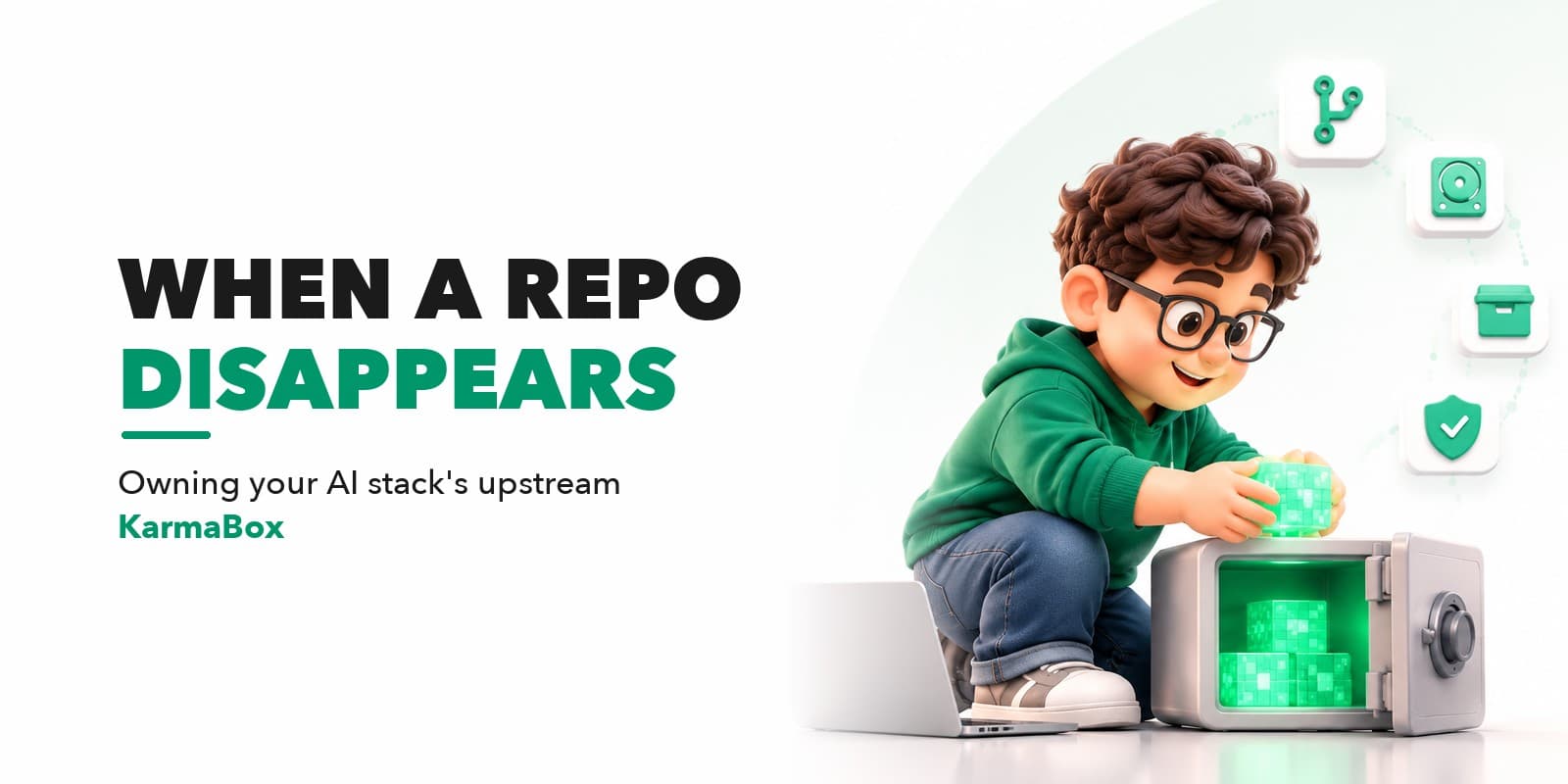
If your build depends on code hosted in someone else's account, your build can fail because of a decision you were never told about. An open-source license gives you rights to the code. It says nothing about whether the place you fetch it from will exist tomorrow.
Upstream risk is the chance that a repository, model weight, or artifact source your work depends on goes offline with no notice, no export window, and no copy on your side. Its neighbors are better known. An outage ends; a shutdown comes with a notice period and an export button. Upstream disappearance has neither. There is nobody to email, because you were never the customer.
On November 17, Microsoft's ONNX Runtime repository, a 22,000-star project that sits under a large share of production AI inference, started returning 404 on GitHub with no explanation, and continuous-integration pipelines around the world failed the same morning. The repository may yet come back; large vendors restore things, and GitHub itself has reversed takedowns before. Restoration would not weaken the point. It would confirm it: whether the code is reachable today is decided on someone else's side of the fence.
01Two contracts, and you only signed one
Every dependency in your stack involves two separate promises, and almost everyone treats them as a single thing.
The first promise is the license: MIT, Apache 2.0, GPL. It grants you the right to use, copy, modify, and redistribute the code. It is irrevocable for the copies you already hold, it costs nothing, and it survives anything the author does later. The license on a vanished project is as valid today as it was the day before the repository went dark.
The second promise would be about availability: that the code will remain fetchable, at that URL, tomorrow. Read any hosting platform's terms and you will find the opposite of a promise. Content can be removed by the account owner or by the platform, at any time, for reasons they do not have to explain. GitHub is not unusual here; this is how every free hosting arrangement works. There is no SLA (service-level agreement) on a public repository, because nobody is paying for one.
A paid plan does not close the gap either. Paying the platform buys support and uptime commitments for your own account and your own repositories. The repository you depend on sits in someone else's account, and your invoice creates no obligation about it.
Platforms do offer a gentler ending. GitHub lets maintainers archive a repository, which freezes it read-only but keeps it reachable; an archive is an orderly retirement, announced by its own banner. An unannounced 404 is no archive. The difference is the difference between a store that closes with a sign on the door and one that is simply not there in the morning.
Removal has more than one trigger, and most of them have nothing to do with the project's health. The account owner can delete a repository or take it private. The platform can act on a terms-of-service complaint. A rights-holder can force the platform's hand regardless of what anyone wants: in 2020, GitHub removed youtube-dl, the widely used video-download tool, after a music-industry DMCA notice. The repository returned about a month later, after review and public pressure, and GitHub revised how it handles such notices. The outcome was as good as takedowns get. The interruption was still real, and anyone whose build pulled from that repository had no say in either direction.
The assumption felt safe for a decade because the big platforms were reliable enough to feel like infrastructure. But infrastructure in the civic sense has obligations attached; a free hosting service has terms of service. The platform's operators answer to their own policies, their own lawyers, and whoever sends them legal notices. None of those parties know your build exists.
The package registries learned the lesson earlier than most of their users did. After the 2016 left-pad removal broke builds across the npm ecosystem, npm restricted the ability to unpublish. Registries also hold their own physical copies of every published artifact rather than pointing at an author's server, which is exactly why a registry install can keep working on the same morning a source clone fails. The faker.js author deleting his own work in 2022 tested those protections a second time. Each incident patched one symptom at one registry. The habit the incidents exposed, treating a fetchable URL as a guarantee, outlived every patch. A fetchable URL is a convenience. A copy on your own disk is a right you have already exercised.
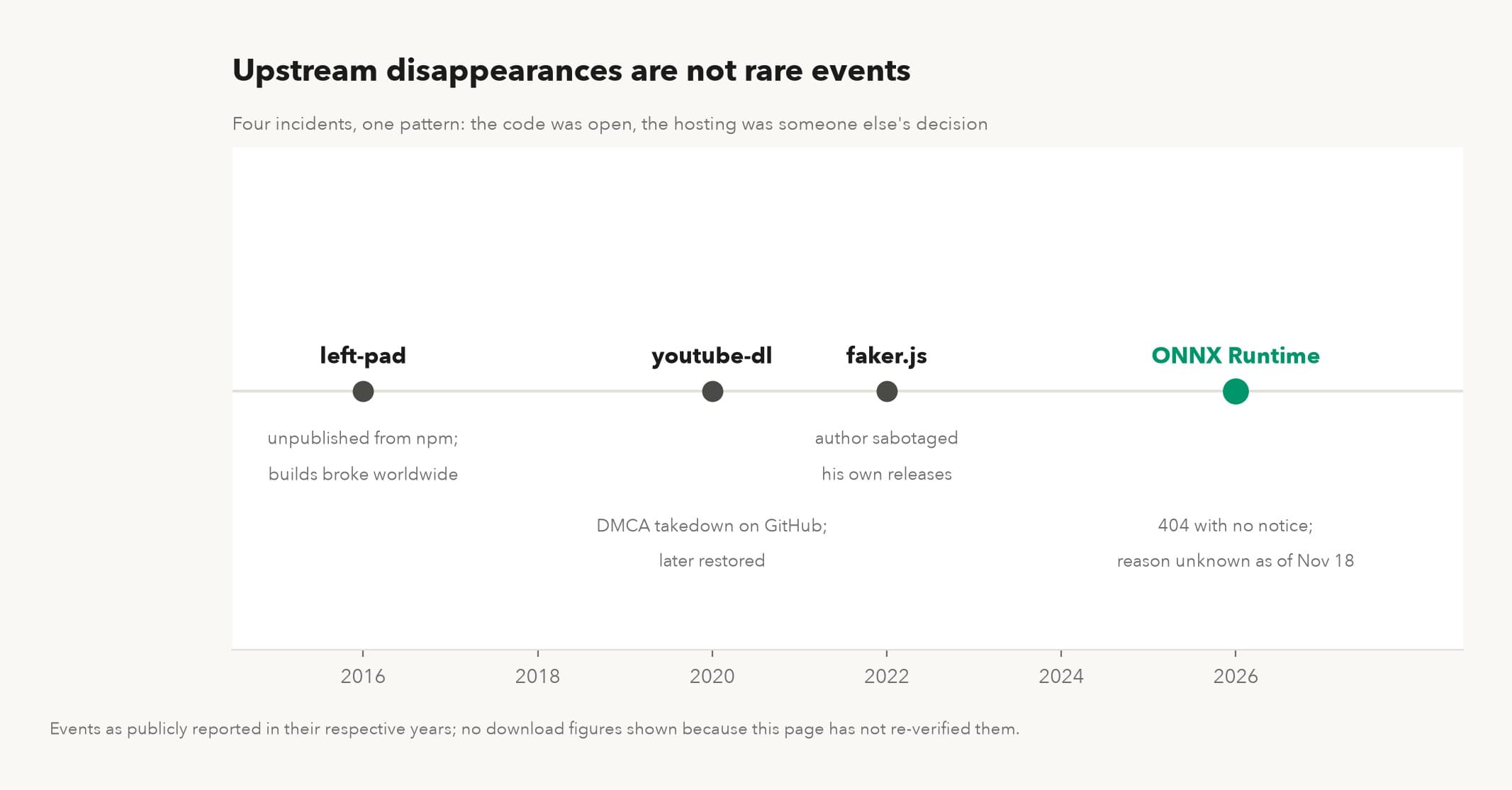
Figure 1. Upstream disappearances are not rare events: four incidents, one pattern — the code was open, the hosting was someone else's decision. Events as publicly reported in their respective years; no download figures shown because this page has not re-verified them.
A dated example: the ONNX Runtime disappearance
The disappearance in the opening paragraphs split along exactly this line. The registries kept serving: pip install onnxruntime worked throughout, because PyPI stores its own copy of every published wheel, and the NuGet packages and the documentation site stayed up (all three checked directly as of November 18). What failed was everything that reached for the repository itself: clones at pinned commits, submodule references, Dockerfiles with a git clone line, scripts fetching release assets from the releases page, which are not part of git data and which no fork preserves. And one layer fell with no registry to catch it: issues, pull-request history, security advisories, the maintainers' explanations that teams had linked from their own runbooks and audit notes. Artifacts survived wherever an independent copy existed. Everything served only from the repository went away with it.
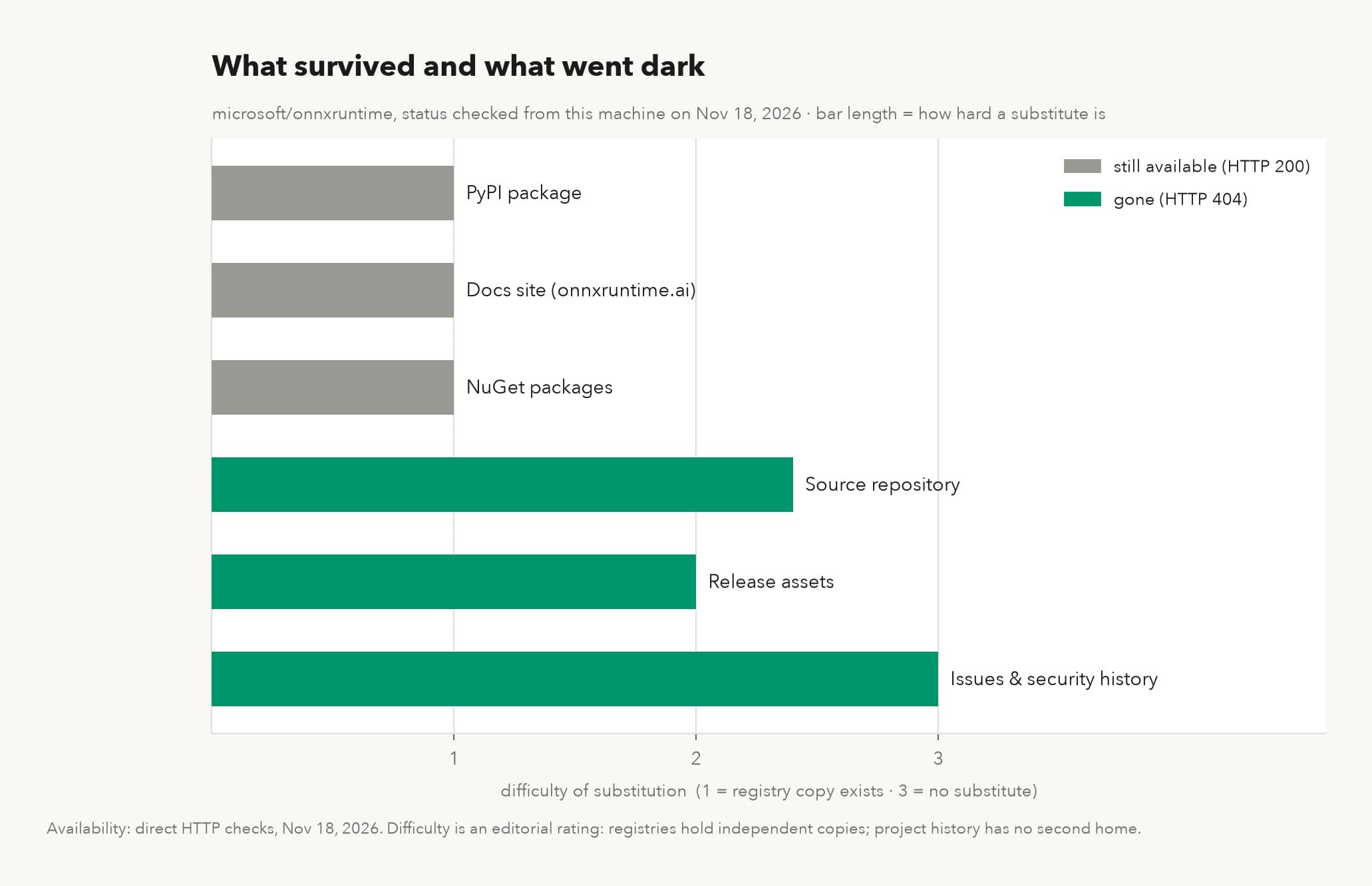
Figure 2. What survived and what went dark: microsoft/onnxruntime, status checked directly on Nov 18, 2026. Bar length = how hard a substitute is. Source repository, release assets, and issue & security history returned 404; the PyPI package, docs site, and NuGet packages stayed available.
If a vendor one day gives you notice and an export window before closing a service, you are in a different and better situation, and what to do when an AI tool shuts down covers that playbook: the dates that matter, what exports reach, what they miss. Upstream disappearance is defined by the absence of that window. The preparation has to be done while the upstream is still alive.
02Where upstream risk lands in an AI stack
Classic software has a well-understood dependency surface: packages, maybe some vendored C libraries. An AI stack multiplies that surface in ways most dependency tooling never sees.
Start with model weights. A team running open-weight models locally typically downloaded them once, from Hugging Face or from a vendor's release page, and kept exactly one copy in the place the inference server expects. Weights run from tens to hundreds of gigabytes, so people avoid duplicating them. That single copy usually lives on one machine, and the download link is treated as the backup. The link is hosted by someone else, and weight hosting has its own version of the two-contracts gap: several model families on Hugging Face, the Llama series most prominently, sit behind a gate where you accept license terms before the download works. Acceptance is per-account, and the gate's policy can change after you clicked through it. A download that was open when you chose the model can be closed or re-termed by the time you need it again. If that happens, the "backup" is gone, and re-creating a specific quantized variant of a specific weight version can be impossible: quantizations are often community uploads with no canonical second home. The economics of open-weight models only favor you if you actually hold the weights.
Then the runtime layer. Inference engines, tokenizers, CUDA kernels, serving frameworks. These are rebuilt from source far more often than ordinary application dependencies, because performance work happens at specific commits, not releases. Inference runtimes are the typical case: teams build them from source to get specific execution-provider behavior on specific hardware, which is exactly the usage a registry wheel cannot replace. A pinned commit hash in your build is a pointer into someone else's repository. The hash guarantees integrity; it guarantees nothing about reachability.
Third, the skills and glue. Agent systems accumulate small upstream dependencies at a remarkable rate: a prompt library here, a tool-calling schema there, a scraper someone published eight months ago and has not touched since. Each one arrived through a URL. Few ever got a second copy, partly because each one is small enough that copying it feels paranoid. The sum is not small. An agent that cannot load one tool schema does not degrade gracefully; it fails the task that needed the tool.
Last, the toolchain itself: CI actions, base images, installer scripts piped from URLs. A uses: someorg/some-action@v3 line in a workflow file is a runtime fetch from a repository you do not control, executed with your credentials. Most workflows pin actions by tag, and a tag is a movable pointer: it can be re-pointed to different code without the name changing. Pinning by commit hash fixes that integrity problem and leaves the reachability problem untouched. Base images have the same property one layer down: a Dockerfile's FROM line is a fetch from a registry account you do not control, re-resolved every time the cache goes cold.
There is also a layer that never appears in any dependency graph: the project's accumulated explanations. Issue threads, security advisories, the maintainer's comment on why a flag defaults the way it does. Teams link those from runbooks and audit notes, and the links are pointers into the same account as the code. When the account goes, that institutional memory goes with it, and no registry holds a copy of a discussion. A build can be restored from a mirror. An explanation cannot be re-derived from artifacts.
Take an inventory along those four rows and ask a single question per row: if the upstream vanished tonight, do I hold a copy I can rebuild from? For most teams the honest answers are: packages probably yes (registries), weights usually no, source and skills mostly no, toolchain almost never.
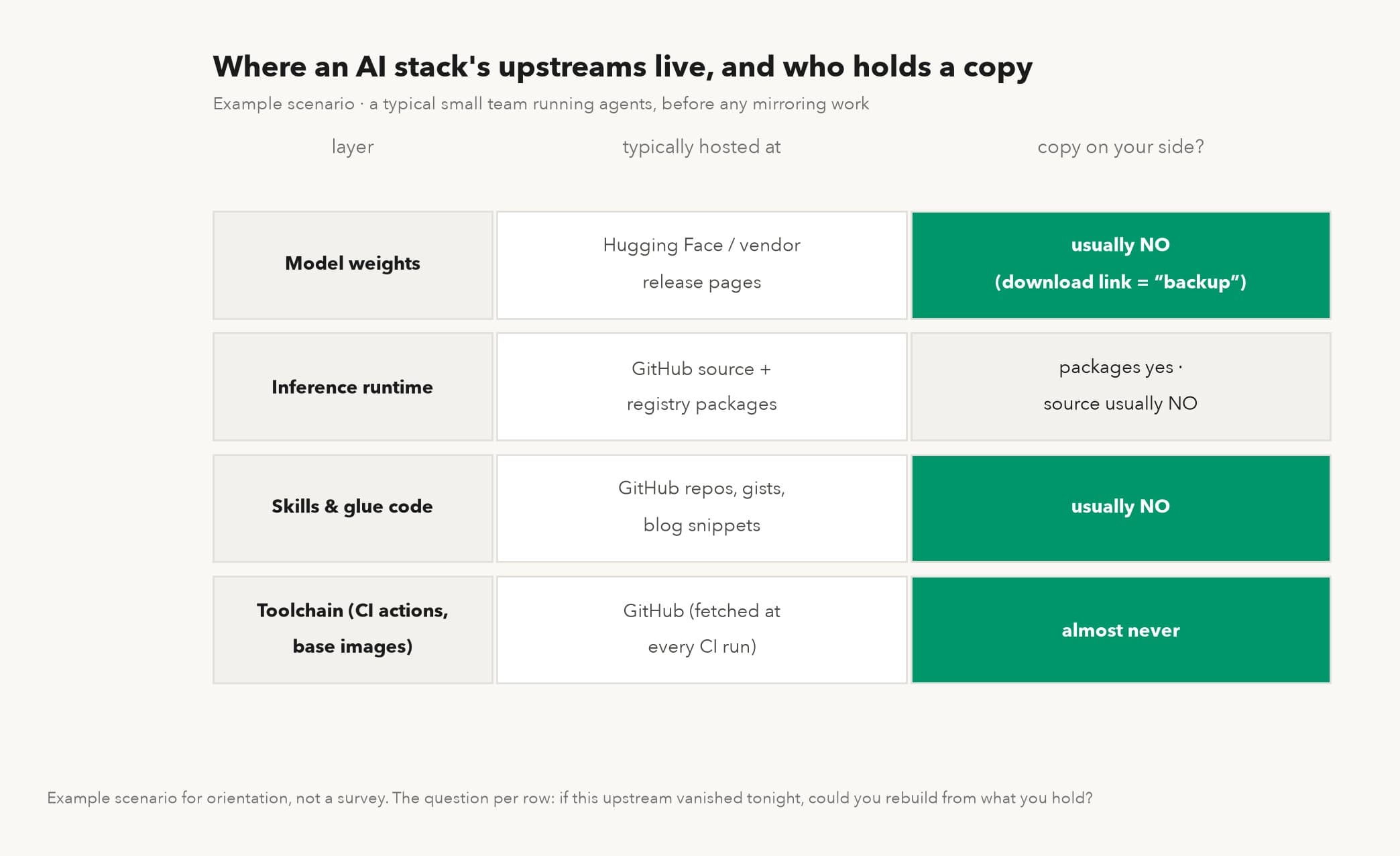
Figure 3. Where an AI stack's upstreams live, and who holds a copy: example scenario of a typical small team running agents, before any mirroring work. Model weights and skills/glue code are "usually no"; the toolchain is "almost never."
03What holding your own copies actually costs
The reflexive objection to mirroring is cost, so it deserves numbers rather than adjectives.
Consider a ten-person team with a realistic surface: fifty source dependencies worth mirroring (the ones referenced by commit or submodule, not every transitive package), two model weight sets at 80 GB together, release assets and base images at perhaps 40 GB, and a weekly refresh job. Storage for all of it fits in well under half a terabyte. On a NAS the team already owns, the marginal cost is near zero; bought new, a 2 TB disk is a double-digit dollar purchase (assuming commodity SSD prices as of late 2026). The refresh job is a cron entry running git remote update across a directory of mirrors; the weights, by far the largest objects, change the least often and mostly sit still. Call it one engineer-day to set up and an hour a month to tend. The one operational subtlety is that mirrors go stale silently, so the refresh should log what it updated, and a mirror that has not changed in months deserves a question: did upstream stop moving, or did the job break? Reading that log is most of the monthly hour. The surface also scales gently: double the team and the mirror barely grows, because the copies are per-stack, not per-person.
Against that: half a day of a blocked pipeline for the same team. Ten people idling or context-switching for four hours is forty working hours. At a loaded cost of $100 an hour (adjust to your own payroll; the figure is an assumption you should replace), one incident costs $4,000, before counting missed deadlines or the afternoon an engineer spends hunting for a community mirror of unknown provenance. The mirror pays for itself on the first incident, and incidents of exactly this shape are on the record, dates and star counts attached.
Restore speed belongs in the same arithmetic. When a build has to be re-pointed in a hurry, re-pointing it at a warm local mirror is a one-line configuration change that takes effect on the next run. Re-pointing it at a fork nobody has reviewed takes however long the review takes, and the review is the part that cannot be rushed.
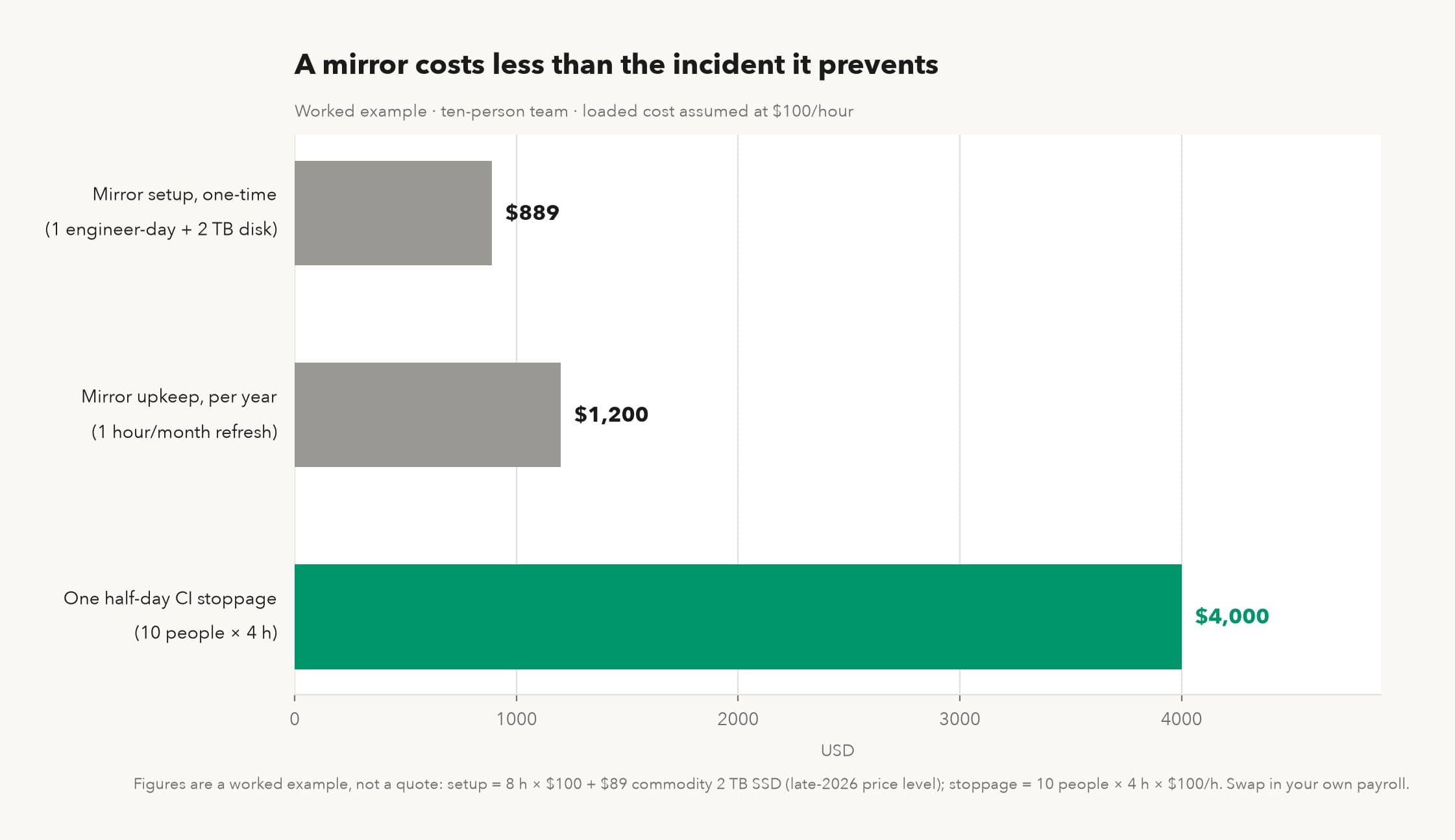
Figure 4. A mirror costs less than the incident it prevents. One-time mirror setup: $889; annual upkeep: $1,200; one half-day CI stoppage (10 people × 4 hours): $4,000. Figures are a worked example, not a quote — swap in your own payroll.
The deeper cost argument is about provenance rather than money. After a disappearance, copies of popular code do surface: forks, community mirrors, archives. But an unofficial mirror found after the fact is exactly the thing your security review should reject, unverifiable lineage at the moment everyone is in a hurry. Published research on backdoored models (Phrack, issue 73, 2026) is a reminder of what hurried re-sourcing invites. A mirror you made yourself, from the original, while it was alive, has provenance by construction, and recording checksums at mirror time makes that provenance checkable later: you can prove that what you build from next year matches what upstream served this year.
04Taking custody this week, not someday
The work divides into three moves, and a small team can do the first two today. (If the word "mirror" suggests infrastructure, lower the image: a mirror here is a folder of clones on a disk you own.)
First, find your exposure. Search your lockfiles, CI configs, Dockerfiles, and build scripts for direct references to hosting URLs: clones, submodules, release-asset downloads, raw-file fetches, action references. This is an afternoon with grep, and the output is a short list of places where your build reaches into accounts you do not control. The output tends to cluster: a handful of source dependencies referenced by commit, one or two submodules nobody remembers adding, and a longer tail of fetches hiding in CI workflow files. Most teams are surprised by that last group; almost nobody carries a complete mental list of their own CI's runtime fetches.
Second, take copies of what the list shows. git clone --mirror preserves the full history of a repository, branches and tags included, in a form you can push to any new host later. Two traps are worth knowing before you script it. A mirror clone does not fetch Git LFS objects, and model-adjacent repositories lean on LFS heavily; run git lfs fetch --all inside the mirror, or the large files in your copy will be pointers to a server that may stop answering. And release assets, as above, are not in the git data at all, so a mirrored repository does not contain the tarballs your build downloads from the releases page. They have to be fetched separately, and the listing API paginates, so a quick script that grabs "the releases" often grabs only the first page of them. Download the assets your builds actually reference, at the versions you pin. Copy the model weights you run to a second disk that is not the serving disk, and copy the whole model directory while you are at it: the tokenizer and configuration files that make a weight file loadable are small, easy to forget, and a weight file without them is a brick. If a repository uses submodules, mirror each one; the parent mirror records only pointers to commits that live in other people's repositories. Record a checksum for each file as the copy lands, alongside the date it was fetched: that is the evidence of provenance you will want later, so you can show a doubter that what you hold matches what upstream served rather than just asserting it. None of this requires new tooling, and all of it is idempotent: a weekly refresh keeps the copies warm.
Where the copies live matters less than whose account they live in. A NAS in the office, a disk in a drawer that gets refreshed monthly, object storage under your own billing: any of them works, provided the failure domain is different from the upstream's and the account answers to you. What defeats the purpose is a "mirror" that is itself a fork on the same platform, in the same legal jurisdiction, subject to the same takedown. The youtube-dl episode made that concrete: forks named in the takedown notice went down with the original. A copy that answers to the same takedown as the original adds redundancy in name only, whatever the folder is called.
Third, make the build prefer your copies. This is the only step with real engineering in it: pointing CI at an internal mirror or artifact cache first and at the public URL as fallback, vendoring the two or three small dependencies that matter most, pinning actions to commits you have mirrored. Git makes the redirection cheap: an insteadOf rewrite in the CI runner's configuration sends every clone of a given host through your mirror without touching a single build script. Do it incrementally, highest-blast-radius dependency first. The principle is the same one that applies to your own working files, keeping the workspace in files you own rather than inside a vendor's database, applied one layer down the stack.
None of this is a ritual. Custody is a property of the build, checkable whenever you doubt it: block the network path to the public host and see whether the build still passes. Reachability of your own copies is testable the same way offline operation is testable: unplug and observe. (An outage drill tests hours of unavailability. This tests permanence. A 404 is an outage with no recovery time objective.)
05A worked example: nine red days
Consider a twelve-person team running a retrieval service and a nightly evaluation suite. Tuesday, 9:40: the nightly job is red. The error says repository not found, which reads like a typo in a URL, so the first fifteen minutes go to re-running the job. The second run fails the same way. GitHub's status page is green. The service itself is fine, because the serving path installs pinned wheels from PyPI; what is red is the evaluation image, which builds an inference runtime from source at a pinned commit, for one hardware-specific flag that no released wheel carries.
The team spends the morning on triage and reaches a conclusion that is quick to state and slow to accept: nothing is wrong with their code, and nothing in their code can fix it. By noon someone has found a fork of roughly the right vintage. The security reviewer refuses to build production artifacts from an unknown fork, which is the correct call, and the argument that follows consumes the afternoon anyway.
The inventory, run that evening along the four rows (weights, runtime, skills, toolchain), takes under an hour with grep. It turns up three clusters: the pinned-commit build in the evaluation image, a submodule in the retrieval toolkit pointing at the vanished account, and a half-dozen CI actions pinned by tag. The weights review is the uncomfortable one. Both model versions the service depends on exist as single copies on the serving disk, and one is a community quantization whose upload page nobody on the team can name.
The week after is the three moves in order. Mirrors first; the LFS fetch triples the expected download, and the release-asset script stops at the first page until someone reads the pagination docs. Weights copied to a second disk, whole directories this time. The submodule re-pointed at the team's own mirror. The CI actions re-pinned to mirrored commits, lowest-effort ones last. A weekly refresh cron entry, plus the log line it writes.
Total elapsed: one lost Tuesday and one engineer-week spread over two calendar weeks, both following from the steps above, and both smaller if the inventory happens before the 404 instead of after. The service never went down. The evaluation suite was red for nine days. The part nobody had budgeted was the conversation with a product manager about why a dependency nobody remembered choosing was able to cost a sprint. Whether nine red days count as a near miss or an acceptable loss is a judgment call. Teams that ask the mirror question in design review get to make that call while the options are still cheap.
The retrospective produced one process change: a line added to the design-review template asking where the copy lives, who refreshes it, and what it costs. The first dependency to cross that template afterward was a small reranking library referenced by commit hash. The proposer wrote "public URL, we accept the risk," and the reviewer let it stand. The template records the decision, with a name attached, while the dependency is still a proposal.
06Before you build on an open-source runtime, what should you mirror?
Decision moments are cheaper than retrofits, so the question belongs in design review, phrased exactly this way, before the dependency is adopted. The team proposing the dependency answers it in one line per item: where the copy will live, who refreshes it, what it costs. If the answer is "we will rely on the public URL," that is also an answer, recorded next to the name of the person who gave it. Review pushes back hardest on the middle case: a dependency important enough to block inference but obscure enough that nobody wants to own its mirror. That case is the reason to ask early. By the time ownership of a mirror is obviously worth it, something has usually already broken.
The same question sorts candidates during selection, before any mirror exists. Two runtimes with similar benchmarks can carry very different custody costs. One publishes signed release artifacts to a registry and keeps its weights ungated; the other lives in a single hosted repository, ships binaries only through its releases page, and gates its weights behind terms that can change. The second is not disqualified by that, and some of the best tools live exactly that way. Its mirror is simply larger, its refresh fiddlier, and its loss harder to absorb. A team that prices custody during selection will sometimes pick the runtime with the registry presence at a small performance cost, because the custody bill arrives either way.
The minimum set, for any upstream that would block your build or your inference if it vanished: the full source history (git clone --mirror, refreshed on a schedule); the release artifacts your build fetches, at the versions you pin; the model weights you serve, in the exact quantization you serve; and a text export of whatever documentation you would need to operate the thing for six months without the project's website. The quantization detail is easy to miss: re-deriving a quantized variant requires the original full-precision weights, which may be exactly the thing you can no longer download. Six months is not an arbitrary horizon either; it is roughly the time a community takes to sort out a successor project, and your mirror's job is to let you wait for that calmly.
What you can skip: transitive packages already held by a registry you trust, anything you could re-derive from your own artifacts, and the long tail of dependencies whose loss would be an inconvenience rather than a stoppage. Mirroring everything is hoarding; the four-row inventory tells you where the line is for your stack.
One rule of thumb covers most cases. If losing the upstream would cost you more than a day, hold a copy. If re-sourcing it would require trusting a stranger's fork, hold a copy. Otherwise, pin versions and rely on the registry.
07How KarmaBox applies this (product section)
Our own product, KarmaBox, is built on the other side of that bet: the runtime, the models, and the avatar's memory live on a machine you own. Concretely, problem by problem:
| The problem upstream | What KarmaBox does | What you set |
|---|---|---|
| Inference runtime's upstream vanishes | Inference runs on the KarmaBox device itself: one GB10, 128 GB unified memory, models pre-installed. Chat, writing, retrieval, image understanding, transcription, and video models run locally | Assign these workloads to a local avatar |
| Quiet fallback to a still-alive cloud masking a dependency | Local-only mode is enforced: if a local run fails, it reports failure rather than silently retrying in the cloud (shipped 2026-10-22) | Switch the avatar to local-only |
| Proving the stack really runs without its upstreams | Our own published unplugged test: over three days (2026-10-28 to 30), 197 local inference runs with zero business data leaving the device; the device page showed "nothing has left" throughout | Check the device page's data-boundary view |
| An avatar's skills and memory becoming someone else's hosted asset | An avatar's memory is stored in a portable file; the same avatar moves between cloud, Mac, and KarmaBox without retraining (shipped 2026-10-24) | Back the memory file up to your own disk on your own schedule |
| Sometimes you still want a frontier cloud model | Cloud models are built into the platform; there is no key for you to provision. When a task would spend money on a cloud model, the avatar asks first and waits for your approval | Approve or decline, per task |
| What the avatar does when an upstream is not connected | In one full run we recorded on November 15, 2026, an advertising avatar asked to adjust bids without its data source connected refused to act on invented numbers and produced a pending plan instead, stating what needed to be connected first | — |
Table 1. How KarmaBox turns "hold your own copies" into six concrete answers
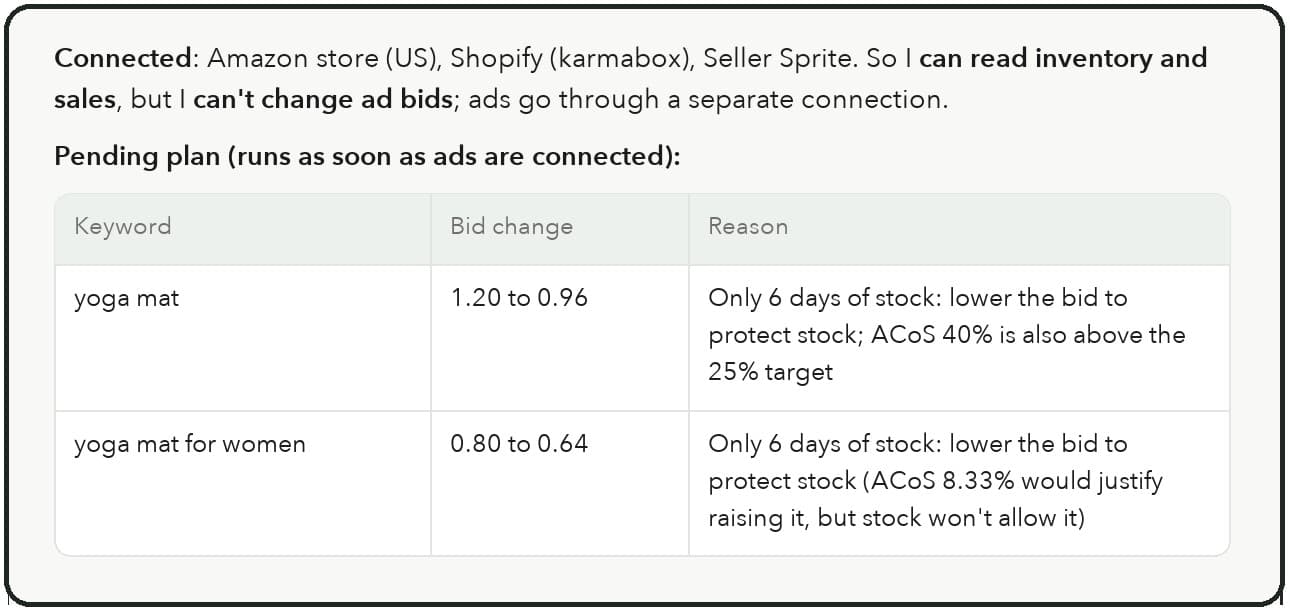
Figure 5. A cropped interface card (not a full page) from a full run recorded on November 15, 2026: with the ads data source not connected, the avatar produces a pending plan instead of acting on invented numbers.
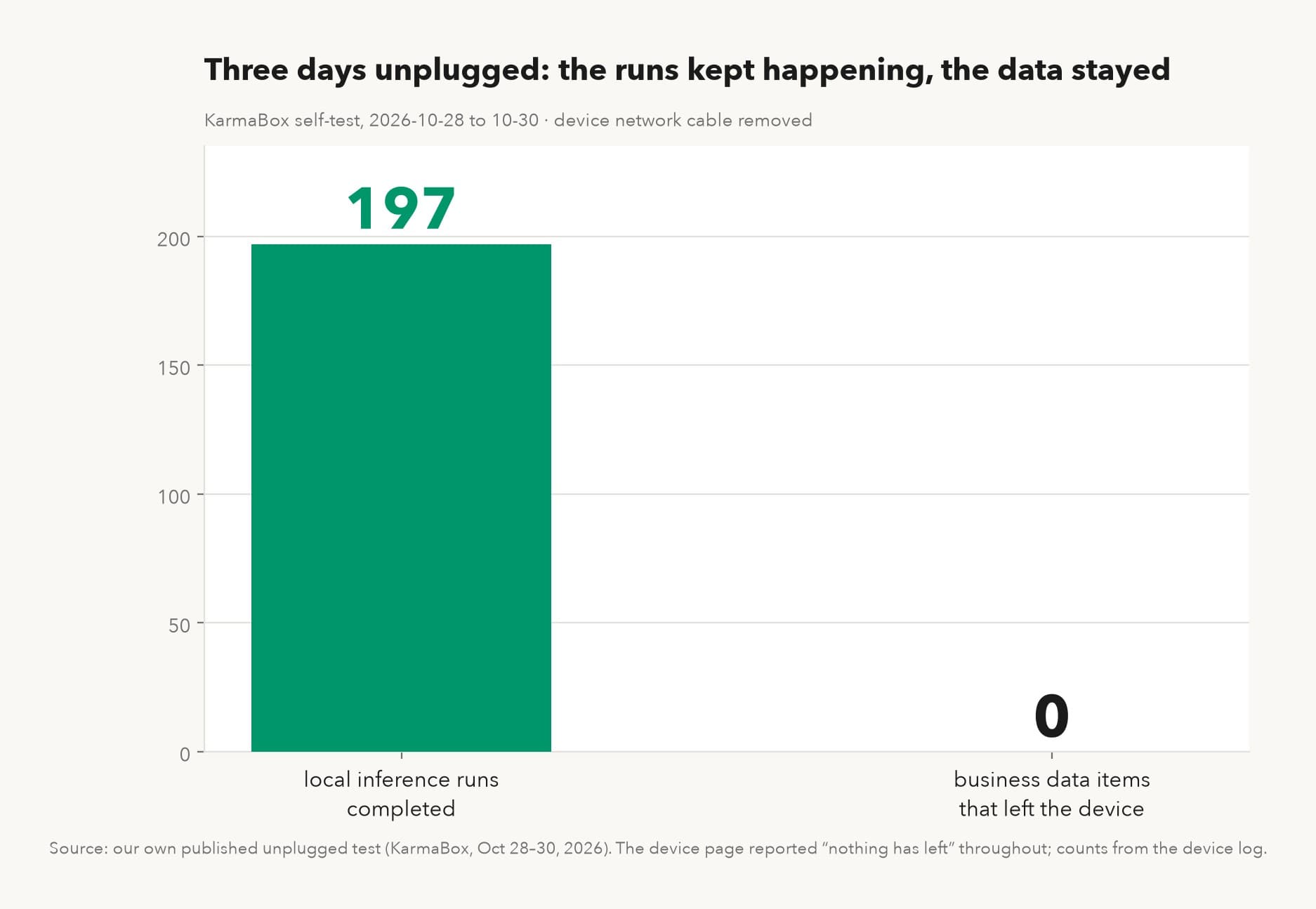
Figure 6. Three days unplugged: the runs kept happening, the data stayed. Source: our own published unplugged test (KarmaBox, Oct 28–30, 2026); the device page reported "nothing has left" throughout, counts from the device log.
All six rows follow one rule: the thing you rely on sits on your side of the fence, and the cases where it reaches across (a cloud model, a data source) are explicit, logged, and gated by a boundary enforced outside the model, so the rule holds no matter which model is running. Running a self-hosted AI agent is the same decision one layer up, and sovereign AI is the name for making the whole column consistent, from the hardware to the memory file. Two of the six criteria for a sovereign AI avatar are the ones upstream risk tests directly: it keeps working offline, and its assets belong to its owner.
08What holding copies does not solve
Custody of copies addresses upstream risk. It does not address three neighboring problems, and pretending otherwise would oversell the method.
It does not maintain the code. A mirror of an abandoned project is a snapshot, not a successor; security fixes stop arriving whether or not you hold the history. If the ONNX repository stays dark, the community's problem next month is not access to old commits, it is who reviews new CVEs. Holding copies buys you time to choose a successor calmly instead of at gunpoint. It does not remove the need to choose. What it changes is the clock: with a full mirror, the choice can wait for the dust to settle, instead of being made in the week the pipelines are red.
It does not vet the code. A perfect mirror of a compromised upstream is a perfect copy of the compromise. Provenance and review are a separate discipline, and the backdoor research cited above makes the point on its own: a copy inherits whatever was in the original, reviewed or not.
And it does not cover the services that were never code to begin with: the hosted APIs, the login that walks through someone else's identity provider, the data sources you query per-call. Those are availability and exit problems, with their own pages and their own playbooks, and a disk full of mirrors does nothing for any of them.
Name the risk you are buying down (upstream disappearance) and buy down the others separately.
09Frequently asked questions
Is onnxruntime still on PyPI?
Yes. As of November 18, the PyPI package, the documentation site, and the NuGet packages all remain available; what disappeared is the GitHub source repository, its release assets, and its issue history. Teams consuming only pinned registry packages were not directly affected.
What is upstream risk in an AI stack?
Upstream risk is the chance that a repository, model weight, or artifact source your work depends on goes offline with no notice, no export window, and no copy on your side. It differs from outage risk (the service returns) and exit risk (you get a notice period and an export path).
Does an open-source license guarantee the code stays available?
No. A license grants rights to copies of the code; it makes no promise that any particular server will keep serving it. Hosting platforms' terms generally allow content removal at any time. The copies you hold are yours; the URL never was.
What is the difference between vendoring and forking?
Vendoring copies a dependency's code into your own repository so your build no longer fetches it at all. Forking creates your own hosted copy that you may also maintain and change. Vendoring is about build independence; forking is about control of future development. For upstream risk alone, a mirror or vendored copy is enough.
How big is the mirror a small team actually needs?
Typically under half a terabyte: full-history clones of the repositories your builds reference directly, the release assets you pin, and the model weights you serve (these dominate the total). Transitive registry packages usually do not need mirroring. A ten-person team's setup is roughly one engineer-day plus a scheduled refresh job.
Before we build on an open-source AI runtime, what should we mirror?
At minimum: the full source history, the release artifacts at your pinned versions, the exact weight files you serve, and enough documentation to operate for six months without the project's website. Ask the question in design review, before adoption; the copies are cheap while the upstream is alive and unobtainable after it is gone.
10About the author
Karma Box Team publishes practical guides on AI sovereignty, workspace control, and vendor evaluation. This article separates verified fact from analysis: repository and registry availability were checked directly; community reports are attributed to their threads; cost figures are worked examples with stated assumptions, not benchmarks. KarmaBox-related content is confined to its own section. News facts and availability checks dated November 18, 2026.