
A landlord sends over the lease for a new storefront. The owner asks the "Legal Eye · Contracts" avatar to check it for traps, attaching the file directly. Sent at 09:30 — by 09:41 the avatar reports back: fully reviewed, 3 high-risk clauses, 4 medium-risk.
Before
- Read contract clauses one by one in Word, highlight risk items
- Log key terms and risk levels across contracts in Excel tracker
- Use Beyond Compare to diff current vs. previous contract versions
- Email review opinions to business teams and follow up on revisions
After
- Instant full-text parsing, auto-flag 30+ risk categories with fix suggestions
- Produce a redline you can accept directly, not a vague suggestion
- Every edit cites a verified statute; anything unverifiable is flagged honestly

Not a suggestion — an edit you can accept
Clause 9.1 on late payment: the original charges 5% of monthly rent per day of delay. The avatar rewrites it to 0.05% of the overdue amount per day, with the note: 5% daily compounds to over 1800% annualized — clearly excessive and challengeable in court — citing Civil Code Article 585, verified. Clause 9.2 originally let only the landlord terminate at will; the avatar rewrites it to require 60 days' written notice from either party, with compensation if the landlord terminates without cause, citing Article 563, verified. Clause 9.3 on fit-out ownership gets a suggested split between movable and fixed improvements — but this one is honestly flagged "local rules — unverified", not dressed up as checked.
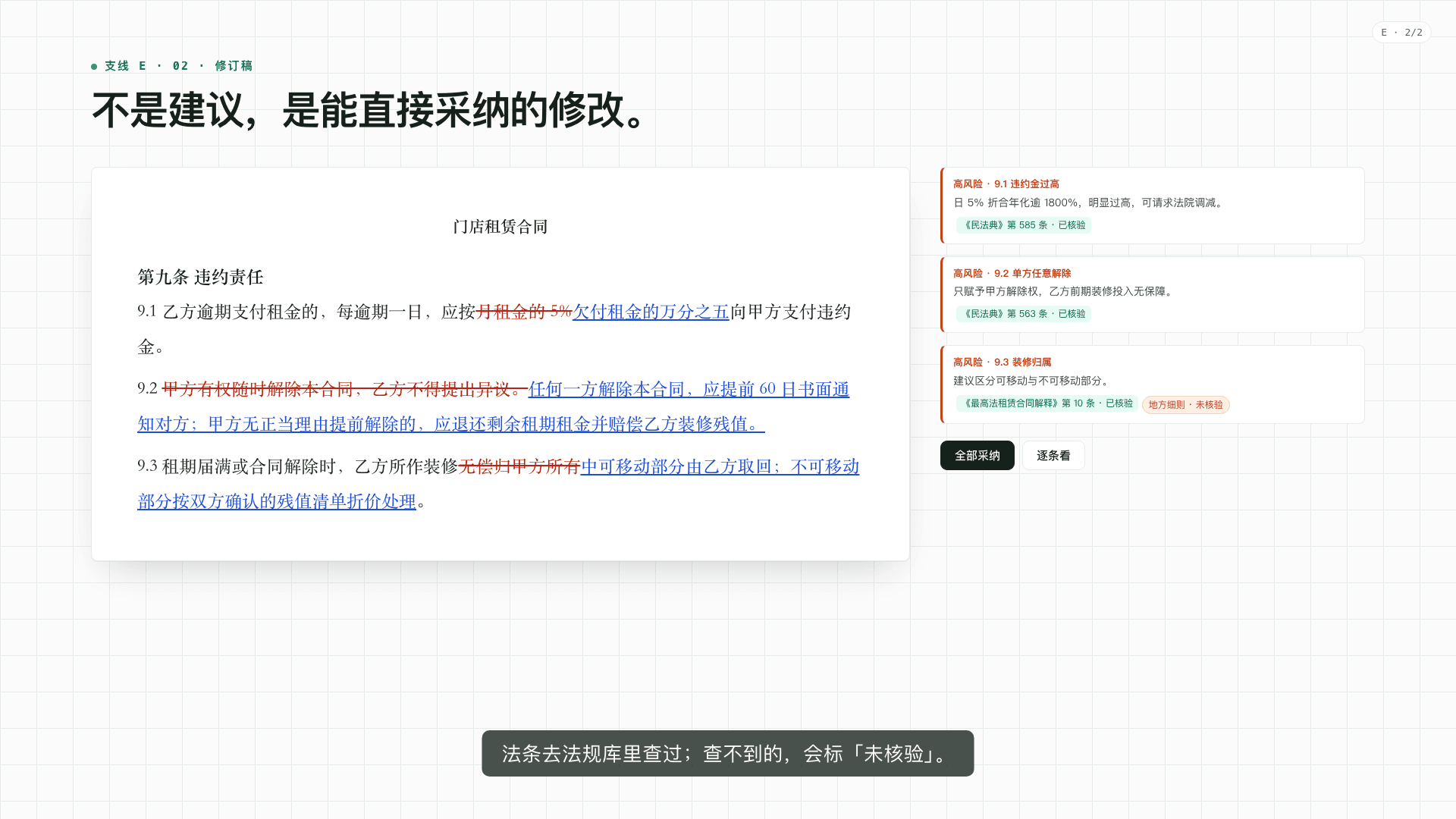
High-risk items surface first; original text above, revision below; statutes are checked against a legal database — anything that can't be verified is labeled as such.
What a contract-review avatar is actually doing
It isn't "paraphrasing" the contract in its own words. It's doing three specific things: decomposing the full text into independently assessable clause units, assigning a risk level to each with a stated reason (not a vague "this looks risky"), and producing an actual redlined revision for clauses that can be fixed — not stopping at "you may want to review this." All three together are what make an 11-minute full review possible. A generic chat tool can do the first step, most can do the second — but the third, a redline you can accept directly with statute citations, requires legal-database lookup and document-formatting fidelity that a general-purpose model doesn't have by default. It has to be built in specifically.
Three boundaries that decide whether it can be trusted
Boundary one: statute citations must be verifiable, and "can't verify" has to be said outright. The most dangerous failure mode in contract review isn't missing a risk — it's fabricating an authoritative-sounding statute to back up a suggested edit, which is worse than giving no citation at all because it looks more credible. The Legal Eye avatar checks every citation against an actual legal database and labels anything it can't verify as such, rather than glossing over it. Boundary two: it drafts the redline, it doesn't decide. A redlined revision is a draft, not a binding text — whether to accept it, whether to renegotiate with the other party, whether a lawyer should review it again, stays a human decision. Boundary three: confidential contracts never leave the machine. Contract text often carries sensitive information — rent figures, equity structure, client lists — and the review can run entirely on a local Karma Box without routing sensitive text through a cloud model.
How to put it into an actual contract-review workflow
1. Calibrate against contracts you've already reviewed. Feed it a handful of contracts your team has already reviewed manually with a known conclusion, and compare its risk ratings and citations against the human conclusion — this surfaces systematic bias far more reliably than testing fresh, unreviewed contracts. 2. Start it as first-pass, not final sign-off. Let it own the first full read and risk triage, and concentrate human attention on the clauses it flags high-risk — rather than letting its conclusion take effect directly. 3. Build a checklist for "unverified" clauses. Local regulations, industry custom, a specific court's tendencies — this kind of content often isn't in a statute database at all. Agree in advance that these get routed to a licensed lawyer for review, rather than letting the avatar offer an uncertain guess. 4. Spot-check citation accuracy on a schedule. Statutes get amended or repealed — a periodic spot-check catches a stale citation before it ends up in front of the other party at the negotiation table, not after.
How to measure whether it's actually reducing risk
Don't just track "review got faster." Track: recall on high-risk clauses (did it miss anything a human review would have caught — this needs periodic backtesting against contracts with a known outcome); the rate of "unverified" labels (a suspiciously low rate is itself a warning sign — it may mean the search scope doesn't reach local regulations, not that everything was actually verified); acceptance rate (what share of redlined revisions get accepted as-is without a lawyer's major rewrite — a low rate means it doesn't yet understand this contract type or clause well enough); and, once it reaches the actual negotiation table, how the other party responds to the proposed edits.
Common mistakes
The most common mistake is equating "a verified statute" with "this suggestion is definitely correct" — the statute genuinely exists, but whether it applies to this contract's specific situation still needs professional judgment. Verification solves "was this fabricated," not "was this applied correctly." A second mistake is treating the "unverified" label as a system flaw rather than an important signal — that's exactly the part that most needs a human to step in. A third is letting the avatar send the redline straight to the other party, skipping internal sign-off — sending anything externally should always be a deliberate human decision, never an automatic next step after review finishes.
Frequently asked questions
Can it review English contracts or ones under a different legal jurisdiction? Citation ability depends on the coverage of the connected statute database. For cross-jurisdiction contracts, confirm the database covers the target jurisdiction first — an uncovered jurisdiction should be treated entirely as "unverified," not patched with citations from a different jurisdiction. Does it use contract content to train a model? Review can run entirely on a local Karma Box — the original contract text never leaves that machine and is never used as training data for any external model. What if its conclusion disagrees with a human lawyer's opinion? The human lawyer's professional judgment governs. The avatar's output is a tool to speed up first-pass review and reduce the chance of missing something — it is not a substitute for a practicing lawyer's legal opinion.
How one team actually adopted it
A 6-location restaurant chain where legal review had always been the founder's own side job, done alone. The first two weeks after adopting the Legal Eye avatar, the founder did exactly one thing: fed it 12 lease and supplier contracts signed over the past two years whose clause details were still fresh in memory, and checked the avatar's risk ratings against their own past judgment clause by clause. The result: it was accurate on penalty and termination clauses, but flagged "unverified" three times on fit-out-ownership clauses — a category that leans heavily on local custom, and, tellingly, the exact area the founder hadn't been fully sure about either until a lawyer friend helped sort it out back then. Once that boundary was confirmed, lease review during the next round of new-store expansion switched to "avatar reviews first, founder only reads the high-risk and unverified clauses" — a contract that used to take two hours to read in full now takes ten minutes to know exactly which clauses deserve attention. Supplier-contract review copied the same pattern rather than inventing a separate process.
Before using the contract-review avatar in an actual external negotiation, calibrate it first against a batch of historical contracts with known conclusions — confirm risk-detection recall and citation accuracy meet a level your team is comfortable with, then expand gradually to new contracts and new contract types.