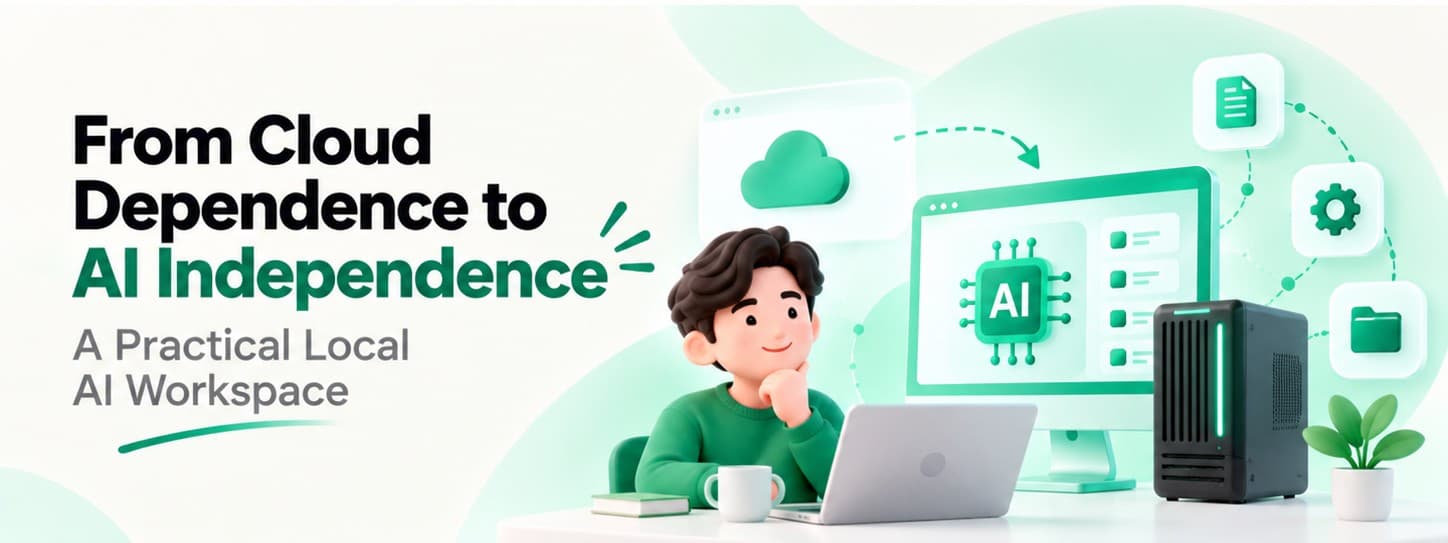
A lot of personal and team AI workflows slide into full cloud dependence without anyone quite deciding to. First a cloud tool drafts a document, then it analyzes some data, then project memory starts living there too, and a few months later, every piece of critical work sits on a platform you can't audit, can't export from, and have no say over the pricing of. It's rarely one bad decision, it's a string of convenient ones stacking up. Building AI independence means walking that process back in reverse.
Lock-in doesn't happen suddenly, it accumulates
The telltale signs of cloud lock-in are familiar once you look for them. Your project memory and conversation history live only on the vendor's servers with no export path. Your workflow depends heavily on a feature unique to one platform, so switching tools means rebuilding from scratch. You have no real idea whether that platform uses your data to train its next model. None of these looks alarming in isolation, but stacked together, they mean that the moment a vendor raises prices, throttles access, changes its terms, or simply kills a feature, you have almost no fallback and just have to absorb it.
Three questions quickly surface over-dependence: can your data be exported, can the workflow run on a different platform, and can the task keep moving if the network goes down. If even one answer is no, lock-in risk is already real.
What a local-first workspace actually looks like
Local-first doesn't mean giving up cloud capability. It means setting the default path to local. Organizing private files, drafting routine content, retrieving from a knowledge base, these get handled by a local model first, so nothing leaves the device. When a task genuinely needs a cloud model's stronger reasoning or wider coverage, only the minimum, pre-cleared information gets sent out, and a person reviews the result before it comes back into the local workspace. Under this architecture, the cloud becomes capability called on demand, not the only default path, which means workflow continuity stays in your own hands rather than depending on whether one vendor's service happens to be up.
A portable workflow matters more than the single strongest model
When choosing an AI tool, most people's first instinct is to compare which model is most capable, and rarely ask whether their workflow could keep running if they had to switch tools today. A genuinely portable workflow means your prompts, task instructions, and project memory are stored in a format you yourself can access and export, rather than locked into one vendor's proprietary format. Even if you decide to switch models or platforms someday, the work you've accumulated still belongs to you and doesn't need to be rebuilt from scratch.
Where KarmaBox fits on this path
KarmaBox's design is aimed precisely at reducing this kind of single-cloud lock-in. It supports local Llama and Qwen models while keeping the flexibility to connect to cloud APIs, and the workspace itself is built around portability and cross-device collaboration. That doesn't mean using KarmaBox automatically grants AI independence, it means the local-first, cloud-on-demand, workflow-portable architecture comes built into the product's default shape, saving users the engineering cost of building an inference environment from scratch themselves. In practice, it's still worth validating model performance, data handling, and permission settings against your own task, especially anything touching sensitive information.
Reducing dependence is gradual, not a one-time migration
Moving from cloud dependence to AI independence doesn't need to, and shouldn't, happen as one sweeping migration. The more realistic path is migrating one low-risk, high-frequency task category to a local-first approach first, validating output quality, response time, and the actual time saved, then expanding once it's proven stable. Alongside that, keep a simple running list: which task depends on which model, which data must never leave local, how long it would take to get running again on a different platform. That list is itself the most concrete expression of independence. You can actually state the dependencies out loud, instead of discovering at the exact moment a vendor has a problem that you never really had those answers.