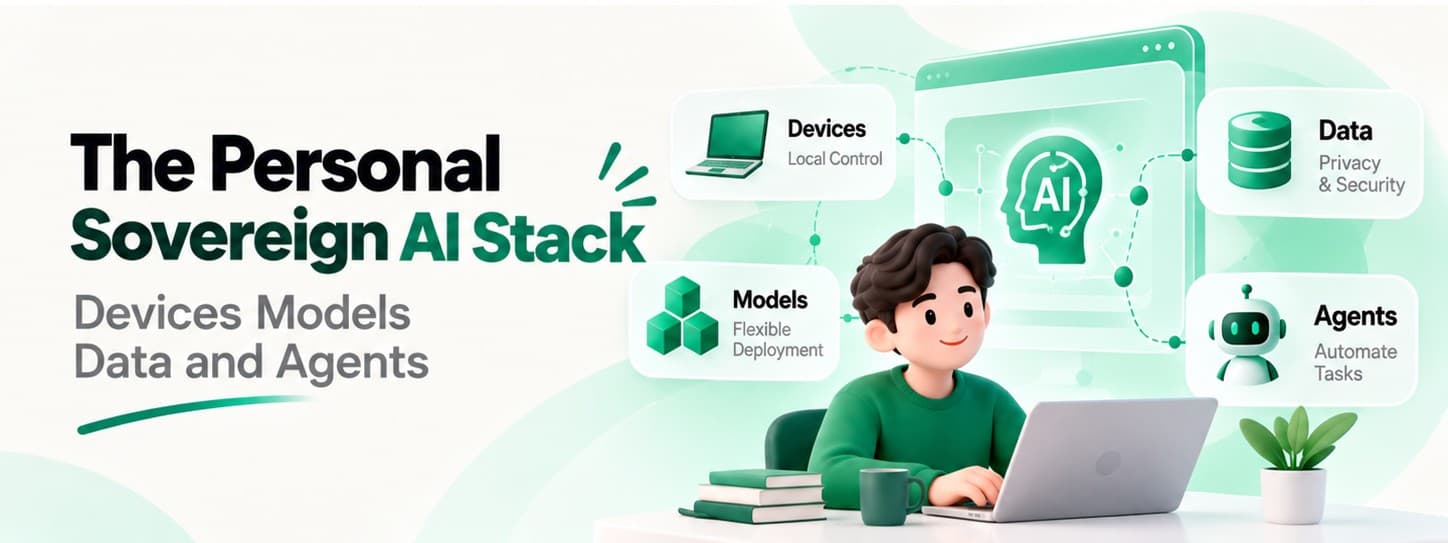
A sovereign AI stack sounds like something only a dedicated infrastructure team could build, but for an individual or small team, it actually breaks down into five concrete layers: devices and compute, data and memory, models and skills, agents and applications, and governance and accountability. Each layer maps to a specific question you can evaluate and tune on its own, rather than one vague worry about whether your AI setup is safe enough.
Layer one: devices and compute, where the task actually runs
This layer asks the most basic question: when you send a request, where does the computation actually happen? On your own laptop or phone, or on a remote server you know nothing about? Local compute means responses don't depend on a network connection and data never has to leave the device. Cloud compute buys more processing power, but in exchange, hands over whether the task can continue at all to whether the other side's service happens to be running. The realistic choice for a personal stack is usually both: routine, repetitive, private tasks stay local, and tasks that genuinely need extra horsepower call on the cloud as needed.
Layer two: data and memory, what's retained, by whom, for how long
This layer concerns where your prompts, uploaded files, conversation history, and long-term memory actually live, how long they're kept, and who can access them. A common misconception is that as long as data sits in a given region, it's secure. But full data sovereignty also covers whether that data trains the next model version, whether backups sit in a different environment entirely, how much access administrators actually have, and whether a single deletion request genuinely propagates through the retrieval index, the logs, and every backup.
Devices and compute, data and memory, models and skills, agents and applications, governance and accountability. These five layers together make up a personal sovereign AI stack. Skip evaluating any one of them and you leave an invisible risk exposure behind.
Layer three: models and skills, which model, and where its limits sit
This layer requires a clear answer to a few things. Is the current task running on an open-weight model or a closed cloud one? Would the workflow break outright if you swapped models? How does this model actually perform on Chinese or the specialized terminology in your industry? Open-source and open-weight models offer more deployment flexibility and auditability, but openness itself doesn't equal safety or production-readiness. Sovereignty at the model layer really comes down to whether you have a basic grasp of the model's capability boundary, training-data transparency, and known limitations, instead of letting the model's reputation make that judgment call for you.
Layer four: agents and applications, who's authorized to do what
This layer is about an agent's permission boundary: which files it can read, which systems it can write to, whether it can publish content or initiate a payment without human confirmation. A common mistake is granting an agent far more access than the task actually requires, which feels more convenient in the short term but makes diagnosing and containing a failure dramatically harder once something goes wrong. The sturdier approach is spelling out exactly which actions an agent can complete autonomously, and which ones, publishing externally, signing a commitment, moving money, must stay the responsibility of a specific named person.
Layer five: governance and accountability, who's responsible when it breaks, and how you recover
The last layer asks whether the entire stack can keep functioning after something goes wrong. What happens if model performance degrades, a device goes offline, permissions get revoked unexpectedly, or a cloud API changes. The governance layer means having a manual fallback ready ahead of time and actually testing these failure scenarios on a regular basis, rather than assuming the system will just keep running smoothly. Owning a lot of tools doesn't automatically buy resilience. Real resilience comes from being able to clearly explain how work continues after a disruption. Walk through all five layers and sovereign AI stops being an abstract concept and becomes five checklists you can actually tick off one at a time. A workspace like KarmaBox tries to pre-build those five layers at the product level, but the final verification, and the responsibility, still rests with the person using it.