
A small company's workload, laid flat, really does come down to a handful of things: finding customers, handling them, minding the shop, managing purchasing, tracking projects, doing the books, reviewing contracts, writing code, making content.
In the past you either had your own people cover these on the side, or cobbled together a pile of tools. Now there's another option: split the work into 19 roles, and put an AI avatar in each one. It's there the day you sign up — no setup, no learning.
1. The numbers first
Open Karma, and the built-in-avatar layer comes down to four numbers.
19 built-in avatars, included the moment you sign up, on every account. There's no "only on the premium tier."
7 job categories, organized not by technical type but by how a small company actually divides labor — growth, steward, helm, ledger, law, forge, studio.
60 playbooks — the part that's easiest to overlook. A playbook isn't a prompt template; it's a written-down procedure for how a task should be done, step by step. Each avatar only has the handful that belong to its own role — it can't see anyone else's.
241 beacon test cases — the standard question bank used for ongoing regression testing. Every time a model or a playbook changes, all 241 run again to confirm nothing regressed.
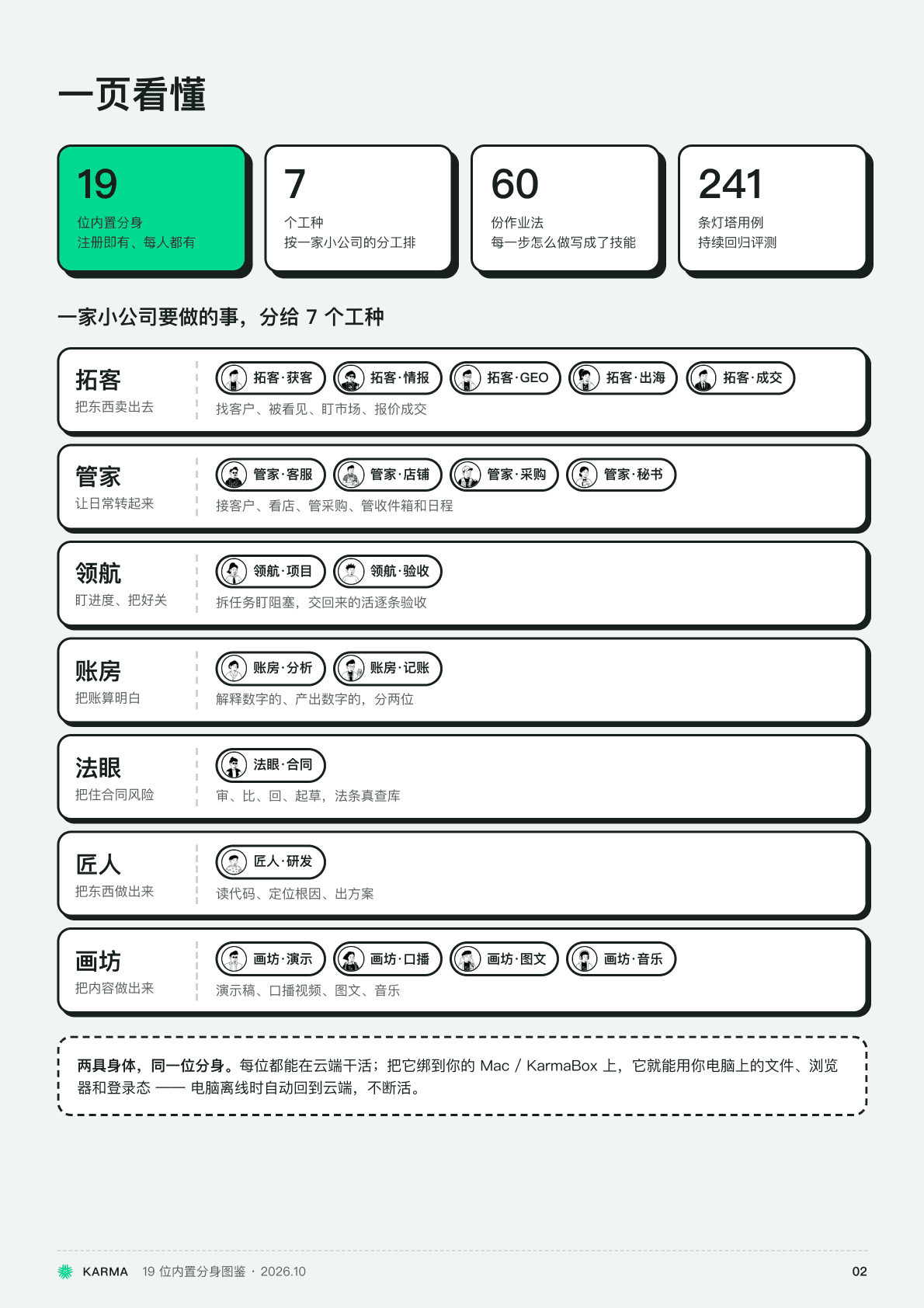
Of these four numbers, the one that actually shapes the experience is the second — job-role division. Most people's disappointment with "AI assistants" isn't that the model isn't smart enough, it's that it wears one face for everything. In the same chat box, one line is reviewing your contract, the next is writing your social post, the next is calculating your margin. Its tone, its caution, what it's allowed to touch — all identical, no matter the job.
Karma does the opposite: fix the roles first, then let each role do only what belongs to that role.
2. Seven job categories, each covering its own stretch
Growth — getting things sold. Five avatars: Acquisition, Intel, GEO, Expansion, Sales. Finding customers, getting seen, watching the market, quoting and closing — one continuous chain, split into five segments, each with its own owner.
Steward — keeping the day-to-day turning. Four avatars: Care, Shop, Buyer, Secretary. Handling customers, minding the shop, managing purchasing, running the inbox and calendar — the kind of work that causes chaos if skipped but earns no applause when done.
Helm — tracking progress, holding the line. Two avatars: Project, Reviewer. One breaks down tasks and watches for blockers; the other checks finished work item by item. The reason they're split is simple: whoever did the work shouldn't be the one who grades it.
Ledger — making sense of the numbers. Two avatars: Analyst, Bookkeeper. The one who explains the numbers and the one who produces them are two different people. The former only reads, never writes; the latter writes, but only with your approval.
Law — guarding contract risk. One avatar: Counsel. It reviews, compares, responds, and drafts. It actually checks statutes against a regulatory database — and if it can't find one, it writes "unverified" rather than guessing.
Forge — building the thing. One avatar: Dev. It reads code, locates root causes, and proposes solutions. Bind it to your Mac and it can actually run commands, edit code, and spin up a preview.
Studio — producing the content. Four avatars: Deck, Shortform, Social, Music. Decks, voiceover videos, social posts and articles, songs — it ships the finished piece; whether it goes out is your call.
3. How to call one in
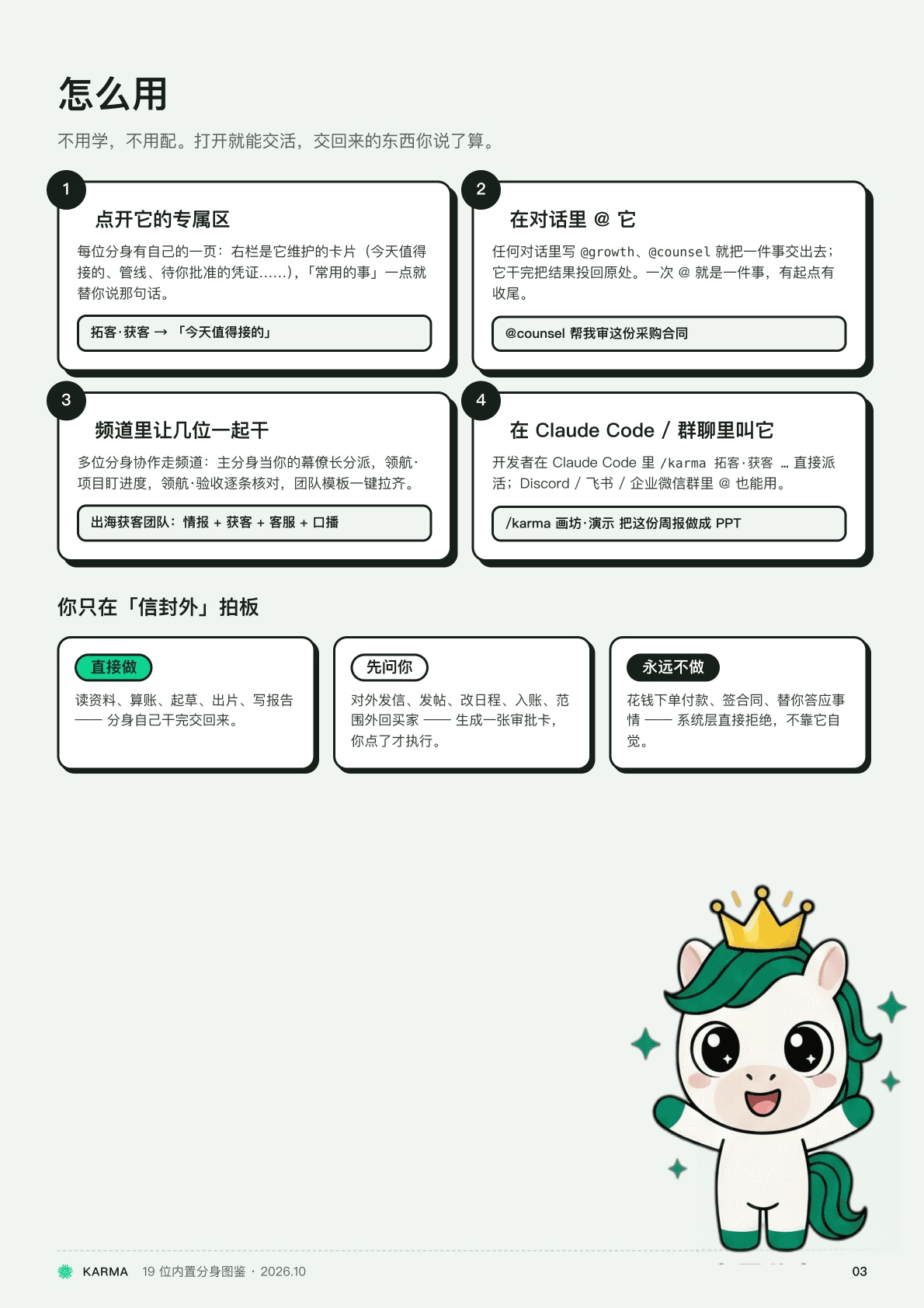
No learning, no setup. Four ways to invoke one, pick by situation.
@ mention it in chat. Write @growth, @counsel, or @analyst in any conversation and the task is handed off, with the result dropped back where you asked. Every @ is one task with a start and an end — unlike ordinary chat, it doesn't drift on forever. For example: "@counsel review this purchase agreement for me."
Open its dedicated page. Every avatar has its own page, with a right-hand rail of cards it maintains itself — today's worthwhile leads, the quote pipeline, vouchers waiting on your approval — plus a row of common actions below that speak the request for you with one click. On the Growth avatar's page, the first card is literally titled "Worth following up on today."
Get several working together in a channel. Multi-avatar collaboration runs through channels: a lead avatar acts as your chief of staff and dispatches, Project tracks progress, Reviewer checks line by line, and a team template assembles the group in one click. The "overseas growth team" template, for instance, bundles Intel, Acquisition, Care, and Shortform into one group of four.
Call it from Claude Code or a group chat. Developers can dispatch directly from Claude Code with /karma Growth·Acquisition; @ mentions also work inside Discord, Feishu, and WeCom groups. For example: "/karma Studio·Deck turn this weekly report into a slide deck."
4. What you actually sign off on
This is the part of the design most worth explaining. Karma splits every avatar action into three tiers, written into the system itself — not left to the avatar's own judgment.
Do directly — the avatar finishes it and hands it back. Reading material, running numbers, drafting, producing a finished piece, writing reports. None of this needs you present.
Ask first — it generates an approval card, and nothing runs until you click it. Sending a message externally, posting, changing a calendar, posting an entry to the books, replying to a buyer outside its scope. The avatar lays out what it wants to do, who it's going to, and what it says — it doesn't move until you click.
Never — refused at the system level. Spending money, placing orders, paying, signing contracts, making promises on your behalf. These three aren't "prompted against" — the capability simply doesn't exist at the system layer.
In plain language: you only make the call on what's "outside the envelope." Inside the envelope — organizing, calculating, drafting, checking, producing — is the avatar's job, done on its own. Outside the envelope — speaking externally, spending money, making promises — requires your own hand on the button.
5. Seven job categories, 19 avatars, one by one
Here's a walk through all 19, grouped by job category. Each one covers four things: what it can do, what it hands back, what it won't do, and how you might phrase a request.
Growth — getting things sold
Finding customers, getting AI to remember you, watching the market, making overseas content — each covering its own stretch.
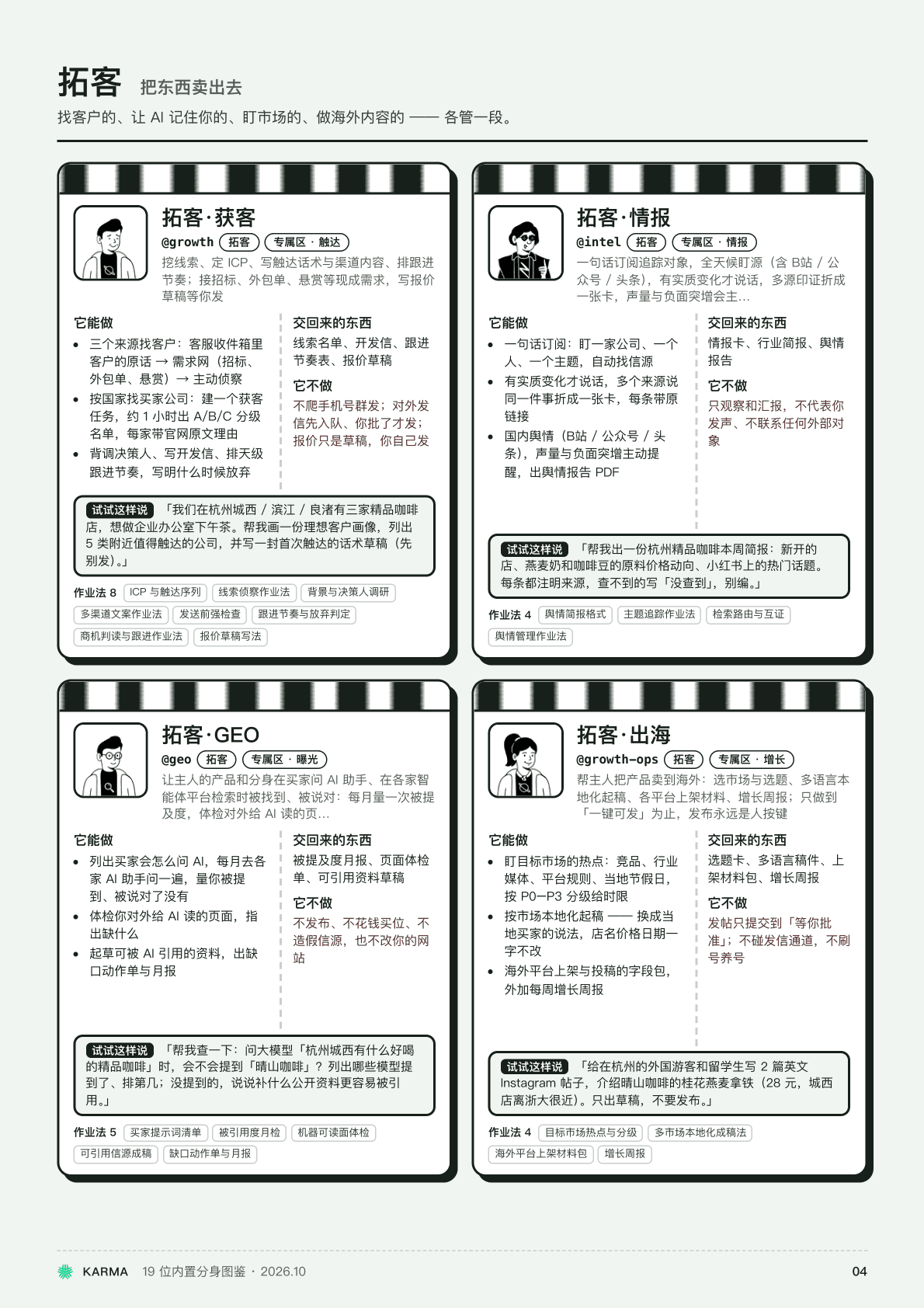
Growth·Acquisition @growth Dedicated zone: Outreach 8 playbooks: ICP and outreach sequencing, lead scouting, background and decision-maker research, multi-channel copywriting, pre-send verification, follow-up cadence and give-up criteria, deal-signal triage, quote drafting.
It does three things. First, it sources customers from three places: a customer's own words sitting in the support inbox, ready-made demand already posted online (tenders, outsourcing listings, bounties), and its own active scouting. Second, it finds buyer companies by country — spin up an acquisition task and get an A/B/C-graded list in about an hour, each company backed by a reason quoted straight from its own website, not a guess. Third, it researches decision-makers, writes outreach letters, lays out a day-by-day follow-up cadence, and spells out exactly when to give up.
What it hands back: a lead list, outreach letters, a follow-up cadence sheet, a quote draft. What it won't do: it doesn't scrape phone numbers and mass-blast; outbound letters queue for your approval before sending; a quote is only ever a draft — sending it is on you.
"We run three specialty coffee shops in Hangzhou — Chengxi, Binjiang, and Liangzhu — and want to sell afternoon-tea service to office clients. Draw up an ideal-customer profile, list 5 categories of nearby companies worth reaching out to, and draft a first-touch message (don't send it yet)."
Growth·Intel @intel Dedicated zone: Intelligence 4 playbooks: sentiment briefing format, topic tracking, search routing and cross-verification, sentiment management.
Subscribe to a tracking target in one sentence and it watches sources around the clock, including Bilibili, WeChat official accounts, and Toutiao. Its core discipline is speaking only when something materially changes — not a daily digest stuffed into your inbox regardless. Multiple sources covering the same thing fold into one card, each with its original link. A sudden spike in volume or negative sentiment triggers a proactive alert, and it produces a PDF sentiment report.
What it hands back: intel cards, industry briefings, sentiment reports. What it won't do: it only observes and reports — it never speaks on your behalf, and never contacts anyone externally.
"Give me this week's briefing on specialty coffee in Hangzhou: new shop openings, oat-milk and coffee-bean price movements, and trending topics on social media. Cite a source for every item, and write 'not found' for anything you can't verify — don't make it up."
Growth·GEO @geo Dedicated zone: Visibility 5 playbooks: buyer-prompt checklist, monthly citation audit, machine-readability check, citable-source drafting, gap action list and monthly report.
GEO only became a buzzword this year, but the problem it solves is concrete: when a buyer asks an AI assistant "what's good nearby," do you get mentioned, and is it accurate? Its approach makes this measurable — it lists out how buyers phrase that question to AI, runs it against every major AI assistant monthly, and quantifies whether you're mentioned, where you rank, and whether anything is wrong. It also audits the pages you expose for AI to read, and flags what's missing. Finally, it drafts citable material and produces a gap action list plus a monthly report.
What it hands back: a monthly mention-rate report, a page health checklist, draft citable material. What it won't do: it doesn't publish, doesn't pay for placement, doesn't fabricate sources, and doesn't edit your website.
"Check this for me: when you ask a large model 'what's good specialty coffee in Chengxi, Hangzhou,' does it mention 'Qingshan Coffee'? List which models mention it and where it ranks; for the ones that don't, suggest what public material would make it more likely to get cited."
Growth·Expansion @growth-ops Dedicated zone: Growth 4 playbooks: target-market hotspot tracking and tiering, multi-market localization drafting, overseas platform listing material packs, weekly growth report.
It watches target-market hotspots — competitors, trade media, platform rule changes, local holidays — grading each P0 through P3 with a deadline. It drafts localized copy per market under one rule: rephrase for how local buyers actually talk, but never touch the shop name, price, or date. It also supplies field-ready packs for overseas platform listings and submissions, plus a weekly growth report. Its own self-imposed limit is deliberately narrow: it only goes as far as "ready to publish with one click."
What it hands back: topic cards, multilingual copy, listing material packs, weekly growth reports. What it won't do: posts only ever go as far as "awaiting your approval"; it never touches messaging channels, and never farms or manipulates accounts.
"Write 2 English Instagram posts for foreign tourists and international students in Hangzhou, introducing Qingshan Coffee's osmanthus oat latte (28 RMB, Chengxi location near Zhejiang University). Drafts only, don't publish."
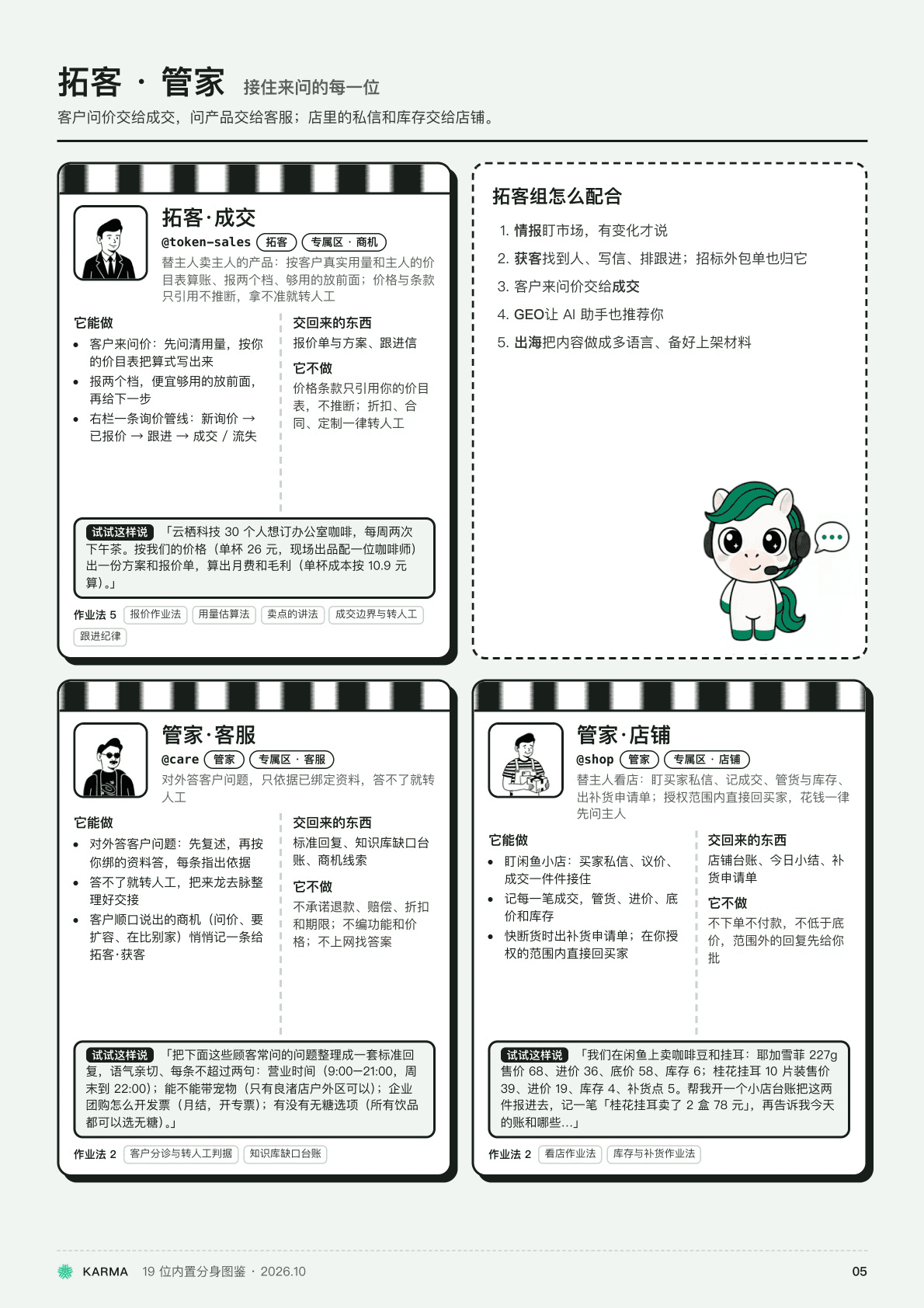
Growth·Sales @token-sales Dedicated zone: Deals 5 playbooks: quoting, usage estimation, pitching the value, deal boundaries and handoff to a human, follow-up discipline.
When a customer asks for a price, its first move is to pin down usage, then write out the actual math against your price sheet — never a vague "around this much." It quotes two tiers, leading with whichever one is cheap-but-sufficient, then proposes the next step. Its side rail maintains a live deal pipeline: new inquiry → quoted → following up → closed / lost.
What it hands back: a quote with a proposal, follow-up letters. What it won't do: prices and terms are only ever quoted from your price sheet, never inferred; discounts, contracts, and custom deals all hand off to a human.
"Yunqi Tech, 30 people, wants to order office coffee — afternoon tea twice a week. Using our pricing (26 RMB per cup, on-site service with a barista), put together a proposal and a quote, and work out the monthly fee and margin (cost per cup is 10.9 RMB)."
How the Growth team works together: the handoff order is fixed. Intel watches the market and only speaks up when something changes; Acquisition finds the people, writes the letters, and sets the follow-up cadence (tenders and outsourcing listings fall to it too); when a customer asks about price, it goes to Sales; GEO gets AI assistants recommending you too; Expansion turns content multilingual and preps listing materials. In one line: Intel senses at the front end, Acquisition pulls the thread to a person, Sales pulls the thread to money, GEO manages the new AI channel, and Expansion handles language and platforms.
Steward — keeping the day-to-day turning
A price question goes to Sales, a product question goes to Care; a shop's DMs and inventory go to Shop.
Four avatars: Care, Shop, Buyer, Secretary.
Steward·Care @care Dedicated zone: Support 2 playbooks: customer triage and human-handoff criteria, knowledge-gap ledger.
It answers customer questions only from material that's already been bound to it, citing the source for every answer. When it can't answer, it hands off to a human with the full context organized — not just a shrug of "I don't know." One neat design: when a customer casually mentions a sales signal — asking about price, wanting to scale up, comparing you to a competitor — it quietly logs a note for Growth·Acquisition. Care never pitches, but no lead gets lost.
What it hands back: standard replies, a knowledge-gap ledger, sales leads. What it won't do: it never promises refunds, compensation, discounts, or deadlines; never invents features or prices; never searches the open web for an answer.
"Turn these frequently asked questions into a set of standard replies, friendly tone, no more than two sentences each: business hours (9:00–21:00, until 22:00 on weekends); pets allowed (only the outdoor area at the Liangzhu location); invoicing for corporate bulk orders (monthly settlement, VAT invoice); sugar-free options (available on every drink)."
Steward·Shop @shop Dedicated zone: Shop 2 playbooks: storefront monitoring, inventory and restocking.
It watches a secondhand-marketplace storefront: catching every buyer DM, negotiation, and sale as it comes in; logging every transaction and tracking stock, cost price, floor price, and inventory; issuing a restock request when something's about to run out. It replies directly to buyers within whatever scope you've authorized, but anything involving spending always asks the owner first.
What it hands back: a shop ledger, a daily summary, restock requests. What it won't do: it never places orders or pays, never negotiates below the floor price, and anything outside its authorized scope waits for your approval first.
"We sell coffee beans and drip bags on a secondhand marketplace: Yirgacheffe 227g sells for 68, costs 36, floor price 58, stock 6; osmanthus drip bags, 10-pack, sells for 39, costs 19, stock 4, restock point 5. Set up a shop ledger with these two items, log a sale of '2 boxes of osmanthus drip bags, 78 RMB,' then tell me today's totals and what needs restocking."
Steward·Buyer @buyer Dedicated zone: Procurement 3 playbooks: inventory and restock points, supplier sourcing and background checks, price inquiry and comparison.
It watches inventory and calculates restock points against one standard: hold until the next delivery arrives. It sources suppliers and runs background checks — business registry, sanctions lists — and for cross-border orders, works out tariffs and landed cost. Finally, it compares three suppliers' quotes by total landed cost and produces a purchase request.
What it hands back: a price comparison table, supplier background checks, a purchase request. What it won't do: it never places orders, never pays, never signs contracts; inquiry letters go out only after you've seen them first.
"We have 18 cases of oat milk left, the three shops use 4 cases a day combined, and delivery takes 5 days. Work out when to restock and how much, then find two suppliers and compare their landed prices."
Steward·Secretary @secretary Dedicated zone: Secretary 3 playbooks: inbox triage, meeting scheduling, meeting minutes.
It sorts the inbox into four tiers and drafts replies for you; when scheduling a meeting, it offers three candidate times with time zones converted automatically; meeting minutes spell out conclusions, decisions, and exactly who does what by when, with reminders when the deadline nears.
What it hands back: reply drafts, scheduling candidates, meeting minutes and to-dos. What it won't do: every letter and every schedule change asks you first; it never makes a promise on your behalf, and never discusses money.
"Look at today's inbox and sort it by urgency, draft a reply to that payment-reminder email from Zhixuan, and set up a meeting next week with the Binjiang store manager."
Helm — tracking progress, holding the line
Buyer watches stock and compares prices, Secretary runs the inbox and calendar; Helm breaks down tasks, watches for blockers, and checks finished work item by item.
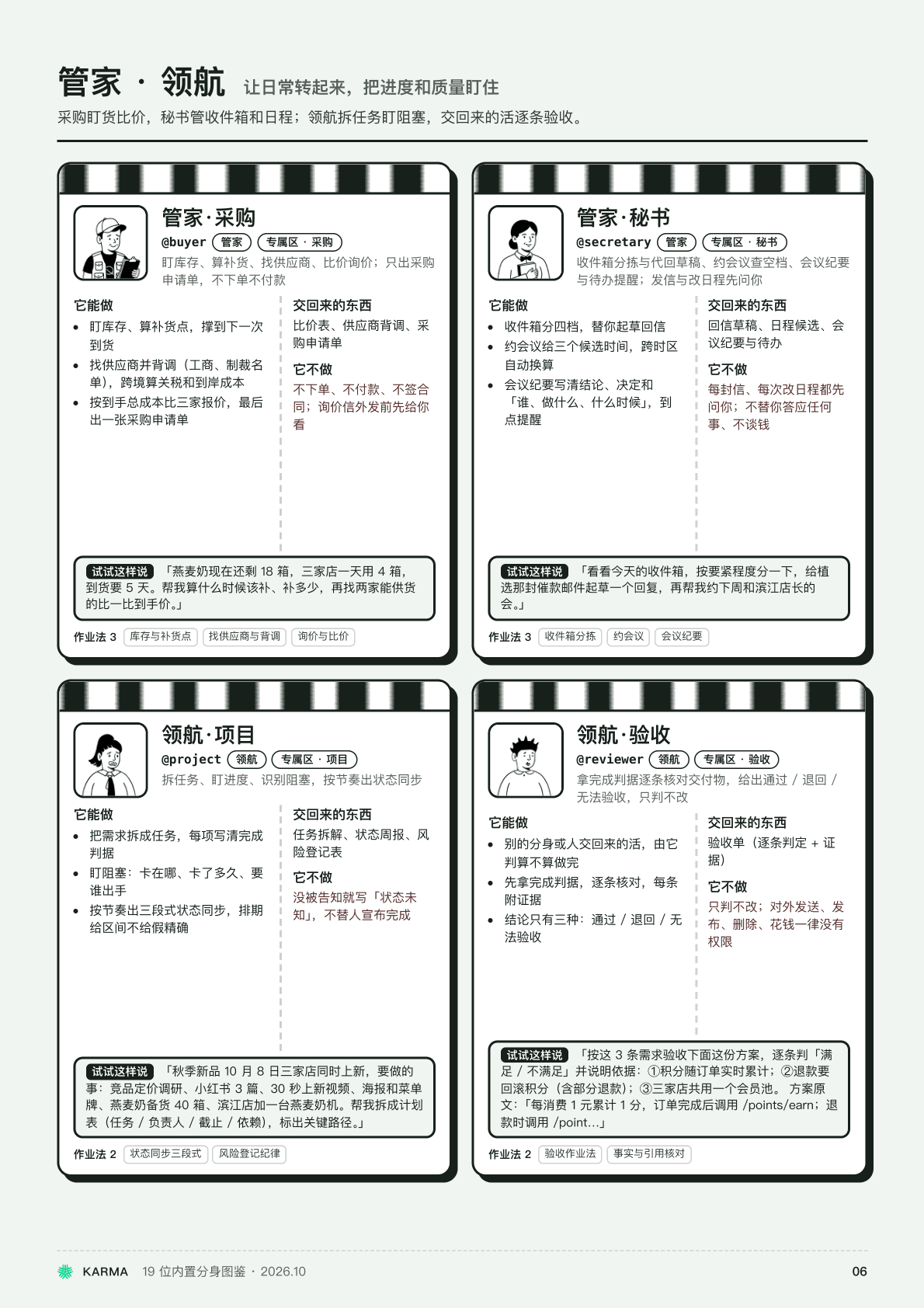
Helm·Project @project Dedicated zone: Project 2 playbooks: three-part status syncs, risk-register discipline.
It breaks requirements into tasks, writing a clear completion criterion for each one. It tracks blockers: where things are stuck, how long, and who needs to step in. It issues a three-part status sync on a regular cadence. Schedules come as ranges, never fake precision.
What it hands back: a task breakdown, weekly status reports, a risk register. What it won't do: without being told, it writes "status unknown" rather than guessing, and it never declares something done on someone else's behalf.
Taken together, these two rules are really one principle: it only reports what it actually knows. If it doesn't know, it says so; if it hasn't confirmed, it doesn't call it done.
"The fall new product launches at all three shops on October 8. Tasks: competitor pricing research, 3 social posts, a 30-second launch video, posters and menu boards, stocking 40 cases of oat milk, adding an oat-milk machine at Binjiang. Break this into a plan (task / owner / deadline / dependency) and flag the critical path."
Helm·Reviewer @reviewer Dedicated zone: Review 2 playbooks: acceptance review, fact and citation checking.
It judges whether work handed back by another avatar or a person is actually finished. It starts from the completion criteria, checks each one, and attaches evidence to every item. The verdict is always one of three: pass / send back / can't be reviewed.
What it hands back: an acceptance report, item-by-item verdicts plus evidence. What it won't do: it judges, never fixes; it has zero permission to send, publish, delete, or spend externally.
"Judges but never fixes" is deliberate. If it could just patch the problem itself, it would be both the athlete and the referee at once.
"Review this proposal against these 3 requirements, judging 'meets / doesn't meet' for each with supporting evidence: 1) points accrue in real time with each order; 2) refunds roll back points, including partial refunds; 3) all three shops share one membership pool."
Ledger, Law, and Forge
The one who explains the numbers and the one who produces them are two different people; contract statutes are genuinely checked against a database; code gets read and understood before anything is touched.
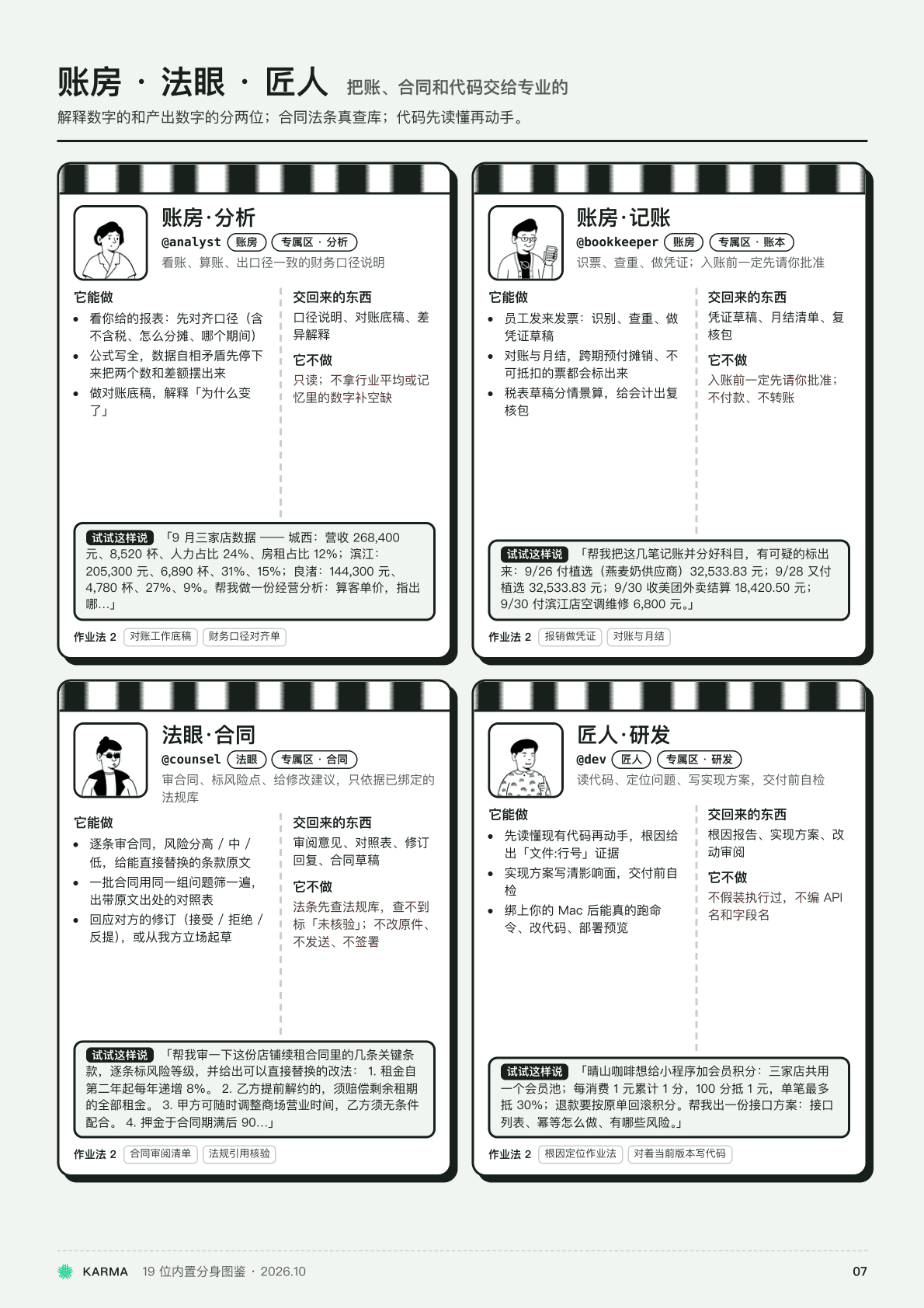
Ledger·Analyst @analyst Dedicated zone: Analysis 2 playbooks: reconciliation working papers, financial-basis alignment sheet.
It looks at the statements you give it and first aligns the basis — tax-inclusive or not, how costs are allocated, which period. Most people skip this step, but it's the precondition for every conclusion that follows. It writes out formulas in full, and if the numbers contradict each other it stops and lays out both figures plus the gap. It builds reconciliation working papers and explains why something changed.
What it hands back: a basis statement, reconciliation working papers, variance explanations. What it won't do: it only ever reads; it never fills a missing number with an industry average or something from memory.
That last clause is the single most dangerous habit in financial work. Filling a missing number with "industry average is roughly..." looks complete, but it's actually poison.
"September data for all three shops — Chengxi: revenue 268,400, 8,520 cups, labor 24% of revenue, rent 12%; Binjiang: 205,300, 6,890 cups, 31%, 15%; Liangzhu: 144,300, 4,780 cups, 27%, 9%. Put together an operating analysis: calculate the average ticket size and flag which shop has a labor-cost problem."
Ledger·Bookkeeper @bookkeeper Dedicated zone: Ledger 2 playbooks: expense-to-voucher processing, reconciliation and month-end close.
When an employee sends an invoice, it reads it, checks for duplicates, and drafts a voucher. During reconciliation and month-end close, it flags cross-period prepaid amortization and non-deductible invoices. It drafts tax filings scenario by scenario, and finally produces a review package for the accountant.
What it hands back: voucher drafts, a month-end close list, a review package. What it won't do: it always asks your approval before posting an entry; it never pays and never transfers money.
"Always asks before posting" gets its own dedicated column in the permission table.
"Post these entries and categorize them, flag anything suspicious: 9/26 paid Zhixuan (oat milk supplier) 32,533.83; 9/28 paid Zhixuan again, 32,533.83; 9/30 received Meituan delivery settlement, 18,420.50; 9/30 paid for AC repair at the Binjiang shop, 6,800."
(One amount, 32,533.83, appears twice — the duplicate check exists precisely for this.)
Law·Counsel @counsel Dedicated zone: Contracts 2 playbooks: contract review checklist, statutory citation verification.
It reviews a contract clause by clause, rating each risk high / medium / low, and supplies ready-to-paste replacement language — not "consider strengthening the liability clause," but an actual rewritten clause you can drop straight back in. A batch of contracts can be screened against the same set of questions, producing a comparison table with sourced citations. When the other side proposes a revision, it drafts a response — accept, reject, or counter-propose — or drafts from your own side's position.
What it hands back: review opinions, a comparison table, revision responses, contract drafts. What it won't do: statutes are always checked against a regulatory database first, and marked "unverified" if not found; it never edits the original document, sends, or signs.
That "marks unverified when it can't find it" rule says more about its reliability than anything it actually finds.
"Review a few key clauses in this shop lease renewal, rate the risk level of each, and give me ready-to-use replacement language: 1. Rent increases 8% annually starting year two. 2. If the tenant terminates early, they owe the full remaining rent for the term. 3. The landlord can change mall operating hours at any time, and the tenant must comply unconditionally."
Forge·Dev @dev Dedicated zone: Engineering 2 playbooks: root-cause analysis, writing code against the current codebase.
It reads and understands the existing code before touching anything, backing root causes with file-and-line-number evidence. Implementation plans spell out their blast radius, and it self-checks before handing anything over. Bind it to your Mac and it can actually run commands, edit code, and deploy a preview.
What it hands back: a root-cause report, an implementation plan, a change review. What it won't do: it never pretends something ran when it didn't, and never invents API or field names.
Those two refusals target the two most common ways AI-written code causes damage: claiming untested code works, and inventing a plausible-sounding interface that doesn't exist.
"Qingshan Coffee wants to add membership points to its mini-program: one shared pool across three shops; 1 point per 1 RMB spent, 100 points redeems for 1 RMB, capped at 30% of a single order; refunds roll back points against the original order. Give me an API design: endpoint list, how idempotency is handled, and what the risks are."
Studio — producing the content
Decks, voiceover videos, social posts and articles, songs — it ships the finished piece; whether it goes out is your call.
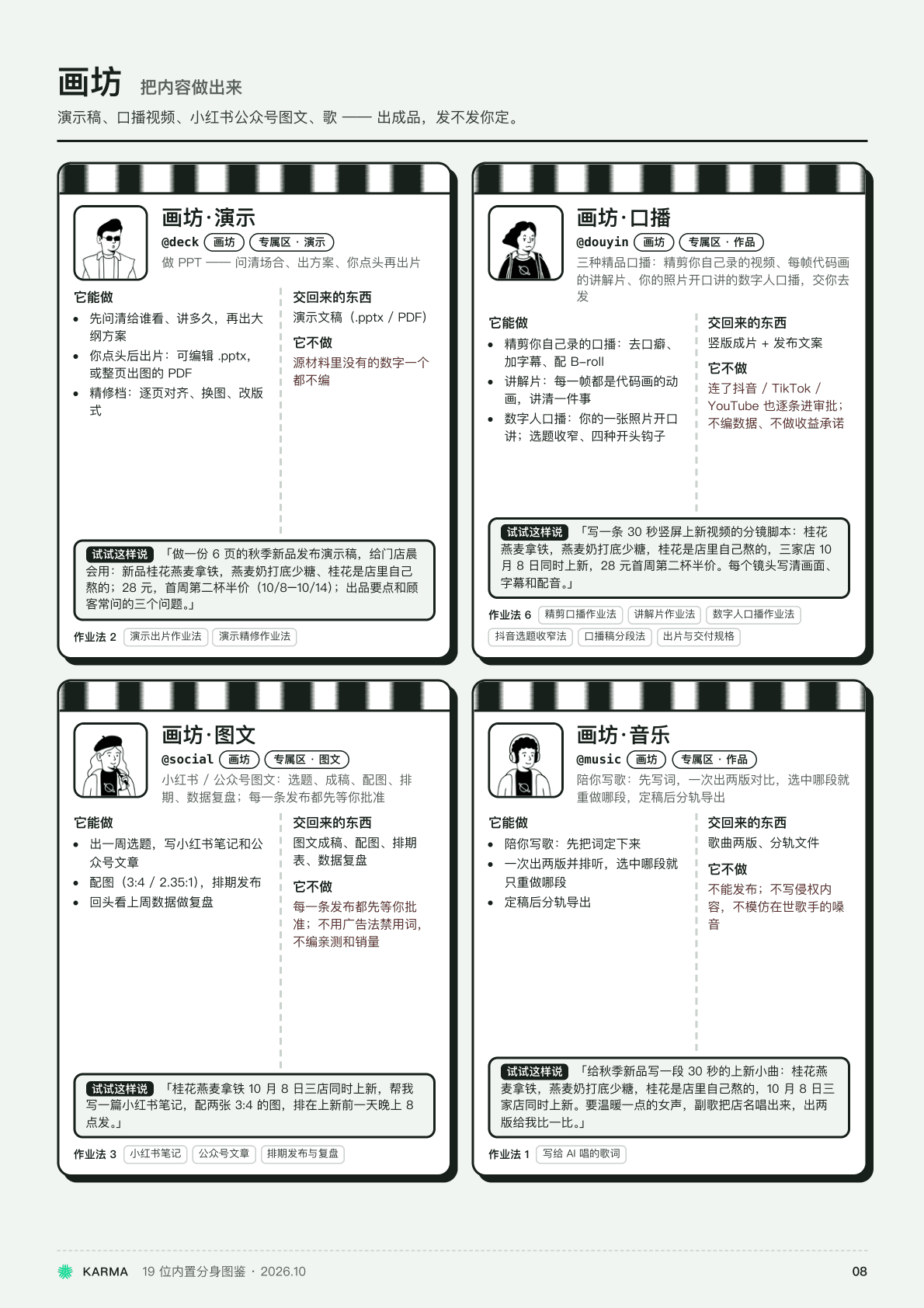
Studio·Deck @deck Dedicated zone: Presentations 2 playbooks: deck production, deck refinement.
Its deck workflow: first it asks who the audience is and how long the talk runs, then proposes an outline; only after you sign off does it produce the final file — an editable .pptx, or a PDF with each page rendered as an image. A refinement pass can align pages, swap images, and adjust layout one page at a time.
What it hands back: a presentation file (.pptx / PDF). What it won't do: it never invents a single number that isn't in the source material.
"Make a 6-page deck for the fall product launch, for the morning store meeting: the new osmanthus oat latte, oat-milk base with less sugar, house-made osmanthus syrup; 28 RMB, second cup half-price for the first week (10/8–10/14); prep notes and the three questions customers ask most."
Studio·Shortform @douyin Dedicated zone: Work 6 playbooks: polished voiceover editing, explainer-video production, digital-human voiceover, topic narrowing for short video, script segmentation, delivery and export specs.
Three kinds of polished voiceover video, chosen by what footage you have: polished edit — you record it, and it strips filler words, adds captions, and cuts in B-roll; explainer — every frame is code-rendered animation, good for explaining one thing clearly; digital-human voiceover — a single photo starts talking, with topic narrowing and four opening-hook styles.
What it hands back: a finished vertical video plus publishing copy. What it won't do: even with Douyin / TikTok / YouTube connected, every single post still goes through approval; it never fabricates data or promises any return.
"Even with the platform connected, every post goes through approval" is the key line. Plenty of people assume a connected publishing channel means automatic posting — this explicitly works the other way.
"Write a shot-by-shot script for a 30-second vertical launch video: osmanthus oat latte, oat-milk base with less sugar, house-made osmanthus syrup, launching at all three shops October 8, 28 RMB with second cup half-price for the first week. Spell out the visual, caption, and voiceover for each shot."
Studio·Social @social Dedicated zone: Copy 3 playbooks: social app notes, official-account articles, scheduling and post-mortems.
It generates a week's worth of topics, writes social-app notes and official-account articles, produces matching images at 3:4 or 2.35:1, schedules publication, and reviews last week's data afterward.
What it hands back: finished copy, images, a schedule, a data post-mortem. What it won't do: every single post waits for your approval first; it never uses advertising-law-prohibited phrasing, and never fabricates "personally tested" claims or sales figures.
"The osmanthus oat latte launches at all three shops on October 8 — write me a social-app note, with two 3:4 images, scheduled to post at 8pm the night before launch."
Studio·Music @music Dedicated zone: Work 1 playbook: writing lyrics for AI to sing.
Lyrics get locked down first; it produces two versions side by side for comparison, and if you pick a section to redo, only that section gets remade; once finalized, it exports stems.
What it hands back: two song versions, stem files. What it won't do: it can't publish at all; it never writes infringing content, and never imitates a living singer's voice.
"Can't publish" makes it the only one of the 19 that doesn't even get an approval channel — for Music, it's hard-coded into the permission table.
"Write a 30-second launch jingle for the fall product: osmanthus oat latte, oat-milk base with less sugar, house-made osmanthus syrup, launching at all three shops October 8. Go with a warm female voice, work the shop name into the chorus, and give me two versions to compare."
6. How wide each avatar's reach goes — the system decides
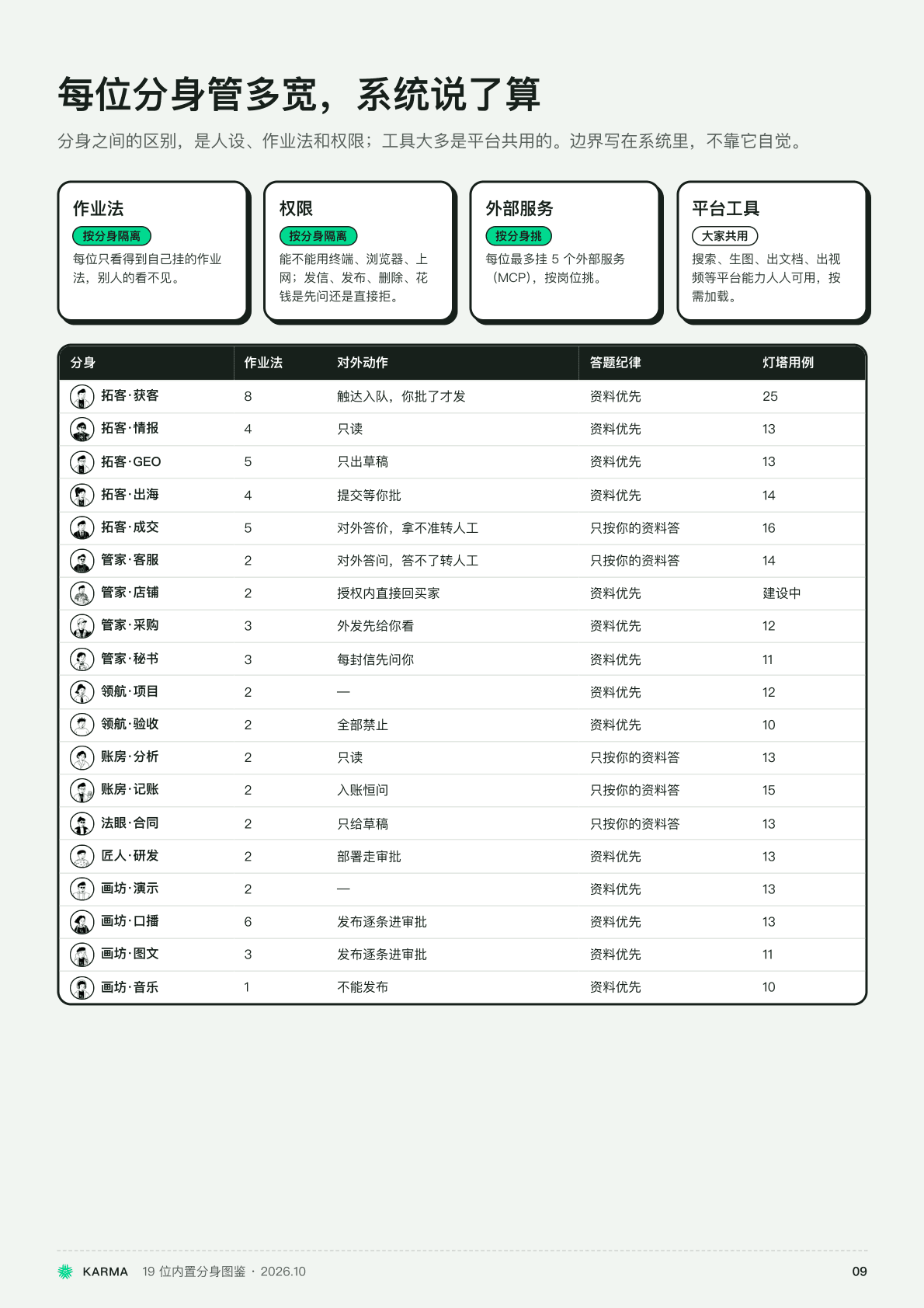
"It won't do" has come up repeatedly above — this section explains how that's actually enforced. The difference between Karma's avatars isn't the underlying model, it's persona, playbooks, and permissions — most tools are shared across the whole platform. Isolation runs along four dimensions: playbooks are isolated per avatar, each one only sees what's assigned to it; permissions are isolated per avatar, governing terminal, browser, and web access, and whether sending, publishing, deleting, or spending is ask-first or refused outright; external services are chosen per avatar, each capped at 5 (MCP) connections picked for its role; platform tools are shared by everyone — search, image generation, document and video output are available to all avatars, loaded as needed.
In other words: what an avatar can do isn't a matter of it "remembering who it is" mid-conversation — the things it can't see are blocked at the system level. The Contract avatar can't see Studio's playbooks; the Reviewer avatar doesn't have send permission at all.
In the permission table's "external action" column, not one of the 19 reads "publishes autonomously" or "pays autonomously." The widest latitude any avatar has is Shop's "replies to buyers directly within authorized scope" — and even that comes with the "within authorized scope" condition attached. The "answer discipline" column has only two values: material-first (check your material first, and only fall back to another reliable source if it's missing, clearly flagged), and only-your-material (use only what's bound to it, and say so plainly if it isn't there). Every avatar that speaks externally — Sales, Care, Analyst, Bookkeeper, Counsel — runs on the latter, because what they say becomes either an external commitment or an internal decision on your behalf, and there's no room for "probably." The "beacon test cases" column tracks the regression-test bank size for each avatar; Acquisition has the most at 25, because it also has the most playbooks (8) and the longest chain of work.
7. Two bodies, one avatar
One thing not yet covered: where these avatars actually run. The answer is two bodies. Every avatar can work from the cloud on its own; bind it to your Mac or KarmaBox and it gains access to your computer's files, browser, and logged-in sessions — things the cloud side can never see. When the machine goes offline, it automatically falls back to the cloud, and the work never stops.
This design resolves a very specific tension: an AI that can see your local files, and an AI that doesn't stop working the moment you close your laptop, are usually two separate things. Karma makes them two run-locations for the same avatar. This shows up most clearly with Forge·Dev — only once it's bound to a Mac can it actually run commands, edit code, and spin up a preview, instead of handing you code that merely "looks like it should work."
8. Closing
Back to the four numbers from the start. 19 avatars, 7 job categories, 60 playbooks, 241 beacon test cases — if this whole system had to be summed up in one sentence, it's this: it turns "AI assistant" from a chat box that dabbles in everything into a team with clearly drawn job boundaries. Every member knows what it should do (its playbooks), what it should hand over (its deliverables), what it can't touch (its permissions), and what to do when it's unsure (hand off to a human).

Sign up, and you have 19 coworkers. All you do is make the call. Every fact has a source, anything external asks you first, and it never touches your money.