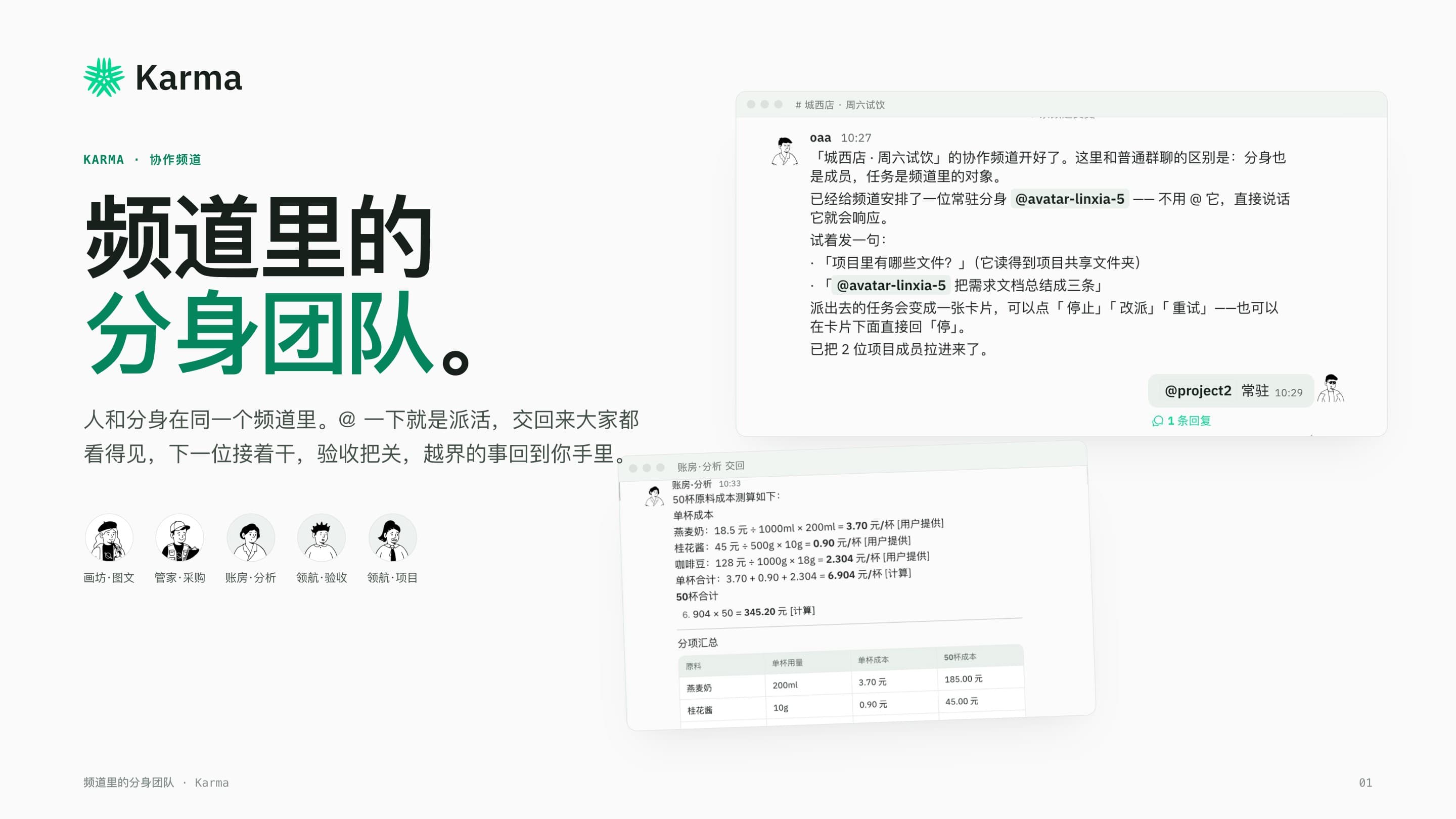
We don't just have one avatar at the store. Copywriting has its own (the copy avatar), procurement has its own (the purchasing avatar), accounting has its own (the finance avatar), and that's fine on its own. The trouble starts the moment a single job needs three or four avatars working in sequence. The copy sits in one conversation, the supply list in another, the cost breakdown in a third, and the only place that knows who's done what and who's next is my own head. Once there's enough going on, I just can't keep track, and the handoff ends up being me copying and pasting between windows.
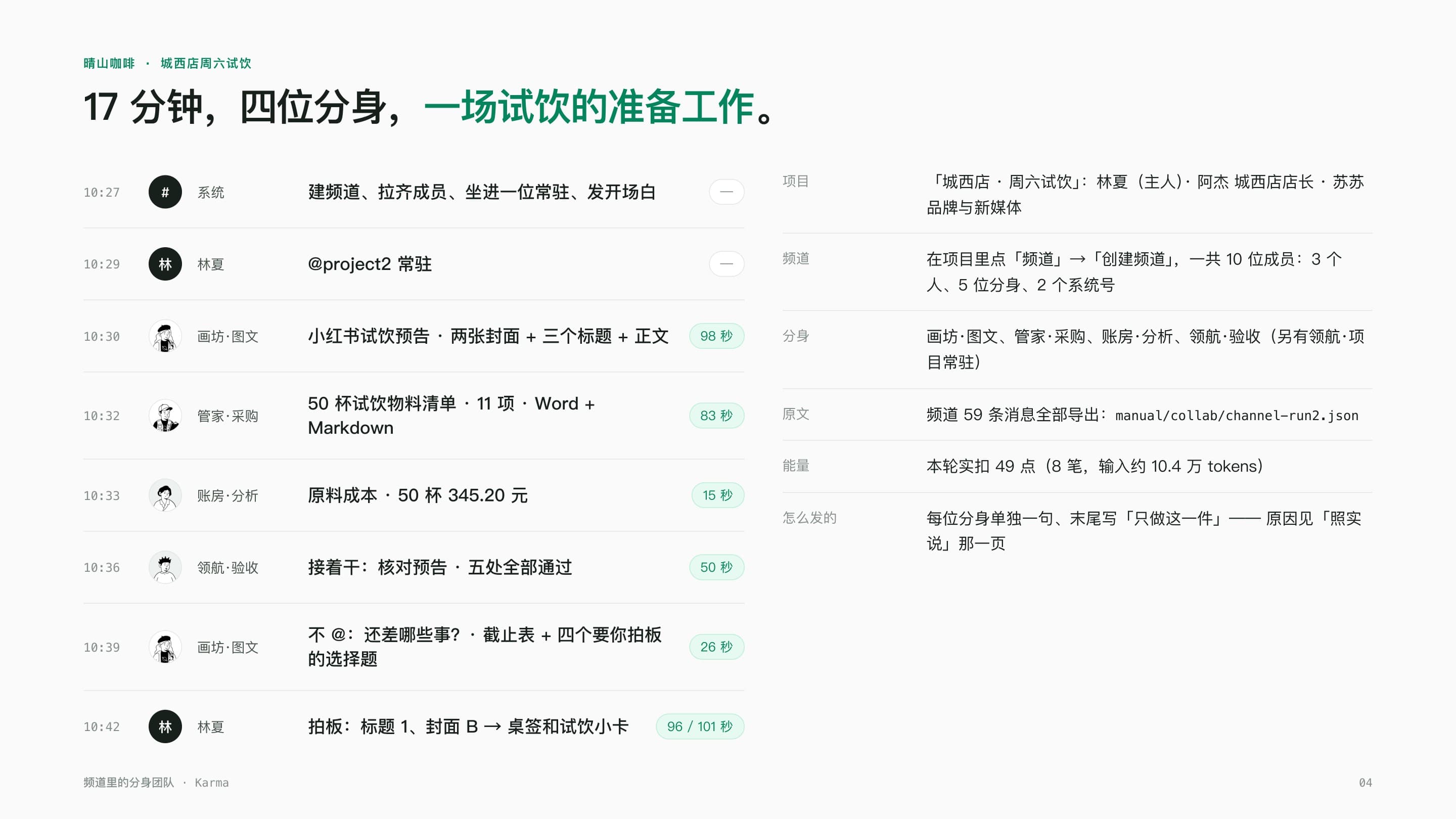
This time, with a Saturday osmanthus oat-milk latte tasting at the Qingshan Coffee west-side store, I tried something different. I set up a collaboration channel called West-Side Store · Saturday Tasting and put both people and avatars into the same place. The project had 10 members in total: 3 real people, 5 avatars, 2 system accounts, the copy avatar, the purchasing avatar, the finance avatar, the review avatar, plus a project avatar sitting resident in the channel. The difference from an ordinary group chat is that avatars are full members here too, the task belongs to the whole channel, not a private thread between me and one avatar.
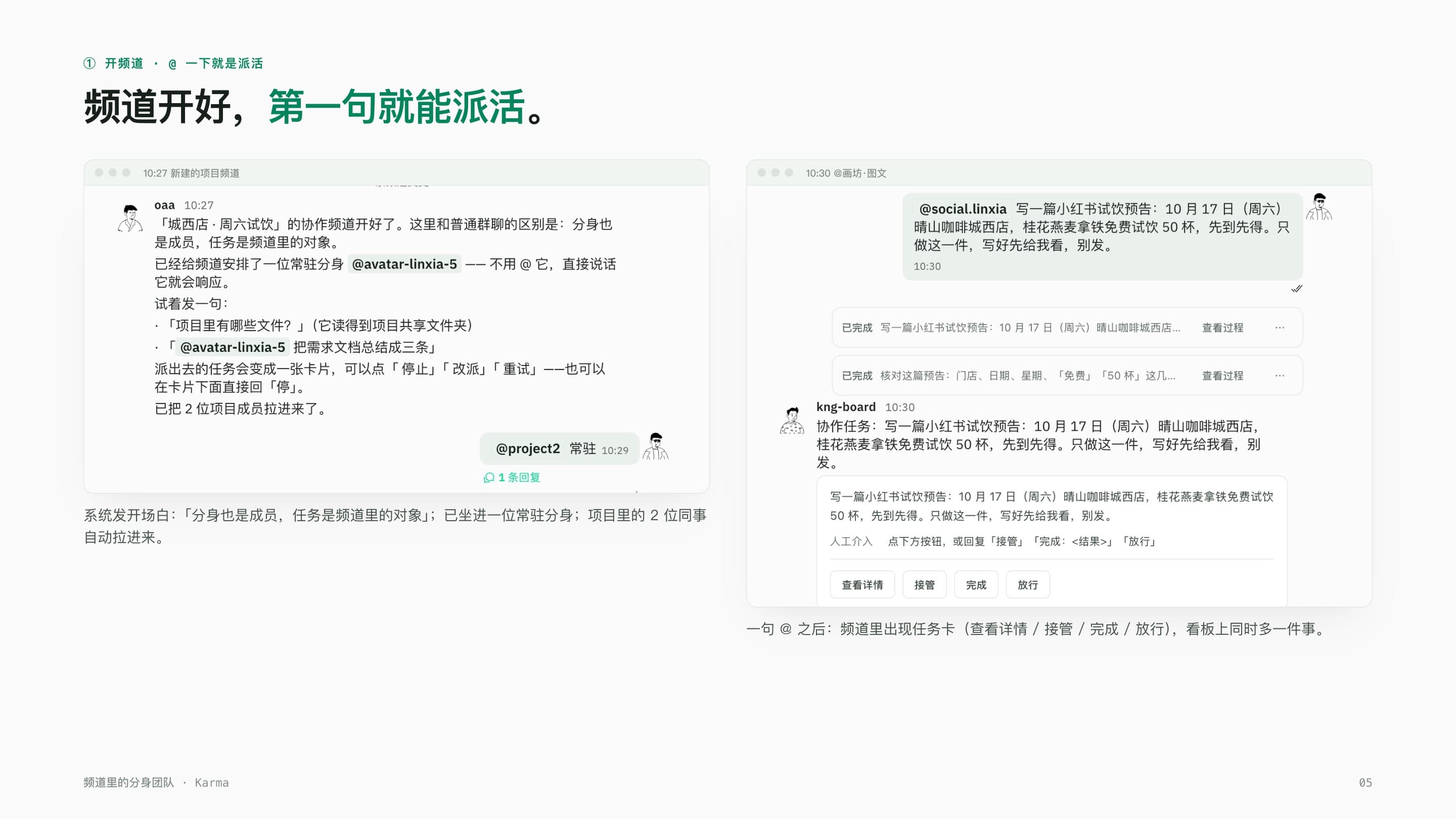
The channel opens, and the first message already dispatches work
After the channel was created, the system posted an opener: avatars are members too, tasks belong to the channel; a resident avatar was already seated in, you don't even need to @ it, it responds when spoken to directly. I pulled in 2 teammates, then said to the copy avatar: write a Xiaohongshu tasting announcement, October 17th Saturday, Qingshan Coffee west-side store, free osmanthus oat-milk latte tasting, 50 cups, first come first served. Just this one thing, show it to me before you post it. One @ later, a task card appeared in the channel (view details / take over / complete / release), and the kanban picked up one more item at the same time.
98 seconds later, the copy avatar delivered two cover images, three headline options, and a full draft, ending with written and waiting for you to see, not posted. It didn't post anything on its own, and it didn't fabricate a line about personally trying the drink, the callout at the end of the draft was direct about it, no real tasting material was provided, it wouldn't make one up or post on its own, awaiting your confirmation.
The list comes back as a file, cost down to the decimal, every number sourced
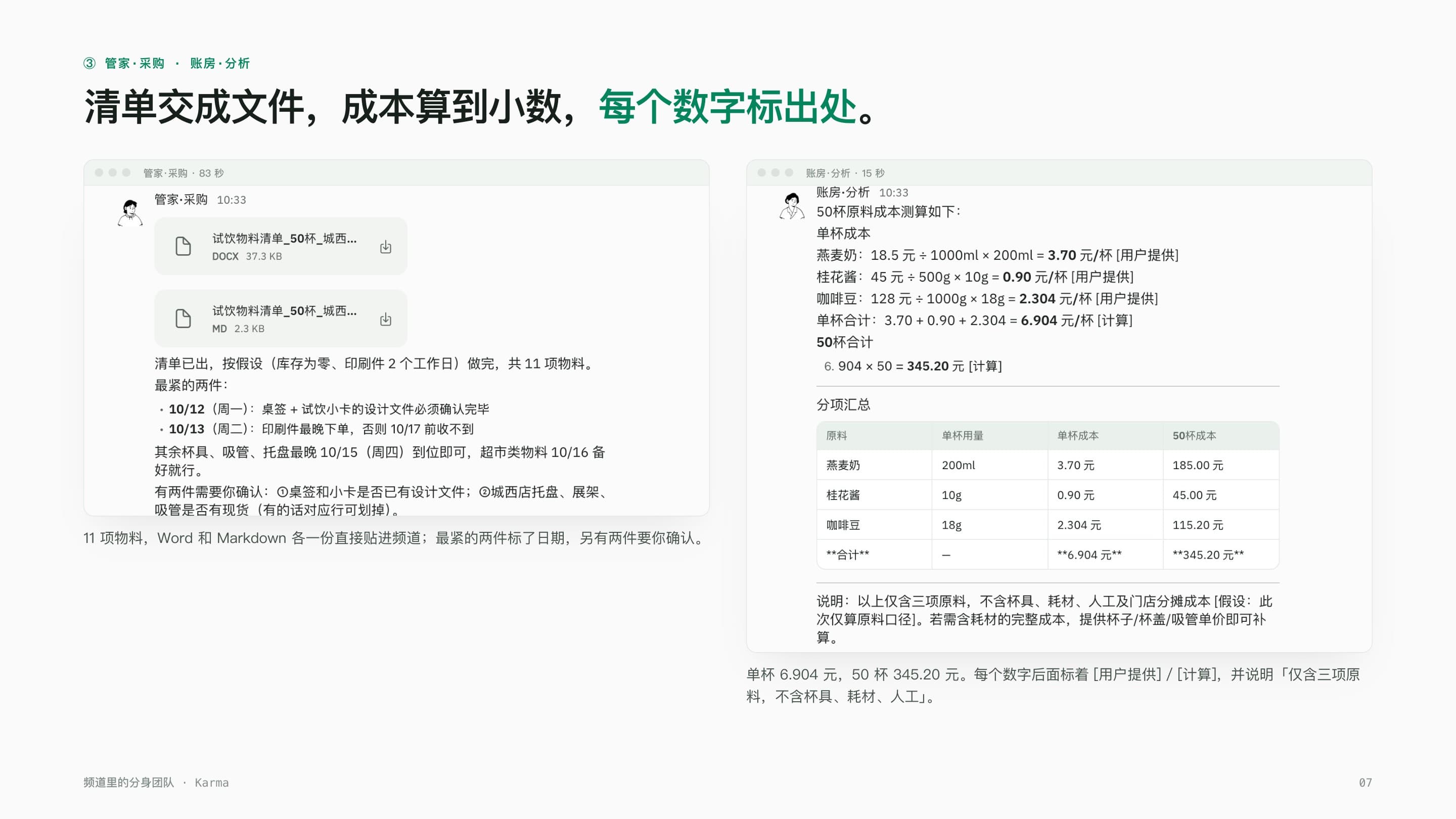
While the copy track was running, two other avatars were working in parallel on separate things. The purchasing avatar took 83 seconds to deliver an 11-item supply list (one Word, one Markdown), flagging the two most urgent items with dates, table tents and tasting cards need design files confirmed by 10/12 Monday, print orders need to go in by 10/13 Tuesday or they won't make it by the 17th. The finance avatar took 15 seconds to work out the raw-material cost for 50 cups, oat milk, osmanthus syrup, and coffee beans add up to 6.904 yuan per cup, 345.20 yuan for 50 cups, every line tagged either user-provided or calculated, and it was upfront that this is only the raw-material cost, not cups, supplies, or labor.
One "keep going" hands the result, plus proof, to the next avatar
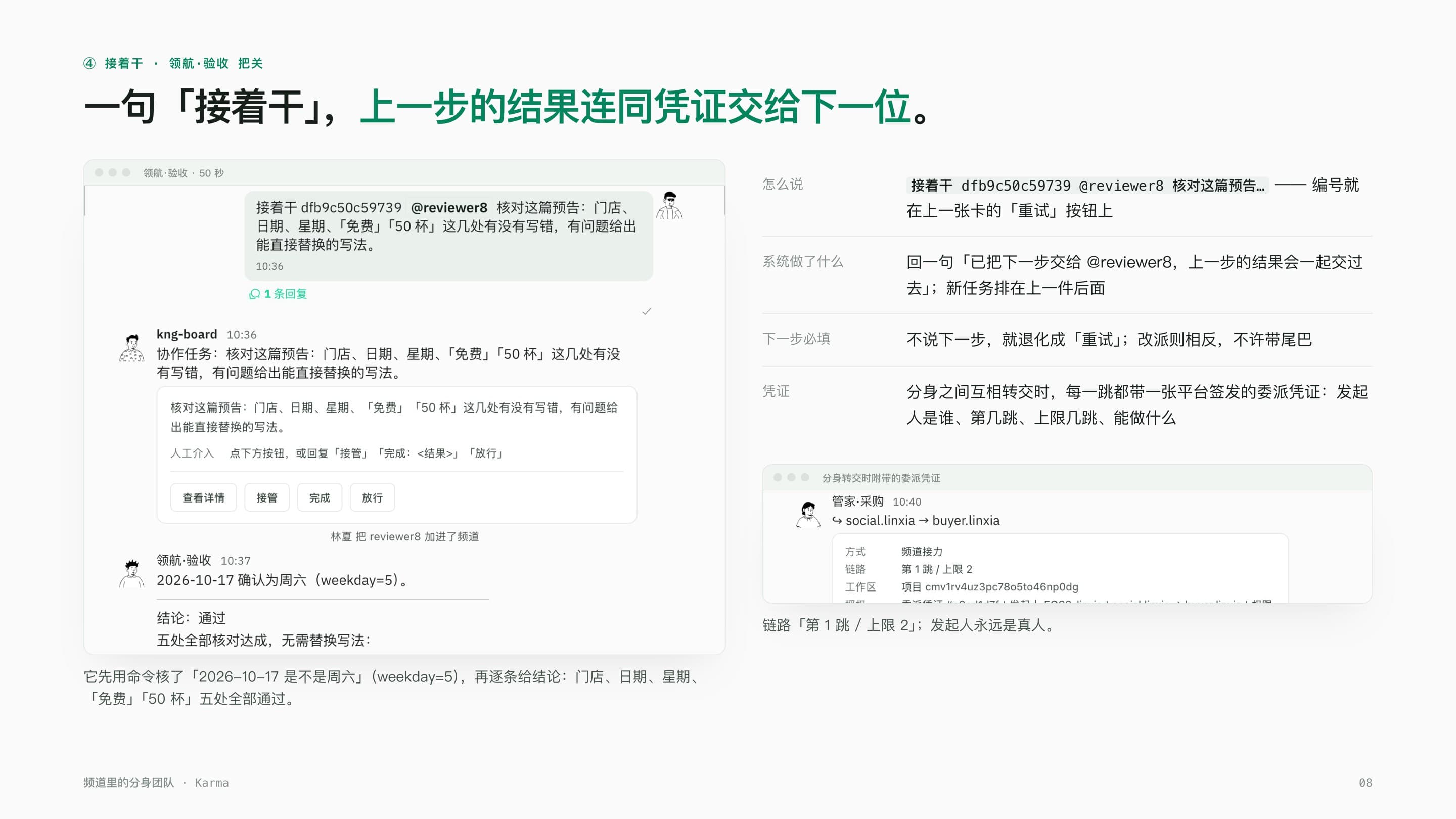
Once the draft was ready, it needed checking, and I didn't want to copy the content over myself and paste it to the review avatar. So I replied to that same card: keep going dfb9c50c59739 @reviewer8 check this draft, the store, date, day of week, free, and 50 cups need to be right, give me a direct fix for anything wrong. That number was the one sitting on the previous card's retry button. The system replied the next step has been handed to @reviewer8, along with the result from the last step, and 50 seconds later the review avatar first verified on its own whether 2026-10-17 actually falls on a Saturday, confirmed it does, then checked each item in turn, all five passed, verdict: approved.
When avatars hand work to each other, every hop carries a platform-issued delegation certificate stating who initiated it, which hop this is, the hop limit, and what it's allowed to do, capped at two hops, and the human who kicked it off is always a real person, so there's no scenario where avatars keep bouncing a task back and forth forever. This keep-going mechanism basically replaces what used to be me copying and pasting between separate conversation windows with one line and a number.
No @ needed: "what's still not locked down?"
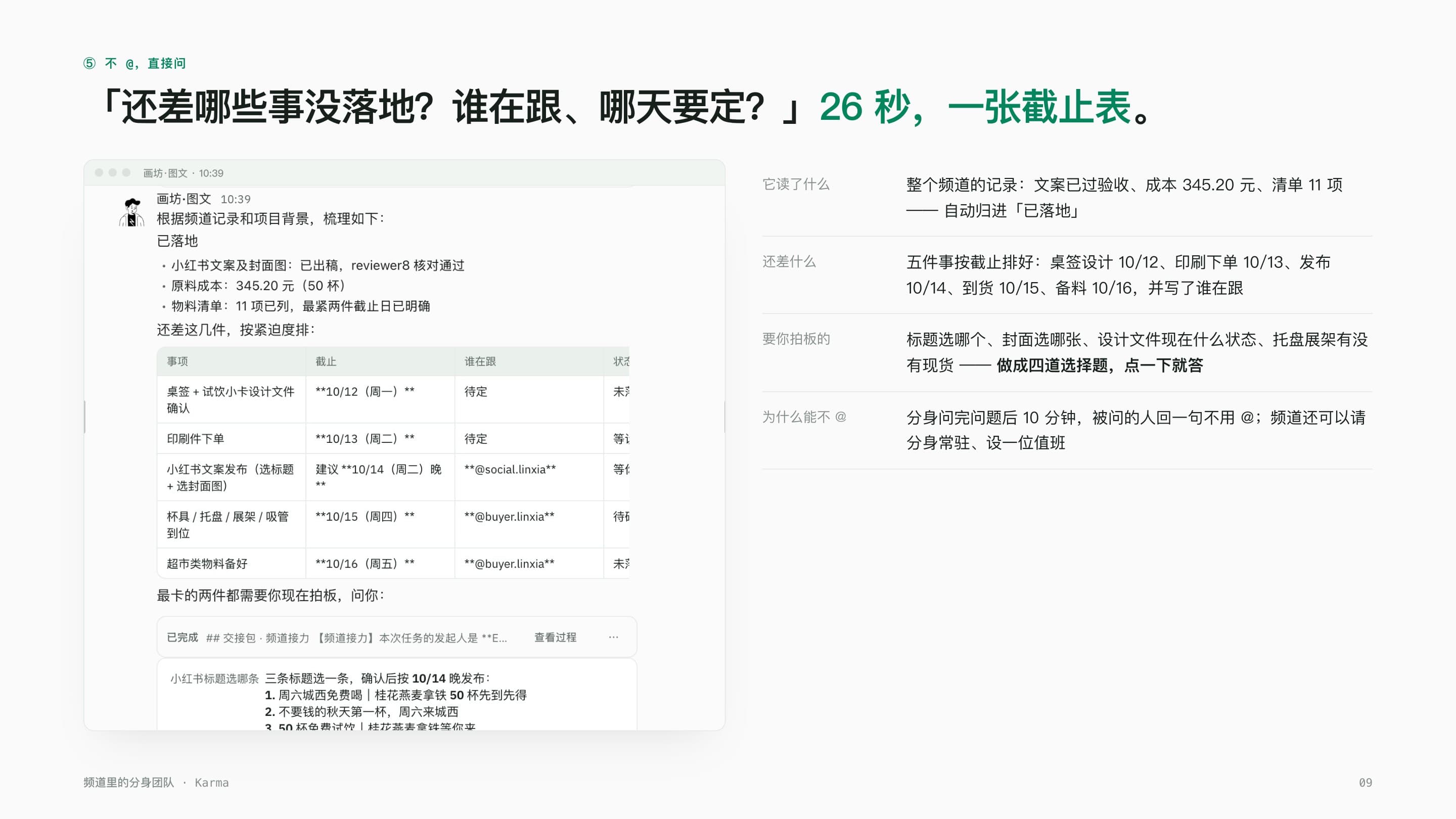
Once the copy was verified, I wasn't totally sure what was left, so I just asked the channel directly, without @-ing anyone: what's still not locked down, who's tracking it, and by when. The reply came from the copy avatar that had just been talking, not the resident project avatar, because of the channel rule that lets whoever you just asked skip the @ for 10 minutes. It read the whole channel history, the copy had passed review, the cost came to 345.20 yuan, the list had 11 items, automatically filing all of that under already done, and laid out a five-row deadline table by urgency: signage design 10/12, print order 10/13, publish 10/14, delivery 10/15, prep 10/16, each row tagged with who's on it. The two tightest items were turned straight into a four-option multiple choice. The whole thing took 26 seconds.
Headline 1, cover B — two jobs dispatched at once
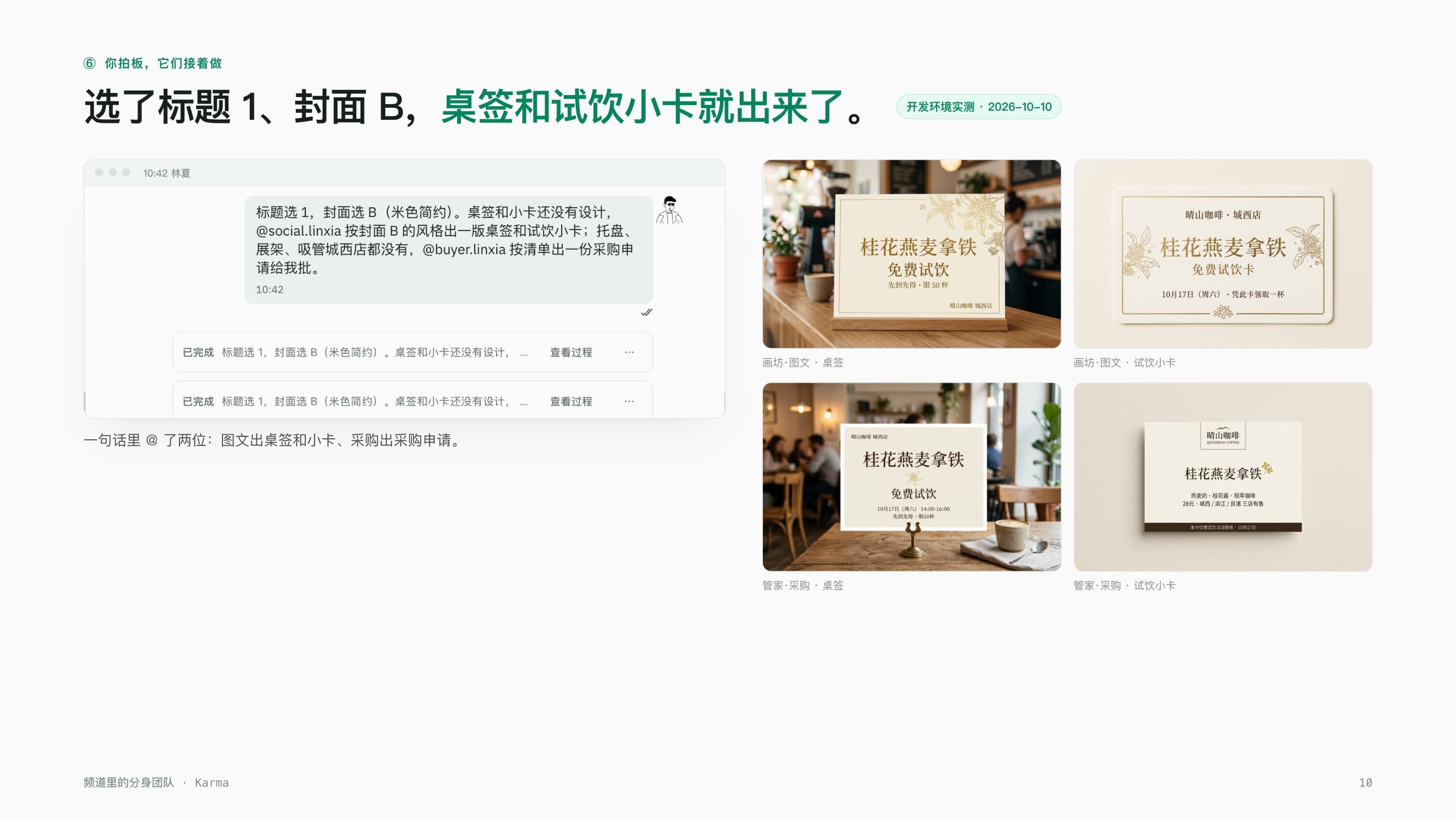
After signing off, I @-ed two avatars in one message: headline 1, cover B, beige minimal. Table tents and cards haven't been designed yet, @social.linxia do a set in cover B's style. We're out of trays, stands, and straws at the west-side store, @buyer.linxia put together a purchase request off the list for me to approve. The table tents and tasting cards came back as four images, with both avatars producing their own version, each running its own track.
A channel isn't just another group chat, and it isn't a one-on-one AI conversation either. It's a place where people and several avatars are all present at once: an @ dispatches, keep going relays, and whatever gets stuck finds its way back to you on its own.
Everything dispatched sits on the kanban, and anything stuck finds its way back
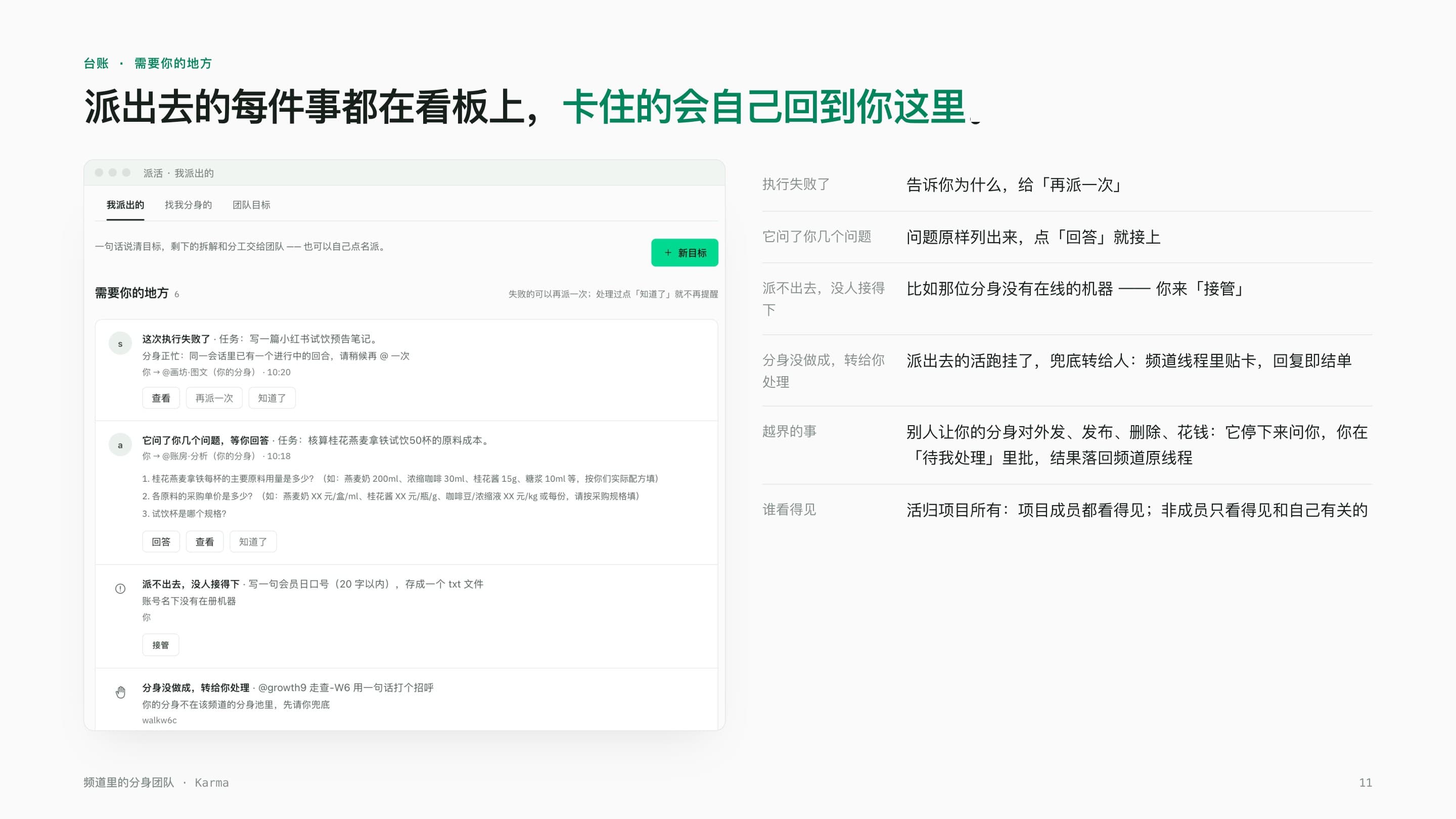
Once the channel is running, I don't really need to chase progress on each item myself, the needs you column pulls in everything that's mine to handle: if execution failed, it tells me why and offers retry; if an avatar asked a question and is waiting, it's listed as-is; if something can't be dispatched because that avatar has no machine online, it falls to me to take over; if a job crashes mid-run, it gets routed back to me as a fallback, posted as a card in the channel thread, and a reply closes it out; anything that crosses a line (posting externally, publishing, deleting, spending money) stops and asks me first, approved from the same needs you column. Work belongs to the whole project, every project member can see it, and I don't have to go around asking each avatar how far along they are.
Scale it up to a whole store, and it's still the same rules
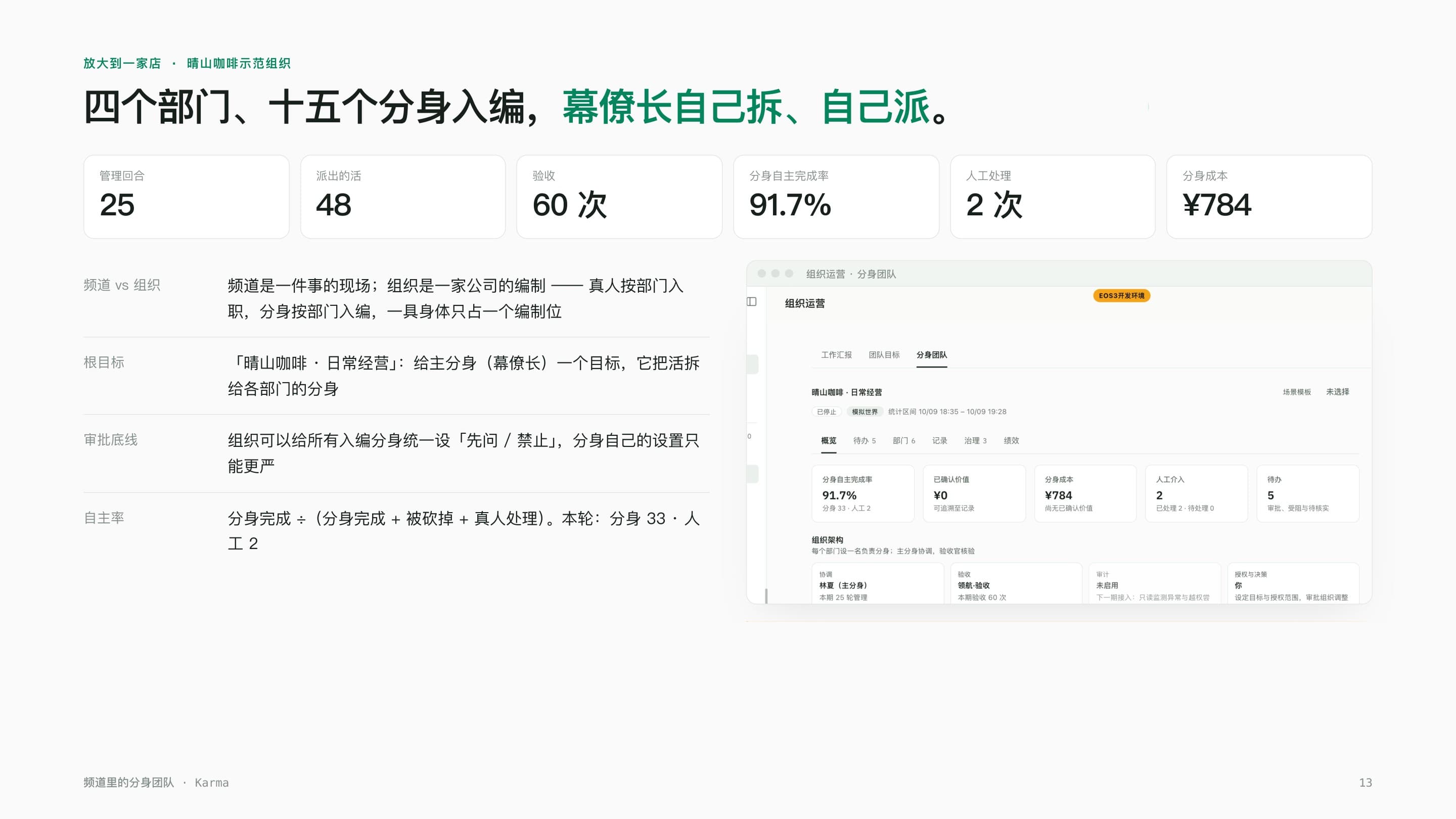
We later tried scaling the same logic up to a four-department, fifteen-avatar setup, giving the lead avatar (chief of staff, Lin Xia) a single goal, Qingshan Coffee · daily operations, and letting it break the work down across each department's avatars on its own. Over a two-day simulated cycle it managed 25 rounds, dispatched 48 items, ran 60 reviews, hit a 91.7% avatar self-completion rate, needed human intervention only twice, and avatar-side cost came to about 784 yuan. A channel is the scene of one job, an organization is a store's full roster: people join by department, avatars get one seat per department too, one body fills exactly one seat. The organization can set a uniform ask-first or forbidden approval baseline across every seated avatar, and an avatar's own settings can only be stricter than that, never looser.